

Care Disclaimer: Plant care recommendations are general guidelines based on common growing conditions. Individual results may vary based on your local environment, climate, and care routine. If your plant is toxic, keep it away from children and pets, and consult a veterinarian if accidental ingestion occurs.
1.Echeveria Topsy Turvy — Overview
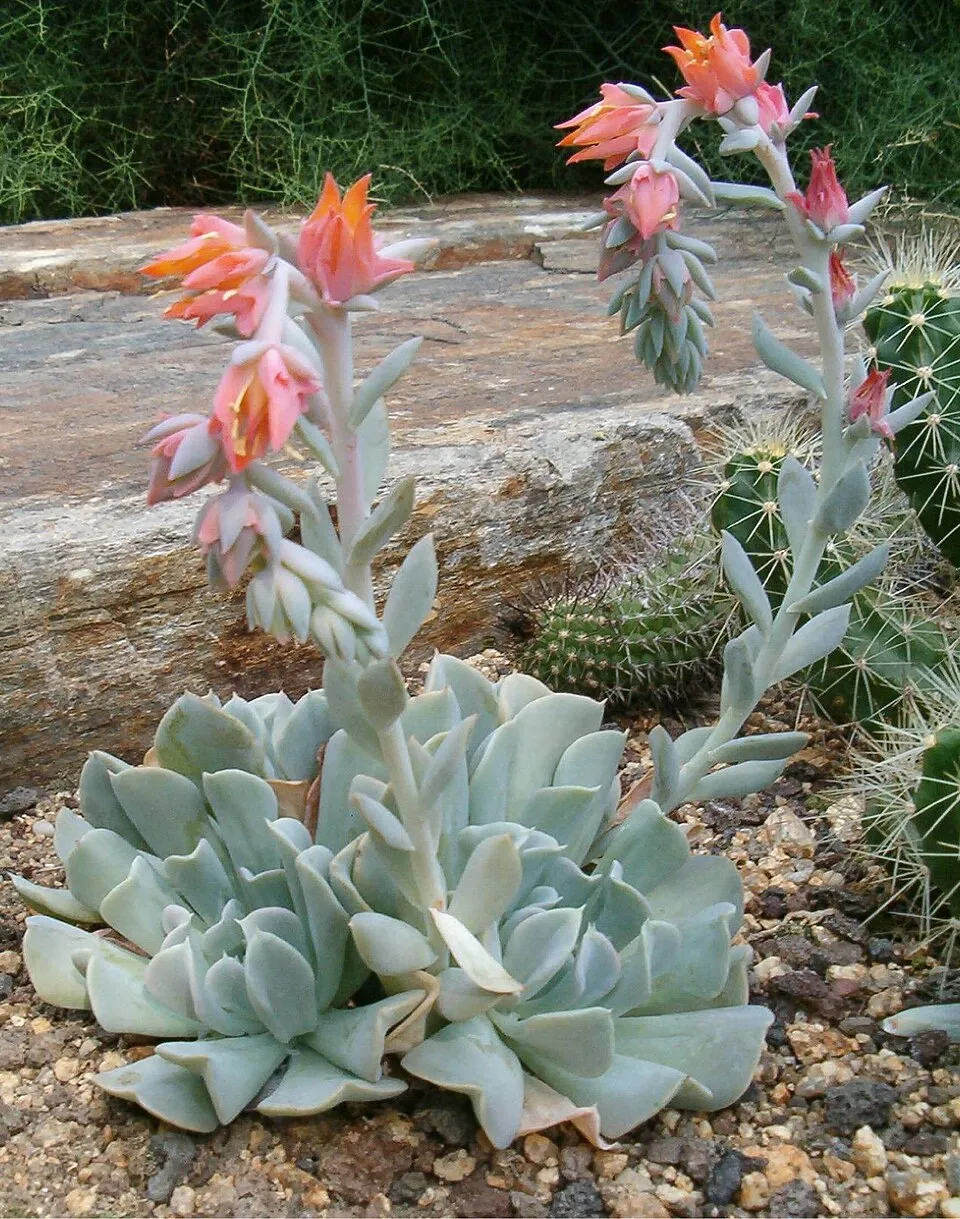
Echeveria Topsy Turvy, a captivating cultivar of Echeveria runyonii, is an iconic succulent belonging to the Crassulaceae family, renowned for its distinctive morphology. This perennial plant forms a compact, rounded rosette of uniquely shaped leaves, typically reaching up to 25 cm (10 inches) in diameter and the overall plant height often ranges from 15-30 cm (6-12 inches). Its foliage is characterized by a powdery, glaucous blue-green hue, often developing delicate pink or reddish tints when exposed to ample bright light.
The most striking feature of Echeveria Topsy Turvy is its leaves, which are obovate and have a remarkable upward-curving tip, giving them an 'inside-out' or 'topsy-turvy' appearance. This adaptation, along with a slightly waxy and smooth texture, aids significantly in moisture retention, crucial for survival in its native arid and semi-arid regions of Mexico. In optimal conditions, the plant produces vibrant, bell-shaped flowers in shades of red-orange or yellow, borne on slender, arching stalks that can extend up to 20 cm above the rosette.
Echeveria Topsy Turvy thrives in well-drained, gritty soils and prefers environments with low humidity, making it an exceptionally popular and adaptable choice for container planting in homes and offices, contributing sculptural elegance and ease of care to any indoor setting. It is also known by common names such as 'Silver Spoons Echeveria' and 'Mexican Hens and Chicks'.
Trusted Scientific References
1. Authoritative external sources for Echeveria runyonii
1.1 Wikipedia — Echeveria runyonii
1.2 Kew POWO (Plants of the World Online)
1.3 PubMed — peer-reviewed research
1.4 NCBI Taxonomy Browser
1.5 GBIF — Global Biodiversity
1.6Echeveria Topsy Turvy should be interpreted through verified botanical identity, practical care, and responsible safety language. This recovery note adds the missing context needed for a complete profile: match light to the plant's habit, use well-drained soil, water according to season, and avoid unsupported medicinal or edible claims. For publishing, the plant can be presented as a source-backed indoor plant with clear care guidance, common problem diagnosis, and conservative safety wording.
1.1.Echeveria Topsy Turvy — Key Features
- ✓ <strong>Striking Rosette Form</strong> — Features a dense, sculptural rosette of leaves, making it a focal point in any collection.
- ✓ <strong>Unique Inverted Foliage</strong> — Leaves are distinctively curved upwards at the tips, giving it its 'topsy turvy' name.
- ✓ <strong>Powdery Blue</strong> — Green Hue — Exhibits a beautiful glaucous, blue-green coloration, often with pink tints in strong light.
- ✓ <strong>Drought Tolerant</strong> — Highly adapted to arid conditions, requiring infrequent watering.
- ✓ <strong>Low Maintenance</strong> — An ideal plant for beginners and those seeking easy-care greenery.
- ✓ <strong>Indoor Plant Suitability</strong> — Thrives in controlled indoor environments, making it a popular houseplant.
- ✓ <strong>Ornamental Flowers</strong> — Produces attractive red-orange or yellow flowers on tall stalks, enhancing its decorative value.
- ✓ <strong>Air Purifying Qualities (Minor)</strong> — Contributes subtly to indoor air quality by exchanging gases.
- ✓ <strong>Adaptable to Containers</strong> — Excellent for pot culture, succulent arrangements, and rock gardens.
- ✓ <strong>Non</strong> — Toxic Nature — Considered safe for households with children and pets, reducing safety concerns.
1.2.Echeveria Topsy Turvy — Quick Summary
- ✓ Echeveria 'Topsy Turvy' is a distinct ornamental succulent known for its unique inverted blue-green leaves.
- ✓ It is a low-maintenance indoor plant, thriving in bright, indirect light and well-draining soil.
- ✓ Primarily valued for its aesthetic appeal, it contributes positively to indoor environments and mental well-being.
- ✓ Generally considered non-toxic to humans and common household pets.
- ✓ Requires minimal watering and is highly drought tolerant, making it ideal for beginner plant enthusiasts.
2.Echeveria Topsy Turvy — Scientific Identity
3.Echeveria Topsy Turvy — Quick Facts
4.Echeveria Topsy Turvy — Appearance & Identification
5.Echeveria Topsy Turvy — Native Habitat
6.Echeveria Topsy Turvy — Water Requirements
- ✓ Light Preference — Provide bright, indirect light; direct afternoon sun can cause scorching, but adequate light is essential for vibrant color.
- ✓ Watering Regime — Water sparingly; allow the soil to dry out completely between waterings to prevent root rot, especially during dormant periods.
- ✓ Soil Requirements — Use a well-draining succulent or cactus potting mix, often amended with perlite or pumice to enhance drainage.
- ✓ Temperature & Humidity — Prefers cool to moderate temperatures (18-24°C / 65-75°F) and low humidity; avoid frost.
- ✓ Fertilization — Fertilize lightly with a balanced, diluted succulent fertilizer during the growing season (spring and summer), typically once a month.
- ✓ Pest Management — Watch for common succulent pests like mealybugs and aphids; treat promptly with insecticidal soap or rubbing alcohol.
- ✓ Propagation — Easily propagated from leaf cuttings or by carefully removing and replanting offsets (pups) that form around the base of the mother plant.
- ✓ Repotting — Repot only when necessary, usually every 2-3 years, to refresh soil and accommodate growth, ensuring the new pot has drainage holes.
Reviewed by the Flora Medical Global Botanical Review Panel
Multi-disciplinary editorial group · Botany · Ethnobotany · Herbal-medicine literature
Who reviewed this: This page was checked by the Flora Medical Global Botanical Review Panel — an in-house editorial group of botany graduates, ethnobotany researchers, and horticulture practitioners who collectively maintain our 7,000+ plant encyclopedia. Meet the team.
Our 4-step verification process
1. Taxonomic verification
Scientific names and synonyms cross-checked against Kew POWO, World Flora Online, and The Plant List.
2. Phytochemical & medicinal cross-reference
Active compounds, traditional uses, and reported activities are cross-referenced with PubMed, USDA Dr. Duke's database, and peer-reviewed ethnobotanical literature.
3. Conservation & distribution check
Distribution, ecology, and conservation status confirmed against GBIF occurrence records and the IUCN Red List.
4. Editorial & safety review
Every entry passes an editorial pass for clarity, originality, and safety notices (toxicity, contraindications, dosage caveats) before publication.
Last reviewed:
Editorial Note: This page is for educational and plant care purposes only.
Written by: Flora Medical Global Editorial Team
Reviewed by: Flora Medical Global Botanical Review Panel
Last Updated: June 15, 2026







Echeveria Topsy Turvy — Comments & Community Reviews
Rate this plant