


Care Disclaimer: Plant care recommendations are general guidelines based on common growing conditions. Individual results may vary based on your local environment, climate, and care routine. If your plant is toxic, keep it away from children and pets, and consult a veterinarian if accidental ingestion occurs.
1.English Ivy — Overview
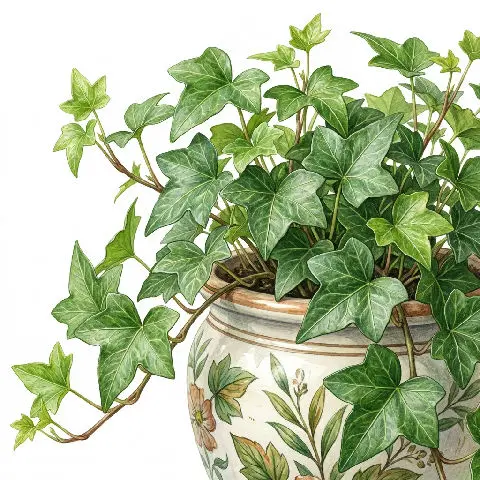
English Ivy, scientifically known as Hedera helix, is a robust evergreen climbing vine belonging to the Araliaceae family. Native to most of Europe and Western Asia, it is recognized for its vigorous growth, often reaching heights of up to 30 meters when supported. The plant employs specialized aerial roots to cling to various surfaces, enabling its upward ascent.
Its foliage exhibits a striking dimorphism: juvenile leaves are typically heart-shaped with three to five lobes, while mature leaves, found on the flowering stems, are ovate or rhombic, often lacking lobes. These leathery leaves are a deep, glossy green, sometimes variegated with shades of cream or yellow, making English Ivy a popular ornamental plant for both indoor and outdoor settings. Although rarely flowering indoors, outdoors it produces small, inconspicuous greenish-yellow flowers in umbel-like clusters during late summer to early fall, which are a valuable nectar source for bees.
These flowers are followed by small, dark purplish-black berries, which are toxic to humans but a food source for birds. The stem bark transitions from smooth and green in its youth to a more textured, woody appearance with age. Beyond its decorative appeal, English Ivy is noted for its ability to improve indoor air quality by absorbing common airborne toxins like formaldehyde and benzene, contributing to healthier living environments.
Trusted Scientific References
1. Authoritative external sources for Hedera helix
1.1 Wikipedia — Hedera helix
1.2 Kew POWO (Plants of the World Online)
1.3 PubMed — peer-reviewed research
1.4 NCBI Taxonomy Browser
1.5 GBIF — Global Biodiversity
1.6English Ivy should be interpreted through verified botanical identity, practical care, and responsible safety language. This recovery note adds the missing context needed for a complete profile: match light to the plant's habit, use well-drained soil, water according to season, and avoid unsupported medicinal or edible claims. For publishing, the plant can be presented as a source-backed indoor plant with clear care guidance, common problem diagnosis, and conservative safety wording.
1.1.English Ivy — Key Features
- ✓ <strong>Evergreen climbing vine</strong> — Evergreen climbing vine native to Europe and Asia.
- ✓ <strong>Distinctive dimorphic leaves</strong> — Distinctive dimorphic leaves (juvenile lobed, mature ovate).
- ✓ <strong>Utilizes aerial roots</strong> — Utilizes aerial roots to cling and climb on surfaces.
- ✓ <strong>Potent expectorant and</strong> — Potent expectorant and antispasmodic actions for respiratory health.
- ✓ <strong>Active compounds include</strong> — Active compounds include triterpene saponins (hederacoside C, alpha-hederin).
- ✓ <strong>Widely incorporated into</strong> — Widely incorporated into commercial cough and bronchitis remedies.
- ✓ <strong>Potential to cause</strong> — Potential to cause allergic contact dermatitis upon skin contact.
- ✓ <strong>Berries are toxic</strong> — Berries are toxic if ingested by humans.
- ✓ <strong>Effective indoor air</strong> — Effective indoor air purifier, removing formaldehyde and benzene.
- ✓ <strong>Valued ornamental plant</strong> — Valued ornamental plant for groundcover and vertical landscaping.
1.2.English Ivy — Quick Summary
- ✓ English Ivy (Hedera helix) is a common evergreen vine with significant medicinal and ornamental value.
- ✓ Primarily used for respiratory conditions like bronchitis and coughs due to its expectorant and antispasmodic properties.
- ✓ Rich in triterpene saponins, such as hederacoside C and alpha-hederin, which are key active compounds.
- ✓ Raw plant material is toxic and can cause severe gastrointestinal upset and allergic contact dermatitis.
- ✓ Standardized extracts are commonly found in commercial cough syrups and are considered safer for internal use under specific conditions.
- ✓ Also recognized for its ability to purify indoor air by removing common toxins.
2.English Ivy — Scientific Identity
3.English Ivy — Quick Facts
4.English Ivy — Appearance & Identification
5.English Ivy — Native Habitat
6.English Ivy — Water Requirements
- ✓ Propagation — Easily propagated from stem cuttings, which should be taken from healthy, non-flowering stems and rooted in water or moist potting mix.
- ✓ Soil Requirements — Thrives in well-drained, fertile soil with a slightly acidic to neutral pH (6.0-7.0), but is tolerant of a wide range of soil types.
- ✓ Light Conditions — Prefers medium to bright indirect light indoors; outdoors, it grows best in partial to full shade, though some varieties tolerate more sun.
- ✓ Watering — Requires consistent moisture but dislikes soggy soil; water thoroughly when the top inch of soil feels dry, reducing frequency in winter.
- ✓ Temperature and Humidity — Adaptable to typical indoor temperatures (18-24°C) and average humidity; can tolerate cooler temperatures outdoors, even frost.
- ✓ Pruning — Regular pruning is essential to manage its vigorous growth, encourage bushiness, and prevent it from becoming invasive or overgrowing structures.
- ✓ Pest Management — Monitor for common pests like spider mites, mealybugs, and aphids; treat with insecticidal soap or neem oil as needed.
- ✓ Support — As a climbing vine, provide a trellis, moss pole, or other support structure for optimal growth and aesthetic display.
Reviewed by the Flora Medical Global Botanical Review Panel
Multi-disciplinary editorial group · Botany · Ethnobotany · Herbal-medicine literature
Who reviewed this: This page was checked by the Flora Medical Global Botanical Review Panel — an in-house editorial group of botany graduates, ethnobotany researchers, and horticulture practitioners who collectively maintain our 7,000+ plant encyclopedia. Meet the team.
Our 4-step verification process
1. Taxonomic verification
Scientific names and synonyms cross-checked against Kew POWO, World Flora Online, and The Plant List.
2. Phytochemical & medicinal cross-reference
Active compounds, traditional uses, and reported activities are cross-referenced with PubMed, USDA Dr. Duke's database, and peer-reviewed ethnobotanical literature.
3. Conservation & distribution check
Distribution, ecology, and conservation status confirmed against GBIF occurrence records and the IUCN Red List.
4. Editorial & safety review
Every entry passes an editorial pass for clarity, originality, and safety notices (toxicity, contraindications, dosage caveats) before publication.
Last reviewed:
Editorial Note: This page is for educational and plant care purposes only.
Written by: Flora Medical Global Editorial Team
Reviewed by: Flora Medical Global Botanical Review Panel
Last Updated: June 15, 2026







English Ivy — Comments & Community Reviews
Rate this plant