

Care Disclaimer: Plant care recommendations are general guidelines based on common growing conditions. Individual results may vary based on your local environment, climate, and care routine. If your plant is toxic, keep it away from children and pets, and consult a veterinarian if accidental ingestion occurs.
1.Epipremnum Pinnatum — Overview
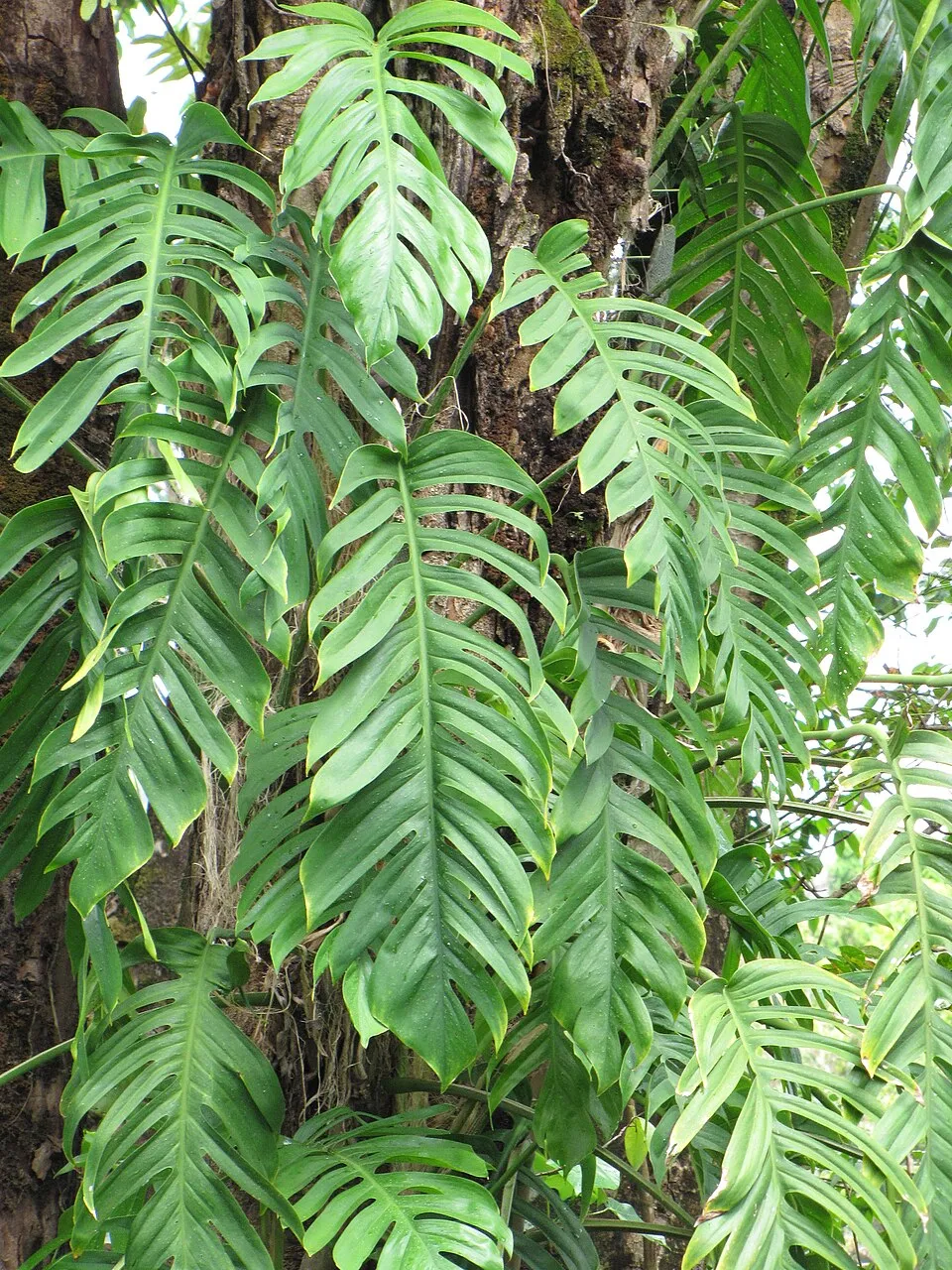
Epipremnum pinnatum, often recognized by common names such as Dragon-Tail Plant, Cebu Blue, or Centipede Tongavine, is a robust climbing herbaceous perennial belonging to the Araceae family. Native to a vast tropical expanse from India and Southeast Asia to the Philippines, New Guinea, and Australia, it thrives in warm, humid rainforest environments, frequently observed ascending tree trunks and sometimes becoming fully epiphytic. Its morphology is highly distinctive, undergoing a dramatic transformation from juvenile to mature stages. Young leaves are typically elliptical or arrow-shaped with entire margins, often exhibiting a striking blue-green hue, particularly in cultivars like 'Cebu Blue'.
As the plant matures and climbs, its leaves evolve, becoming significantly larger (12 to 20 inches long), smooth, thick, ovate, and developing characteristic deep fenestrations or incisions, resembling a dragon's tail. The species epithet 'pinnatum' refers to this pinnate-like division of the mature leaf. While capable of producing a creamy-white to yellow-greenish spadix enclosed by a canoe-shaped spathe, flowering is rare in cultivated indoor settings. The stems are sturdy and vine-like, capable of reaching impressive lengths of 20 to 65 feet in its natural habitat, requiring support when grown indoors.
This species is often confused with Epipremnum aureum, but botanists distinguish them by distinct vegetative features, establishing E. pinnatum as its own unique species.
Trusted Scientific References
1. Authoritative external sources for Epipremnum pinnatum
1.1 Wikipedia — Epipremnum pinnatum
1.2 Kew POWO (Plants of the World Online)
1.3 PubMed — peer-reviewed research
1.4 NCBI Taxonomy Browser
1.5 GBIF — Global Biodiversity
1.6Epipremnum Pinnatum should be interpreted through verified botanical identity, practical care, and responsible safety language. This recovery note adds the missing context needed for a complete profile: match light to the plant's habit, use well-drained soil, water according to season, and avoid unsupported medicinal or edible claims. For publishing, the plant can be presented as a source-backed indoor plant with clear care guidance, common problem diagnosis, and conservative safety wording.
1.1.Epipremnum Pinnatum — Key Features
- ✓ <strong>Striking Fenestrated Leaves</strong> — Develops deep incisions and holes in its mature foliage, giving it a distinctive 'dragon-tail' appearance.
- ✓ <strong>Air Purifying Qualities</strong> — Proven to effectively remove harmful volatile organic compounds (VOCs) like formaldehyde and benzene from indoor air.
- ✓ <strong>Climbing Growth Habit</strong> — A vigorous vine that can reach significant lengths, often grown with support to encourage larger, more mature leaves.
- ✓ <strong>Tropical Native</strong> — Indigenous to the rainforests of Southeast Asia, thriving in warm, humid conditions.
- ✓ <strong>Low Maintenance Houseplant</strong> — Relatively easy to care for, making it a popular choice for indoor plant enthusiasts.
- ✓ <strong>Traditional Topical Uses</strong> — Historically applied externally for various ailments including wounds, skin issues, and musculoskeletal pain.
- ✓ <strong>Toxicity Warning</strong> — Contains calcium oxalate crystals, which cause significant irritation if ingested or if sap contacts skin/eyes.
- ✓ <strong>Aesthetic Appeal</strong> — Highly valued for its ornamental beauty, contributing to biophilic design and enhancing indoor aesthetics.
- ✓ <strong>Adaptable Growth</strong> — Can be cultivated in hanging baskets, as a trailing plant, or as a climber with proper support.
- ✓ <strong>Distinct Juvenile vs. Mature Forms</strong> — Exhibits a notable change in leaf shape and fenestration development as it ages.
1.2.Epipremnum Pinnatum — Quick Summary
- ✓ Epipremnum pinnatum, or Dragon-Tail Plant, is a tropical climbing perennial known for its striking fenestrated leaves that mature from heart-shaped to deeply lobed.
- ✓ It is widely celebrated for its ability to improve indoor air quality by metabolizing volatile organic compounds and for its aesthetic stress-reducing presence.
- ✓ Traditionally, it has been used topically for skin ailments, wounds, rheumatic pain, and even snake bites in various Southeast Asian folk medicine systems.
- ✓ The plant contains calcium oxalate crystals, rendering it toxic if ingested and causing severe oral and gastrointestinal irritation.
- ✓ Cultivation is relatively straightforward, preferring indirect light, warm temperatures, and moderate humidity, making it a popular houseplant.
- ✓ Modern research is exploring its reported anti-inflammatory, antibacterial, and potential anticancer properties, lending scientific support to some traditional uses.
2.Epipremnum Pinnatum — Scientific Identity
3.Epipremnum Pinnatum — Quick Facts
4.Epipremnum Pinnatum — Appearance & Identification
5.Epipremnum Pinnatum — Native Habitat
6.Epipremnum Pinnatum — Water Requirements
- ✓ Light — Prefers bright, indirect sunlight; direct harsh sun can scorch leaves, while too little light can reduce fenestration development.
- ✓ Water — Keep soil consistently moist but not waterlogged; allow the top inch or two of soil to dry out between waterings to prevent root rot.
- ✓ Humidity — Thrives in moderate to high humidity (60% or above); consider misting, a pebble tray, or a humidifier, especially in dry indoor environments.
- ✓ Soil — Use a well-draining, rich, and airy potting mix with good organic matter content, ideally slightly acidic (pH 6.0-6.5).
- ✓ Temperature — Maintain warm temperatures between 65-80°F (18-27°C); avoid exposure to cold drafts or temperatures below 55°F (13°C).
- ✓ Support — Provide a moss pole, wooden stake, or trellis for its aerial roots to cling to, encouraging larger leaves and fenestrations.
- ✓ Pruning — Prune in spring or early summer to manage size, promote bushier growth, and remove any yellowing or damaged foliage.
- ✓ Propagation — Easily propagated from stem cuttings with at least one node, rooted in water or moist soil.
Reviewed by the Flora Medical Global Botanical Review Panel
Multi-disciplinary editorial group · Botany · Ethnobotany · Herbal-medicine literature
Who reviewed this: This page was checked by the Flora Medical Global Botanical Review Panel — an in-house editorial group of botany graduates, ethnobotany researchers, and horticulture practitioners who collectively maintain our 7,000+ plant encyclopedia. Meet the team.
Our 4-step verification process
1. Taxonomic verification
Scientific names and synonyms cross-checked against Kew POWO, World Flora Online, and The Plant List.
2. Phytochemical & medicinal cross-reference
Active compounds, traditional uses, and reported activities are cross-referenced with PubMed, USDA Dr. Duke's database, and peer-reviewed ethnobotanical literature.
3. Conservation & distribution check
Distribution, ecology, and conservation status confirmed against GBIF occurrence records and the IUCN Red List.
4. Editorial & safety review
Every entry passes an editorial pass for clarity, originality, and safety notices (toxicity, contraindications, dosage caveats) before publication.
Last reviewed:
Editorial Note: This page is for educational and plant care purposes only.
Written by: Flora Medical Global Editorial Team
Reviewed by: Flora Medical Global Botanical Review Panel
Last Updated: June 15, 2026







Epipremnum Pinnatum — Comments & Community Reviews
Rate this plant