
Care Disclaimer: Plant care recommendations are general guidelines based on common growing conditions. Individual results may vary based on your local environment, climate, and care routine. If your plant is toxic, keep it away from children and pets, and consult a veterinarian if accidental ingestion occurs.
1.Episcia — Overview
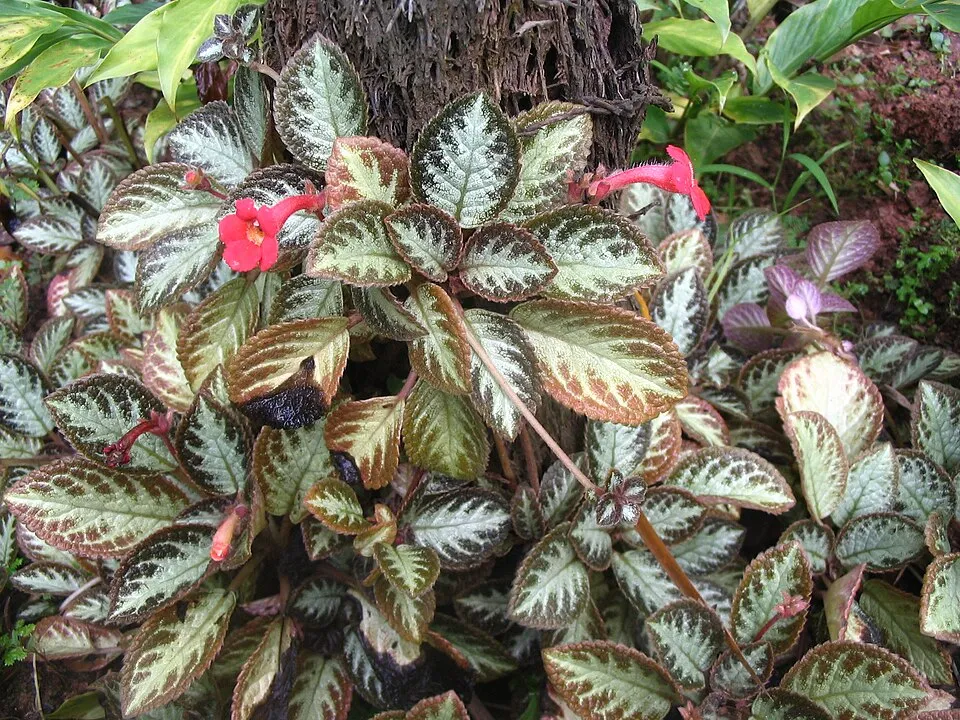
Episcia cupreata, commonly known as the Flame Violet, is an enchanting perennial herb belonging to the Gesneriaceae family, a group renowned for its diverse and often showy flowering plants. This species typically exhibits a compact, trailing, or stoloniferous growth habit, reaching heights of approximately 30 to 45 cm (12 to 18 inches) with an indefinite spread due to its production of 'runners' or stolons that root readily upon contact with suitable substrate.
The foliage is perhaps its most striking feature: rounded to ovate leaves, often reaching 10 cm in length and 6 cm in width, display a captivating quilted texture, also known as bullate, and a rich palette of metallic bronze, coppery-red, or deep green hues, frequently accented with contrasting veins or margins. The adaxial surface is typically velvety due to the presence of fine hairs, while the abaxial side might show a paler green or purplish tint.
The stems of Episcia cupreata are soft, succulent, and somewhat brittle, covered in fine, reddish hairs that give them a distinctive fuzzy appearance. These stoloniferous stems are crucial for the plant's natural propagation, allowing it to rapidly colonize suitable ground cover in its native habitats. The flowers are a dazzling spectacle of vibrant orange to fiery red, tubular in shape, and typically borne singly or in small clusters from the leaf axils.
Each flower consists of five fused petals, often with a yellow throat speckled with red, creating a striking contrast that attracts hummingbirds and other pollinators in its natural environment. Flowering can occur intermittently throughout the year under optimal conditions.
Native to the tropical rainforests of Central and South America, particularly endemic to regions of Colombia and Ecuador, Episcia cupreata thrives as an understory plant. It prefers the warm, consistently humid microclimates found beneath the dense canopy, where light is filtered and diffuse.
Its natural habitat typically consists of rich, organic soil with good drainage, often growing epiphytically or lithophytically on moss-covered rocks and tree trunks, highlighting its adaptability within its specific ecological niche.
Trusted Scientific References
1. Authoritative external sources for Episcia cupreata
1.1 Wikipedia — Episcia cupreata
1.2 Kew POWO (Plants of the World Online)
1.3 PubMed — peer-reviewed research
1.4 NCBI Taxonomy Browser
1.5 GBIF — Global Biodiversity
1.1.Episcia — Key Features
- ✓ <strong>Striking metallic bronze, coppery</strong> — red, or deep green foliage.
- ✓ <strong>Velvety, bullate (quilted)</strong> — Velvety, bullate (quilted) leaf texture.
- ✓ <strong>Dazzling fiery red</strong> — orange tubular flowers with yellow throats.
- ✓ <strong>Trailing or stoloniferous</strong> — Trailing or stoloniferous growth habit, producing 'runners'.
- ✓ <strong>Native to humid</strong> — Native to humid tropical rainforests of Colombia and Ecuador.
- ✓ <strong>Belongs to the</strong> — Belongs to the Gesneriaceae family, known for ornamental plants.
- ✓ <strong>Propagates easily from</strong> — Propagates easily from stolons, making it a popular houseplant.
- ✓ <strong>Attracts hummingbirds in</strong> — Attracts hummingbirds in its natural habitat.
- ✓ <strong>Perennial herbaceous plant,</strong> — Perennial herbaceous plant, often grown as groundcover or in hanging baskets.
- ✓ <strong>Adaptable to indoor</strong> — Adaptable to indoor environments with suitable humidity and light.
1.2.Episcia — Quick Summary
- ✓ Episcia cupreata, or Flame Violet, is a striking perennial herb.
- ✓ Known for its vibrant, metallic foliage and fiery red-orange flowers.
- ✓ Native to the tropical rainforests of Central and South America.
- ✓ Traditionally used in folk medicine for anti-inflammatory and wound healing properties.
- ✓ Requires high humidity, warm temperatures, and indirect light for optimal growth.
- ✓ Primarily cultivated as an ornamental houseplant for its aesthetic appeal.
2.Episcia — Scientific Identity
3.Episcia — Quick Facts
4.Episcia — Appearance & Identification
5.Episcia — Native Habitat
6.Episcia — Water Requirements
- ✓ Light — Provide bright, indirect light; direct sun can scorch leaves and diminish vibrant coloration.
- ✓ Soil — Use a well-draining, rich, and slightly acidic potting mix, ideally with peat moss, perlite, and vermiculite.
- ✓ Watering — Keep soil consistently moist but never waterlogged; allow the top inch to dry slightly between waterings.
- ✓ Humidity — Maintain high humidity (70-80%) through misting, pebble trays, or a humidifier, crucial for optimal growth.
- ✓ Temperature — Thrives in warm tropical conditions, ideally between 18-27°C (65-80°F); avoid temperatures below 15°C (60°F).
- ✓ Propagation — Easily propagated by rooting stolons (runners) or leaf cuttings in moist soil or water.
- ✓ Fertilization — Feed with a balanced liquid fertilizer diluted to half strength every 2-4 weeks during the active growing season (spring to fall).
- ✓ Pest Control — Monitor for common houseplant pests like spider mites, mealybugs, and aphids; treat with insecticidal soap if necessary.
Reviewed by the Flora Medical Global Botanical Review Panel
Multi-disciplinary editorial group · Botany · Ethnobotany · Herbal-medicine literature
Who reviewed this: This page was checked by the Flora Medical Global Botanical Review Panel — an in-house editorial group of botany graduates, ethnobotany researchers, and horticulture practitioners who collectively maintain our 7,000+ plant encyclopedia. Meet the team.
Our 4-step verification process
1. Taxonomic verification
Scientific names and synonyms cross-checked against Kew POWO, World Flora Online, and The Plant List.
2. Phytochemical & medicinal cross-reference
Active compounds, traditional uses, and reported activities are cross-referenced with PubMed, USDA Dr. Duke's database, and peer-reviewed ethnobotanical literature.
3. Conservation & distribution check
Distribution, ecology, and conservation status confirmed against GBIF occurrence records and the IUCN Red List.
4. Editorial & safety review
Every entry passes an editorial pass for clarity, originality, and safety notices (toxicity, contraindications, dosage caveats) before publication.
Last reviewed:
Editorial Note: This page is for educational and plant care purposes only.
Written by: Flora Medical Global Editorial Team
Reviewed by: Flora Medical Global Botanical Review Panel
Last Updated: June 15, 2026







Episcia — Comments & Community Reviews
Rate this plant