
Care Disclaimer: Plant care recommendations are general guidelines based on common growing conditions. Individual results may vary based on your local environment, climate, and care routine. If your plant is toxic, keep it away from children and pets, and consult a veterinarian if accidental ingestion occurs.
1.Espostoa Lanata — Overview
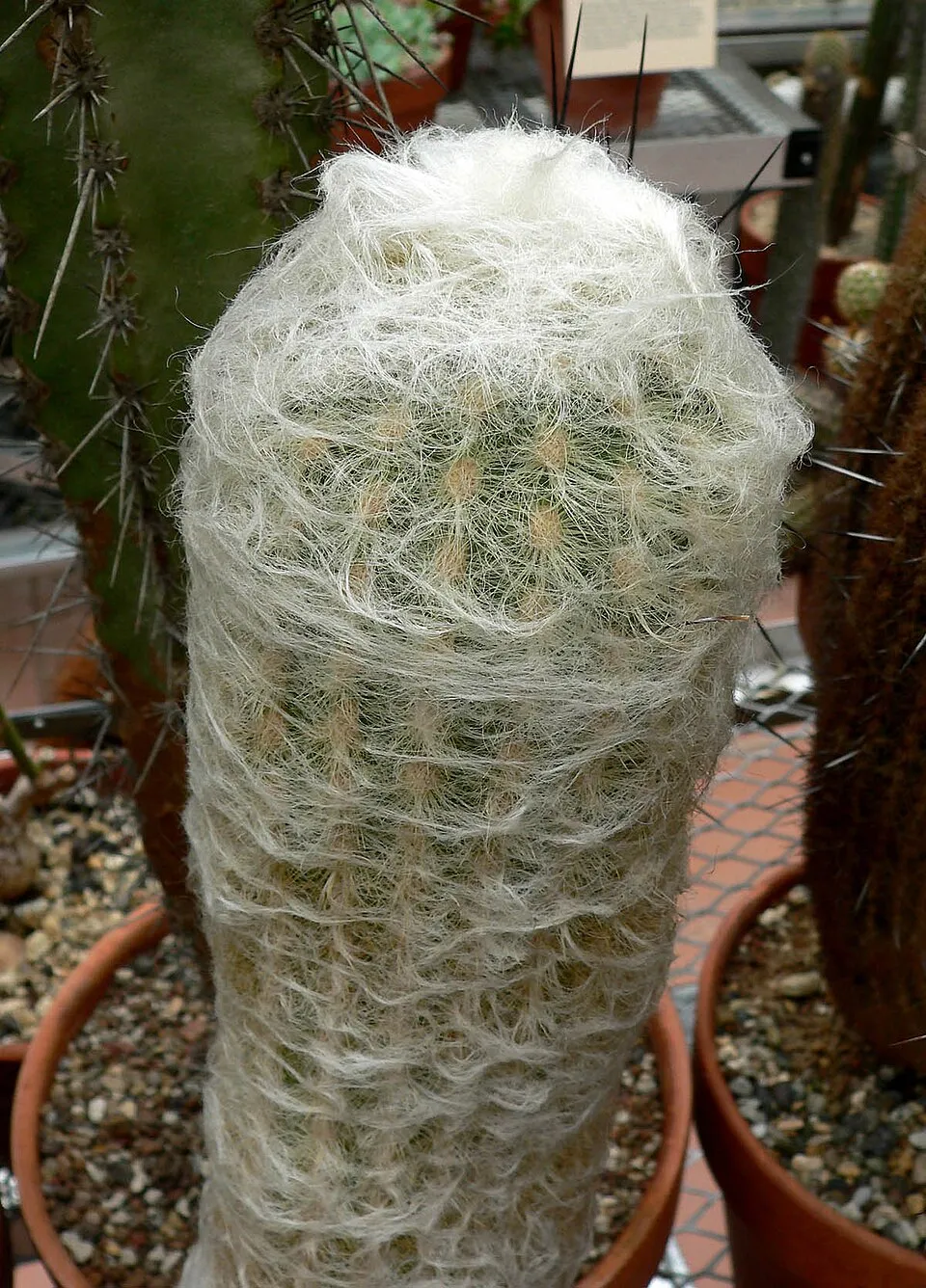
Espostoa lanata, commonly known as the Peruvian old man cactus or 'Old Man of the Andes', is a distinctive columnar cactus belonging to the Cactaceae family. Native to the high-altitude arid regions spanning southern Ecuador and Peru, this species thrives in dry hills, thorny desert matorral, and dry forests, at elevations ranging from 250 to 3,000 meters. It exhibits a majestic, often tree-like stature, capable of reaching heights of up to 4 meters (approximately 13 feet) in its natural habitat, with a trunk diameter of up to 100 cm and stems measuring 6-10 cm in diameter. Its most striking feature is the dense covering of long, soft, white, woolly hairs that envelop its cylindrical stems, providing protection against intense solar radiation and minimizing water loss, giving it an appearance reminiscent of a wise, snow-bearded elder.
Beneath this protective wool, the stem is typically green, ribbed with 18 to 25 prominent ribs that bear areoles from which the wool and sharp spines (1 to 2.5 cm long, yellow to reddish-brown) emerge. Espostoa lanata produces nocturnal, funnel-shaped flowers, typically yellow to creamy-white, measuring about 2.5 to 4 centimeters in diameter. These blooms emerge from a specialized lateral flowering structure called a cephalium, attracting nocturnal pollinators. Following successful pollination, the cactus develops small, edible, berry-like fruits, which are often purplish-red, sweet, and juicy, containing numerous tiny black seeds.
Its fibrous, shallow root system spreads wide to efficiently capture scarce surface moisture. Taxonomically, it is classified as 'Least Concern' on the IUCN Red List, indicating stable populations and no major immediate threats.
Trusted Scientific References
1. Authoritative external sources for Espostoa lanata
1.1 Wikipedia — Espostoa lanata
1.2 Kew POWO (Plants of the World Online)
1.3 PubMed — peer-reviewed research
1.4 NCBI Taxonomy Browser
1.5 GBIF — Global Biodiversity
1.6Espostoa Lanata should be interpreted through verified botanical identity, practical care, and responsible safety language. This recovery note adds the missing context needed for a complete profile: match light to the plant's habit, use well-drained soil, water according to season, and avoid unsupported medicinal or edible claims. For publishing, the plant can be presented as a source-backed indoor plant with clear care guidance, common problem diagnosis, and conservative safety wording.
1.1.Espostoa Lanata — Key Features
- ✓ <strong>Dense White Wool</strong> — Characteristic long, soft hairs covering the stems.
- ✓ <strong>Columnar Growth Habit</strong> — Forms tall, upright, often branching structures.
- ✓ <strong>Native to Andes</strong> — Indigenous to high-altitude arid regions of Peru and Ecuador.
- ✓ <strong>Edible Berry</strong> — like Fruit — Produces sweet, purplish-red fruits.
- ✓ <strong>Nocturnal Flowers</strong> — Yellow to creamy-white blooms emerging from a cephalium.
- ✓ <strong>Spiny Areoles</strong> — Sharp spines hidden beneath the protective wool.
- ✓ <strong>Drought Adaptation</strong> — Succulent stems and CAM photosynthesis for water retention.
- ✓ <strong>Slow Growing</strong> — A long-lived, slow-maturing cactus species.
- ✓ <strong>Ornamental Appeal</strong> — Highly valued for its unique visual texture and form.
- ✓ <strong>Resilient in Harsh Climates</strong> — Thrives in intense sun and dry conditions.
1.2.Espostoa Lanata — Quick Summary
- ✓ Iconic Andean Cactus — Distinguished by dense white wool and columnar growth.
- ✓ Edible, Nutritious Fruit — Produces sweet, juicy purplish-red berries.
- ✓ Drought-Tolerant — Highly adapted to arid, high-altitude environments.
- ✓ Traditional Non-Medicinal Uses — Fruit consumed, wool used for stuffing.
- ✓ Conservation Status 'Least Concern' — Stable wild populations in Peru and Ecuador.
- ✓ Ornamental Value — Prized for its unique aesthetic in desert landscaping.
2.Espostoa Lanata — Scientific Identity
3.Espostoa Lanata — Quick Facts
4.Espostoa Lanata — Appearance & Identification
5.Espostoa Lanata — Native Habitat
6.Espostoa Lanata — Water Requirements
- ✓ Soil Requirements — Prefers well-drained, sandy or gravelly soil, ideally with a pH range of 6.0 to 7.5, mimicking its natural arid, rocky habitat.
- ✓ Light Exposure — Requires full sun exposure to thrive, needing at least 6-8 hours of direct sunlight daily for optimal growth and flowering.
- ✓ Watering Schedule — Water sparingly, allowing the soil to dry out completely between waterings, especially during dormant periods; overwatering is detrimental and can lead to root rot.
- ✓ Temperature and Frost — Can tolerate occasional, short-lived frosts down to -3°C (27°F), but prolonged freezing temperatures should be avoided to prevent damage.
- ✓ Growth Rate — Espostoa lanata is a slow-growing cactus species, requiring patience from cultivators.
- ✓ Propagation — Primarily propagated by seeds, which can be sown in well-drained soil in warm conditions, or occasionally by stem cuttings allowed to callus before planting.
- ✓ Fertilization — Fertilize minimally during the active growing season (spring/summer) with a low-nitrogen, high-potassium fertilizer specifically formulated for cacti and succulents.
Reviewed by the Flora Medical Global Botanical Review Panel
Multi-disciplinary editorial group · Botany · Ethnobotany · Herbal-medicine literature
Who reviewed this: This page was checked by the Flora Medical Global Botanical Review Panel — an in-house editorial group of botany graduates, ethnobotany researchers, and horticulture practitioners who collectively maintain our 7,000+ plant encyclopedia. Meet the team.
Our 4-step verification process
1. Taxonomic verification
Scientific names and synonyms cross-checked against Kew POWO, World Flora Online, and The Plant List.
2. Phytochemical & medicinal cross-reference
Active compounds, traditional uses, and reported activities are cross-referenced with PubMed, USDA Dr. Duke's database, and peer-reviewed ethnobotanical literature.
3. Conservation & distribution check
Distribution, ecology, and conservation status confirmed against GBIF occurrence records and the IUCN Red List.
4. Editorial & safety review
Every entry passes an editorial pass for clarity, originality, and safety notices (toxicity, contraindications, dosage caveats) before publication.
Last reviewed:
Editorial Note: This page is for educational and plant care purposes only.
Written by: Flora Medical Global Editorial Team
Reviewed by: Flora Medical Global Botanical Review Panel
Last Updated: June 15, 2026







Espostoa Lanata — Comments & Community Reviews
Rate this plant