
Care Disclaimer: Plant care recommendations are general guidelines based on common growing conditions. Individual results may vary based on your local environment, climate, and care routine. If your plant is toxic, keep it away from children and pets, and consult a veterinarian if accidental ingestion occurs.
1.Euphorbia Ingens — Overview
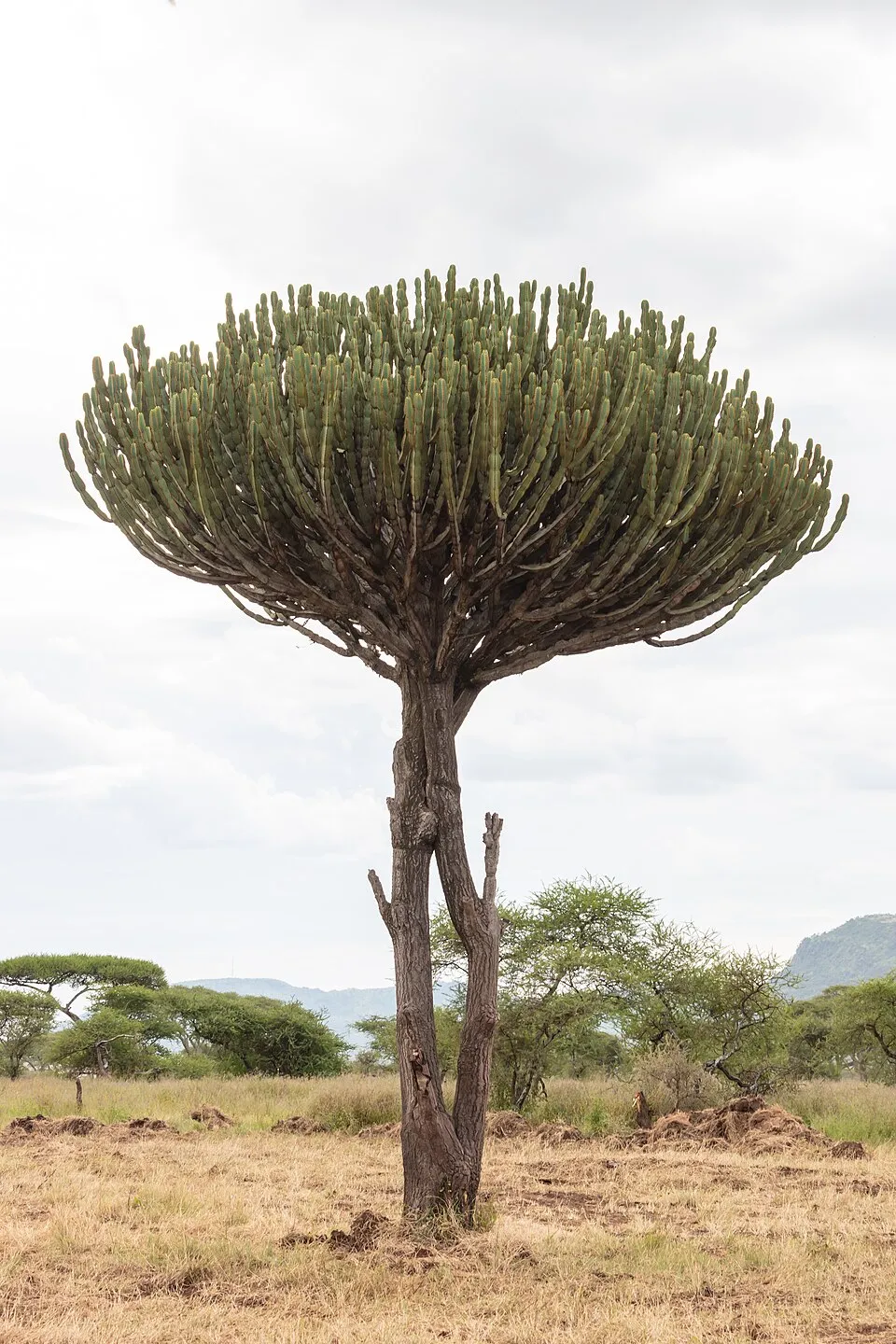
Euphorbia ingens, commonly known as the African Milk Barrel or Candelabra Tree, is a majestic succulent native to the arid and semi-savanna regions of southern and eastern Africa, including countries like South Africa, Zimbabwe, Mozambique, and Kenya. This striking plant is characterized by its robust, tree-like growth, often reaching impressive heights of 6 to 8 meters in its natural environment, forming a distinct candelabra shape. Its thick trunk supports numerous erect, segmented branches, typically 3.5 to 7.5 centimeters in diameter, which are a vibrant dark green and feature five prominent ridges. Young stems are often adorned with paired, short spines measuring 0.5 to 2 millimeters.
The leaves are ephemeral and inconspicuous, usually small and clustered at the apex of newer growth, quickly falling off as the stem matures. During the cooler months, from autumn to winter, Euphorbia ingens produces small, greenish-yellow cyathia—the characteristic flower structure of the Euphorbia genus—along the ridges of its uppermost segments. These flowers are pollinated by various insects, including butterflies and bees. The plant then develops round, three-lobed capsule fruits that mature from green to a deep purple.
Ecologically, it plays a role in its native habitat, providing shelter and food (seeds) for birds. Taxonomically, it belongs to the extensive Euphorbiaceae family, known for its diverse species and the milky latex present in most members. It thrives in well-drained, sandy soils and can withstand prolonged droughts, making it a highly adaptable species in cultivation.
Trusted Scientific References
1. Authoritative external sources for Euphorbia ingens
1.1 Wikipedia — Euphorbia ingens
1.2 Kew POWO (Plants of the World Online)
1.3 PubMed — peer-reviewed research
1.4 NCBI Taxonomy Browser
1.5 GBIF — Global Biodiversity
1.6Euphorbia Ingens should be interpreted through verified botanical identity, practical care, and responsible safety language. This recovery note adds the missing context needed for a complete profile: match light to the plant's habit, use well-drained soil, water according to season, and avoid unsupported medicinal or edible claims. For publishing, the plant can be presented as a source-backed indoor plant with clear care guidance, common problem diagnosis, and conservative safety wording.
1.1.Euphorbia Ingens — Key Features
- ✓ <strong>Striking Candelabra Shape</strong> — Distinctive multi-branched, tree-like succulent form.
- ✓ <strong>Tall Growth Habit</strong> — Can reach 6-8 meters in height in natural habitats.
- ✓ <strong>Dark Green, Ribbed Stems</strong> — Cylindrical, segmented branches with 5 prominent ridges.
- ✓ <strong>Ephemeral Leaves</strong> — Small, quickly deciduous leaves at branch tips.
- ✓ <strong>Toxic Milky Latex</strong> — Contains a highly irritant and poisonous white sap.
- ✓ <strong>Drought Tolerant</strong> — Adaptable to arid and semi-arid environments.
- ✓ <strong>Native to Southern and Eastern Africa</strong> — Indigenous to a wide range of dry regions.
- ✓ <strong>Small Greenish</strong> — Yellow Cyathia — Unique flower structures characteristic of Euphorbia.
- ✓ <strong>Red, Three</strong> — Lobed Capsule Fruits — Develop after flowering, turning purple when ripe.
- ✓ <strong>Low Maintenance Ornamental</strong> — Popular for landscaping and indoor cultivation.
1.2.Euphorbia Ingens — Quick Summary
- ✓ Euphorbia ingens is a large, striking succulent native to Southern and Eastern Africa.
- ✓ Known as African Milk Barrel or Candelabra Tree for its distinctive form.
- ✓ All parts contain a highly toxic, milky latex that causes severe irritation and poisoning.
- ✓ Traditionally used for ailments like ulcers and as a purgative, but these uses are highly dangerous.
- ✓ Primarily cultivated as an ornamental plant due to its unique appearance and low maintenance.
- ✓ Extreme caution is advised when handling due to its caustic latex.
2.Euphorbia Ingens — Scientific Identity
3.Euphorbia Ingens — Quick Facts
4.Euphorbia Ingens — Appearance & Identification
5.Euphorbia Ingens — Native Habitat
6.Euphorbia Ingens — Water Requirements
- ✓ Sunlight — Requires full sun exposure to thrive, ideally 6-8 hours of direct sunlight daily for robust growth.
- ✓ Soil — Prefers well-drained, sandy, or gritty soil mixtures to prevent root rot, mimicking its native arid habitat.
- ✓ Watering — Needs infrequent watering; allow the soil to dry out completely between waterings, especially during dormant periods.
- ✓ Temperature — Thrives in warm temperatures, ideally between 20-35°C (68-95°F), and is not frost-tolerant.
- ✓ Propagation — Can be propagated from stem cuttings, which should be allowed to callus for several weeks before planting in well-drained soil.
- ✓ Fertilization — Benefits from light feeding with a balanced, diluted succulent fertilizer during its active growing season (spring and summer).
- ✓ Pruning — Prune only to remove dead or damaged branches, or to control size; wear protective gloves and eyewear due to toxic latex.
- ✓ Pest Control — Generally pest-resistant due to its toxic latex, but watch for common succulent pests like mealybugs in overly stressed conditions.
Reviewed by the Flora Medical Global Botanical Review Panel
Multi-disciplinary editorial group · Botany · Ethnobotany · Herbal-medicine literature
Who reviewed this: This page was checked by the Flora Medical Global Botanical Review Panel — an in-house editorial group of botany graduates, ethnobotany researchers, and horticulture practitioners who collectively maintain our 7,000+ plant encyclopedia. Meet the team.
Our 4-step verification process
1. Taxonomic verification
Scientific names and synonyms cross-checked against Kew POWO, World Flora Online, and The Plant List.
2. Phytochemical & medicinal cross-reference
Active compounds, traditional uses, and reported activities are cross-referenced with PubMed, USDA Dr. Duke's database, and peer-reviewed ethnobotanical literature.
3. Conservation & distribution check
Distribution, ecology, and conservation status confirmed against GBIF occurrence records and the IUCN Red List.
4. Editorial & safety review
Every entry passes an editorial pass for clarity, originality, and safety notices (toxicity, contraindications, dosage caveats) before publication.
Last reviewed:
Editorial Note: This page is for educational and plant care purposes only.
Written by: Flora Medical Global Editorial Team
Reviewed by: Flora Medical Global Botanical Review Panel
Last Updated: June 15, 2026







Euphorbia Ingens — Comments & Community Reviews
Rate this plant