
Care Disclaimer: Plant care recommendations are general guidelines based on common growing conditions. Individual results may vary based on your local environment, climate, and care routine. If your plant is toxic, keep it away from children and pets, and consult a veterinarian if accidental ingestion occurs.
1.Euphorbia Obesa — Overview
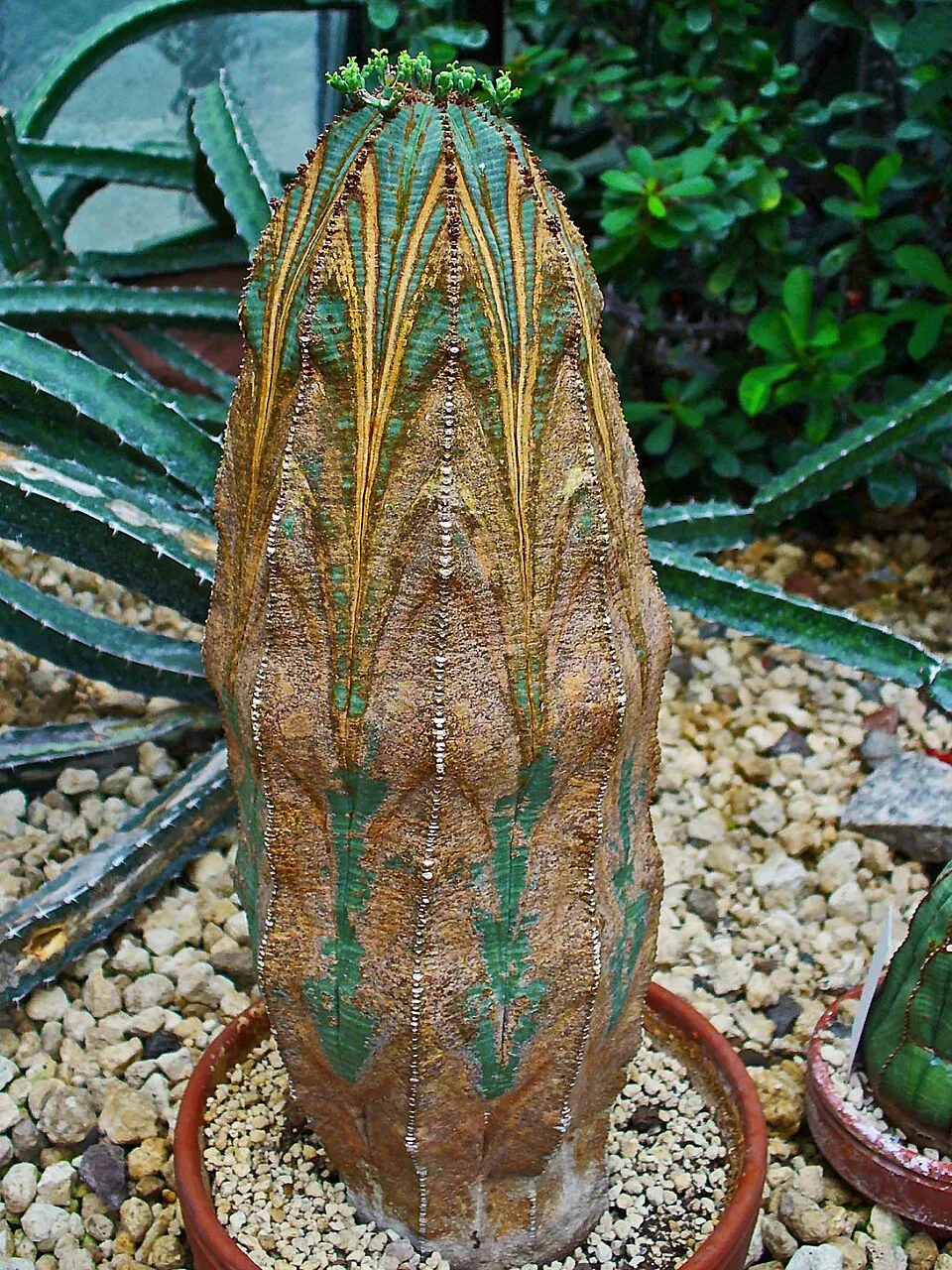
Euphorbia obesa, affectionately known as the Baseball Plant due to its strikingly symmetrical, spherical to ovoid form, is a distinctive succulent species within the diverse Euphorbiaceae family. This fascinating plant typically grows to a compact height of 10 to 15 centimeters with a diameter of 8 to 12 centimeters, making it an ideal candidate for indoor cultivation and specialized plant collections. Its morphology is characterized by 8 to 12 well-defined, vertical ribs adorned with small, conical tubercles, which contribute to its unique aesthetic and efficient water storage capabilities.
While Euphorbia obesa is largely leafless, its ribbed structure is a key feature. The plant is dioecious, meaning individual plants bear either male or female flowers, which are small, yellowish-green cyathia that emerge from the apex, usually during warmer months. Its smooth, waxy surface provides a polished appearance and crucially aids in moisture retention, a vital adaptation for its native habitat.
Indigenous to the arid Karoo region in the Eastern Cape Province of South Africa, including areas around Kendrew and Willowmore, Euphorbia obesa thrives in dry, rocky, well-drained soils. Its robust adaptation to these challenging conditions underscores its resilience and suitability for low-maintenance indoor environments. Taxonomically, it is classified under the genus Euphorbia, a genus renowned for its incredible morphological diversity. There are two recognized subspecies: E.
obesa subsp. obesa, which tends to be taller than broad, and E. obesa subsp. symmetrica, which maintains a more globose, equally wide as tall shape.
This species is also a remarkable example of convergent evolution, sharing a similar form with the unrelated cactus Astrophytum asterias. Due to its increasing rarity in the wild from over-collection and slow growth, it is listed on CITES Appendix II, highlighting its conservation importance.
Trusted Scientific References
1. Authoritative external sources for Euphorbia obesa
1.1 Wikipedia — Euphorbia obesa
1.2 Kew POWO (Plants of the World Online)
1.3 PubMed — peer-reviewed research
1.4 NCBI Taxonomy Browser
1.5 GBIF — Global Biodiversity
1.1.Euphorbia Obesa — Key Features
- ✓ <strong>Distinctive Spherical to Ovoid Form</strong> — Resembles a baseball, giving it its common name and unique ornamental appeal.
- ✓ <strong>Ribbed and Thornless Morphology</strong> — Features 8-12 prominent ribs adorned with small tubercles, lacking the typical thorns of many succulents.
- ✓ <strong>Dioecious Flowering</strong> — Individual plants bear either male or female inconspicuous yellowish-green cyathia at the apex.
- ✓ <strong>Toxic Milky Latex</strong> — Contains a caustic, milky sap (latex) that is a severe irritant upon contact and toxic if ingested.
- ✓ <strong>Drought</strong> — Tolerant Succulent — Highly adapted to arid environments, storing water efficiently within its succulent stem.
- ✓ <strong>Low</strong> — Maintenance Ornamental — Requires minimal care, making it popular for indoor cultivation and xeriscaping.
- ✓ <strong>Native to South African Karoo</strong> — Endemic to the Eastern Cape Province of South Africa, thriving in dry, rocky habitats.
- ✓ <strong>CITES Appendix II Listed</strong> — Protected under the Convention on International Trade in Endangered Species due to wild population declines.
- ✓ <strong>Example of Convergent Evolution</strong> — Exhibits a striking resemblance to the unrelated cactus *Astrophytum asterias*.
- ✓ <strong>Royal Horticultural Society Award of Garden Merit</strong> — Recognized for its excellent garden performance and ornamental value.
1.2.Euphorbia Obesa — Quick Summary
- ✓ Unique spherical succulent, native to South Africa.
- ✓ Characterized by its distinctive ribbed, thornless form.
- ✓ Produces a highly toxic, milky latex upon injury.
- ✓ Primarily cultivated as an ornamental plant, not for internal medicinal use.
- ✓ Requires bright light, extremely well-drained soil, and infrequent watering.
- ✓ Listed on CITES Appendix II due to over-collection and slow growth.
2.Euphorbia Obesa — Scientific Identity
3.Euphorbia Obesa — Quick Facts
4.Euphorbia Obesa — Appearance & Identification
5.Euphorbia Obesa — Native Habitat
6.Euphorbia Obesa — Water Requirements
- ✓ Soil Requirements — Utilize an extremely well-draining succulent or cactus potting mix, ideally amended with extra grit, perlite, or coarse sand to ensure rapid drainage and prevent root rot.
- ✓ Light Exposure — Provide ample bright, direct sunlight for at least 6-8 hours daily; in its native habitat, it thrives in full sun, which encourages compact growth and vibrant coloration.
- ✓ Watering Schedule — Water thoroughly but infrequently; allow the soil to dry out completely between waterings, typically every 2-4 weeks during the active growing season (spring and summer), and significantly reduce or cease watering in winter dormancy.
- ✓ Temperature and Humidity — Maintain warm temperatures, ideally between 20-30°C (68-86°F), and protect from frost, as this subtropical species is highly sensitive to cold; average household humidity is generally adequate.
- ✓ Fertilization — Feed sparingly with a diluted, low-nitrogen fertilizer specifically formulated for succulents, applied no more than once a month during the active growing period.
- ✓ Propagation — Primarily propagated by seed, which can be challenging due to slow germination and growth rates; successful seed production requires both male and female plants for cross-pollination.
- ✓ Potting and Repotting — Use pots with excellent drainage holes; repot only when the plant is root-bound, typically every 2-3 years, to refresh the soil and accommodate its slow growth.
- ✓ Pest Management — Regularly inspect for common succulent pests such as mealybugs and spider mites; address any infestations promptly using appropriate horticultural oils or insecticidal soaps.
Reviewed by the Flora Medical Global Botanical Review Panel
Multi-disciplinary editorial group · Botany · Ethnobotany · Herbal-medicine literature
Who reviewed this: This page was checked by the Flora Medical Global Botanical Review Panel — an in-house editorial group of botany graduates, ethnobotany researchers, and horticulture practitioners who collectively maintain our 7,000+ plant encyclopedia. Meet the team.
Our 4-step verification process
1. Taxonomic verification
Scientific names and synonyms cross-checked against Kew POWO, World Flora Online, and The Plant List.
2. Phytochemical & medicinal cross-reference
Active compounds, traditional uses, and reported activities are cross-referenced with PubMed, USDA Dr. Duke's database, and peer-reviewed ethnobotanical literature.
3. Conservation & distribution check
Distribution, ecology, and conservation status confirmed against GBIF occurrence records and the IUCN Red List.
4. Editorial & safety review
Every entry passes an editorial pass for clarity, originality, and safety notices (toxicity, contraindications, dosage caveats) before publication.
Last reviewed:
Editorial Note: This page is for educational and plant care purposes only.
Written by: Flora Medical Global Editorial Team
Reviewed by: Flora Medical Global Botanical Review Panel
Last Updated: June 15, 2026







Euphorbia Obesa — Comments & Community Reviews
Rate this plant