
Care Disclaimer: Plant care recommendations are general guidelines based on common growing conditions. Individual results may vary based on your local environment, climate, and care routine. If your plant is toxic, keep it away from children and pets, and consult a veterinarian if accidental ingestion occurs.
1.Fatsia Japonica — Overview
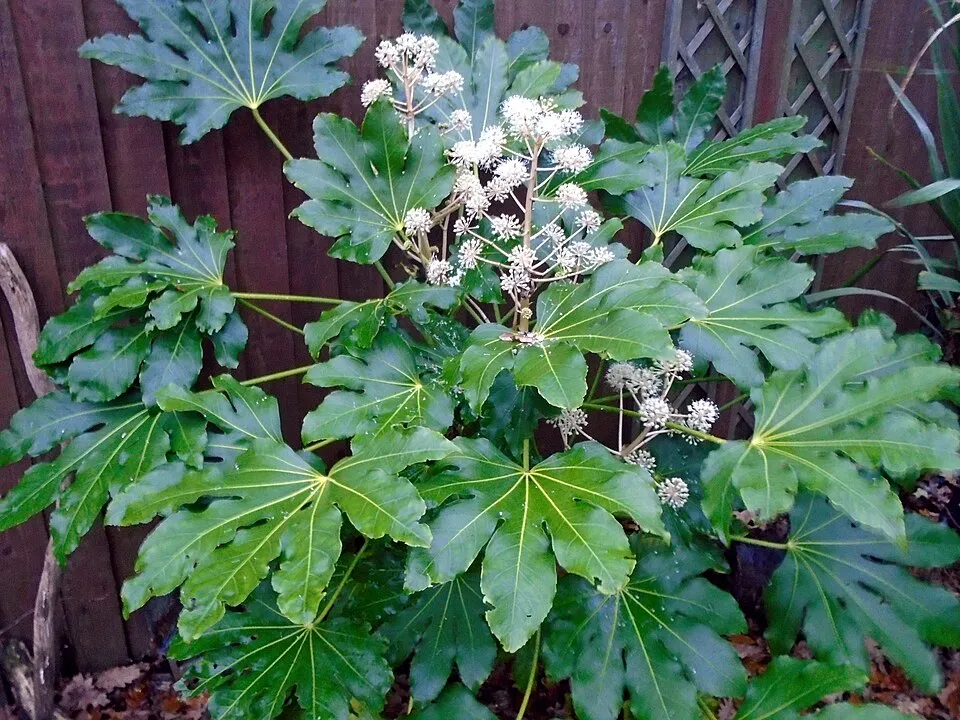
Fatsia japonica, commonly known as Japanese Aralia, is a striking evergreen shrub native to the subtropical and temperate regions of Japan, South Korea, and Taiwan. Belonging to the Araliaceae family, it shares lineage with well-known medicinal plants like ginseng (Panax spp.) and ornamental species such as ivy (Hedera spp.). The genus name 'Fatsia' is derived from 'fatsi,' an approximation of the Japanese word for 'eight,' referencing the characteristic 7-9 deep lobes of its palmate leaves, while 'japonica' denotes its Japanese origin. This robust plant typically grows as a multi-stemmed shrub, reaching impressive heights of 3-6 meters in its natural habitat, though often cultivated to smaller sizes, especially indoors.
Its most prominent feature is its large, glossy, dark green leaves, which can span up to 40 cm, creating a bold, tropical aesthetic. In late autumn, Fatsia japonica produces distinctive upright panicles of small, creamy-white flowers, which are later followed by clusters of small, shiny black berries that ripen in winter. Highly prized for its architectural form and ability to thrive in shadier, protected environments, it gained significant popularity in Victorian-era conservatories and remains a favored ornamental globally. Beyond its aesthetic appeal, traditional folk medicine in its native regions has historically recognized certain parts of the plant for their potential anti-inflammatory and diuretic properties.
Modern scientific inquiry is increasingly focusing on its rich phytochemical profile, investigating compounds such as triterpenoid saponins (e.g., fatsiosides), flavonoids, and polyacetylenes, aiming to validate traditional uses and uncover novel pharmacological activities, particularly in areas like anti-diabetic and potential anti-cancer research. It is known to tolerate various soil types, including sandy and clay, and once established, shows drought tolerance, making it adaptable to diverse landscape uses.
Trusted Scientific References
1. Authoritative external sources for Fatsia japonica
1.1 Wikipedia — Fatsia japonica
1.2 Kew POWO (Plants of the World Online)
1.3 PubMed — peer-reviewed research
1.4 NCBI Taxonomy Browser
1.5 GBIF — Global Biodiversity
1.1.Fatsia Japonica — Key Features
- ✓ <strong>Large, glossy, deeply</strong> — Large, glossy, deeply lobed palmate leaves, giving a tropical appearance.
- ✓ <strong>Evergreen shrub or small tree, maintaining foliage year</strong> — round.
- ✓ <strong>Produces upright panicles of small, creamy</strong> — white flowers in autumn.
- ✓ <strong>Followed by clusters</strong> — Followed by clusters of small, shiny black berries that ripen in winter.
- ✓ <strong>Native to Japan,</strong> — Native to Japan, South Korea, and Taiwan, widely cultivated globally.
- ✓ <strong>Belongs to the</strong> — Belongs to the Araliaceae family, related to ginseng and ivy.
- ✓ <strong>Traditionally used in folk medicine for anti</strong> — inflammatory and diuretic effects.
- ✓ <strong>Contains notable phytochemicals</strong> — Contains notable phytochemicals like triterpenoid saponins and flavonoids.
- ✓ <strong>Adaptable to shade</strong> — Adaptable to shade and tolerant of various soil conditions once established.
- ✓ <strong>Excellent ornamental plant</strong> — Excellent ornamental plant for gardens, patios, and indoor spaces.
1.2.Fatsia Japonica — Quick Summary
- ✓ Japanese Aralia is an evergreen shrub native to East Asia, known for its large, glossy, palmate leaves.
- ✓ Traditionally used for anti-inflammatory and diuretic properties, particularly in Asian folk medicine.
- ✓ Rich in triterpenoid saponins, flavonoids, and polyacetylenes, which are subjects of ongoing research.
- ✓ Modern studies explore its potential anti-diabetic, hepatoprotective, and anti-cancer activities.
- ✓ Primarily an ornamental plant, it thrives in shaded, moist environments.
- ✓ Caution advised for internal use; berries are mildly toxic, and skin contact can cause irritation.
2.Fatsia Japonica — Scientific Identity
3.Fatsia Japonica — Quick Facts
4.Fatsia Japonica — Appearance & Identification
5.Fatsia Japonica — Native Habitat
6.Fatsia Japonica — Water Requirements
- ✓ Soil Preference — Thrives in acidic, moist, well-drained, humus-rich, and fertile soils, but tolerates sandy and clay soils.
- ✓ Light Requirements — Prefers part to full shade; direct sun can scorch leaves, leading to browning.
- ✓ Watering — Requires consistent moisture but is tolerant of drought once established; avoid waterlogging to prevent root rot.
- ✓ Pruning — Can be pruned any time of year to maintain shape and size; new growth produces next year's blossoms.
- ✓ Fertilization — Fertilize regularly during the growing season (spring to early autumn); suspend feeding in winter.
- ✓ Temperature and Hardiness — Best in mild climates (USDA zones 7-10); can be grown as a houseplant or conservatory plant in colder regions.
- ✓ Pest and Disease Management — Generally robust, but indoor plants may encounter aphids, mealybugs, spider mites, or scale; outdoor plants are susceptible to deer damage.
- ✓ Propagation — Easily propagated by seed or stem cuttings.
Reviewed by the Flora Medical Global Botanical Review Panel
Multi-disciplinary editorial group · Botany · Ethnobotany · Herbal-medicine literature
Who reviewed this: This page was checked by the Flora Medical Global Botanical Review Panel — an in-house editorial group of botany graduates, ethnobotany researchers, and horticulture practitioners who collectively maintain our 7,000+ plant encyclopedia. Meet the team.
Our 4-step verification process
1. Taxonomic verification
Scientific names and synonyms cross-checked against Kew POWO, World Flora Online, and The Plant List.
2. Phytochemical & medicinal cross-reference
Active compounds, traditional uses, and reported activities are cross-referenced with PubMed, USDA Dr. Duke's database, and peer-reviewed ethnobotanical literature.
3. Conservation & distribution check
Distribution, ecology, and conservation status confirmed against GBIF occurrence records and the IUCN Red List.
4. Editorial & safety review
Every entry passes an editorial pass for clarity, originality, and safety notices (toxicity, contraindications, dosage caveats) before publication.
Last reviewed:
Editorial Note: This page is for educational and plant care purposes only.
Written by: Flora Medical Global Editorial Team
Reviewed by: Flora Medical Global Botanical Review Panel
Last Updated: June 15, 2026







Fatsia Japonica — Comments & Community Reviews
Rate this plant