
Care Disclaimer: Plant care recommendations are general guidelines based on common growing conditions. Individual results may vary based on your local environment, climate, and care routine. If your plant is toxic, keep it away from children and pets, and consult a veterinarian if accidental ingestion occurs.
1.Faucaria Tigrina — Overview
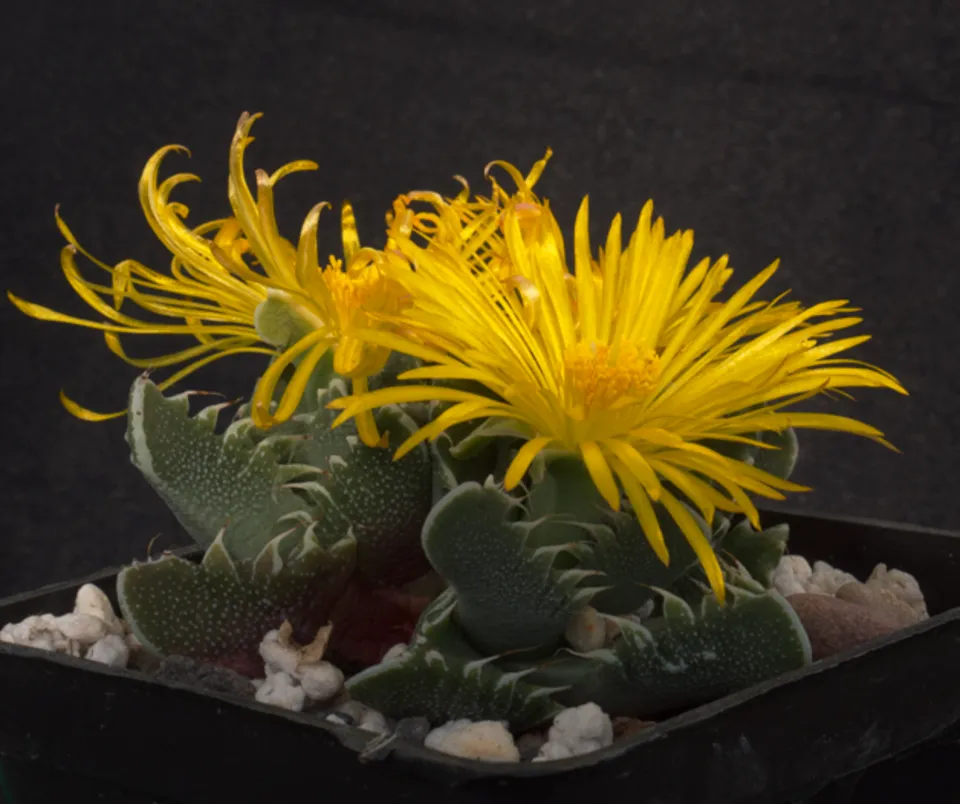
Faucaria tigrina, commonly known as 'Tiger Jaws' or 'Shark Jaws', is a distinctive, low-growing succulent belonging to the Aizoaceae family. This captivating plant is indigenous to the Eastern Cape Province of South Africa, where it thrives within the Albany Thicket vegetation type. Its morphology is characterized by stemless rosettes, typically reaching about 80mm in diameter.
The plant's common name is derived from its unique, fleshy, triangular leaves that grow in opposing pairs and feature prominent, soft, threadlike 'teeth' along their margins, strikingly reminiscent of a carnivorous animal's fangs. These specialized structures are not for defense, but rather an ingenious adaptation to its arid environment, designed to condense atmospheric water vapor from coastal fogs and direct it towards the plant's roots, aiding in moisture acquisition. The leaves themselves can vary in color from vibrant light green to deeper shades of green, or even develop pinkish-red to purple hues under intense sunlight, and are often adorned with small white spots that give them a slightly rough texture.
Older specimens may exhibit a short, woody stem formed by persistent dried leaves.
Flowering occurs primarily from autumn through winter, producing large, solitary, bright yellow, daisy-like blossoms that emerge from the center of the rosette, adding a striking contrast to the foliage. Following successful pollination, the plant develops hard, characteristic fruit capsules typical of the Aizoaceae family, containing numerous tiny seeds. Historically, Faucaria tigrina was first documented in 1789 by Francis Masson and later identified as a new species by Adrian Haworth.
While primarily valued for its ornamental appeal in horticulture, particularly in xeriscaping and succulent collections globally, its conservation status is a concern. It is listed as Endangered in the Red List of South African Plants, facing threats from urban development and over-grazing in its restricted natural habitat.
Trusted Scientific References
1. Authoritative external sources for Faucaria tigrina
1.1 Wikipedia — Faucaria tigrina
1.2 Kew POWO (Plants of the World Online)
1.3 PubMed — peer-reviewed research
1.4 NCBI Taxonomy Browser
1.5 GBIF — Global Biodiversity
1.1.Faucaria Tigrina — Key Features
- ✓ <strong>Botanical Name</strong> — *Faucaria tigrina* (Haw.) Schwantes.
- ✓ <strong>Common Names</strong> — Tiger's Jaw, Shark's Jaws, Tierbekvygie.
- ✓ <strong>Family</strong> — Aizoaceae (commonly known as the stone plant or ice plant family).
- ✓ <strong>Native Region</strong> — Eastern Cape Province, South Africa.
- ✓ <strong>Leaf Morphology</strong> — Fleshy, triangular leaves with soft, threadlike marginal teeth.
- ✓ <strong>Flower Characteristics</strong> — Large, bright yellow, solitary flowers blooming in autumn and winter.
- ✓ <strong>Growth Habit</strong> — Small, stemless, clumping succulent forming dense rosettes.
- ✓ <strong>Drought Tolerance</strong> — Exceptionally well-adapted to arid and semi-arid conditions.
- ✓ <strong>Conservation Status</strong> — Listed as Endangered on the Red List of South African Plants.
- ✓ <strong>Ornamental Appeal</strong> — Highly prized for its unique aesthetics in succulent collections and arid garden designs.
1.2.Faucaria Tigrina — Quick Summary
- ✓ Unique 'Tiger Jaws' Appearance — Distinctive triangular leaves with prominent teeth.
- ✓ Native to South Africa — Endemic to the Eastern Cape, thriving in arid thickets.
- ✓ Highly Valued Ornamentally — A popular succulent for collectors and xeriscaping.
- ✓ Endangered Species — Faces significant threats in its natural habitat.
- ✓ Minimal Medicinal Research — Primarily ornamental with unexplored therapeutic potential.
- ✓ Adaptations for Arid Survival — Leaf structures aid in atmospheric moisture collection.
2.Faucaria Tigrina — Scientific Identity
3.Faucaria Tigrina — Quick Facts
4.Faucaria Tigrina — Appearance & Identification
5.Faucaria Tigrina — Native Habitat
6.Faucaria Tigrina — Water Requirements
- ✓ Seed Propagation — Sow seeds in autumn using a specialized mix of two parts sterilized potting soil, one part 3mm sieved pumice, and one part sand.
- ✓ Soil Preparation — Heat the soil mixture at 70°C for two hours, then allow it to rest for a week before sowing for optimal sterilization.
- ✓ Watering Seedlings — Water germinating seedlings twice daily with a fine mist, optionally with diluted fertilizer, and maintain humidity with a plastic cover initially.
- ✓ Established Plant Watering — Once established, water lightly but frequently, ensuring the soil dries slightly between waterings to prevent prolonged dampness.
- ✓ Winter Care — During winter dormancy, reduce watering to very occasional and light applications, primarily for dusting and deterring red spiders.
- ✓ Optimal Soil for Mature Plants — Use a well-draining medium for mature plants, typically two parts loam, one part coarse sand, and one part pumice.
- ✓ Pest Management — Mist plants daily to deter red spiders; mulch seedlings with grit to prevent burrowing insects and algae; consider systemic insecticide twice a year as a preventative measure.
- ✓ Fungal Prevention — Ensure good air circulation and correct watering to prevent fungal issues; promptly cut off any rotting plant parts to prevent spread.
Reviewed by the Flora Medical Global Botanical Review Panel
Multi-disciplinary editorial group · Botany · Ethnobotany · Herbal-medicine literature
Who reviewed this: This page was checked by the Flora Medical Global Botanical Review Panel — an in-house editorial group of botany graduates, ethnobotany researchers, and horticulture practitioners who collectively maintain our 7,000+ plant encyclopedia. Meet the team.
Our 4-step verification process
1. Taxonomic verification
Scientific names and synonyms cross-checked against Kew POWO, World Flora Online, and The Plant List.
2. Phytochemical & medicinal cross-reference
Active compounds, traditional uses, and reported activities are cross-referenced with PubMed, USDA Dr. Duke's database, and peer-reviewed ethnobotanical literature.
3. Conservation & distribution check
Distribution, ecology, and conservation status confirmed against GBIF occurrence records and the IUCN Red List.
4. Editorial & safety review
Every entry passes an editorial pass for clarity, originality, and safety notices (toxicity, contraindications, dosage caveats) before publication.
Last reviewed:
Editorial Note: This page is for educational and plant care purposes only.
Written by: Flora Medical Global Editorial Team
Reviewed by: Flora Medical Global Botanical Review Panel
Last Updated: June 15, 2026







Faucaria Tigrina — Comments & Community Reviews
Rate this plant