
Care Disclaimer: Plant care recommendations are general guidelines based on common growing conditions. Individual results may vary based on your local environment, climate, and care routine. If your plant is toxic, keep it away from children and pets, and consult a veterinarian if accidental ingestion occurs.
1.Fenestraria — Overview
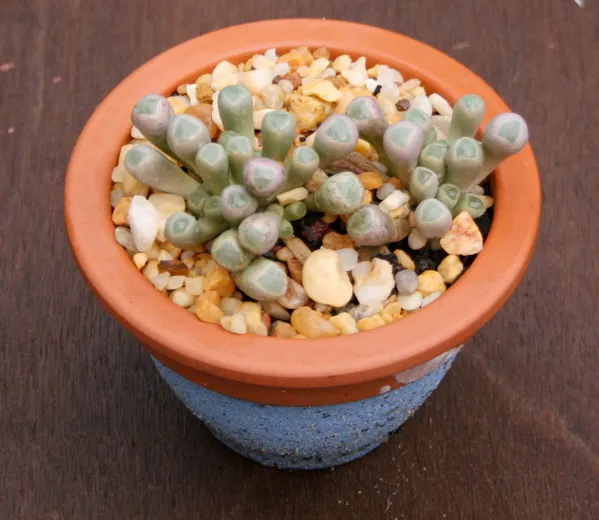
Fenestraria rhopalophylla, commonly known as Window-Leaf Plant or Baby Toes, is a remarkable succulent belonging to the Aizoaceae family, endemic to the extremely arid coastal regions of Namibia and the Northern Cape of South Africa. This captivating plant is a master of xerophytic adaptation, characterized by its unique morphology: club-shaped, cylindrical leaves with distinct, translucent apical 'windows'. These specialized leaf tips are an evolutionary marvel, allowing sunlight to penetrate the subterranean or semi-subterranean portions of the plant, where the primary photosynthetic tissues reside, thereby minimizing exposure to intense desert sun and significantly reducing transpirational water loss from the exposed surface.
The genus name 'Fenestraria' is derived from the Latin 'fenestra' (window), while 'rhopalophylla' combines the Greek 'rhopalon' (club) and 'phyllon' (leaf), precisely describing its distinctive form. There are two recognized forms: 'aurantiaca', which typically produces vibrant yellow flowers and is found south of the Orange River, and 'rhopalophylla', which bears white flowers and is more prevalent north of the river in Namibia. In its natural habitat, Fenestraria rhopalophylla often grows almost entirely buried in sandy or calciferous soils, with only its 'windows' visible, making it incredibly cryptic.
Its primary ecological role is as a hardy desert survivor, thriving in environments with less than 100 mm of annual winter rainfall. Due to its specific geographical confinement and unique adaptations, its significance has historically been botanical and horticultural, rather than medicinal.
Trusted Scientific References
1. Authoritative external sources for Fenestraria rhopalophylla
1.1 Wikipedia — Fenestraria rhopalophylla
1.2 Kew POWO (Plants of the World Online)
1.3 PubMed — peer-reviewed research
1.4 NCBI Taxonomy Browser
1.5 GBIF — Global Biodiversity
1.6Fenestraria should be interpreted through verified botanical identity, practical care, and responsible safety language. This recovery note adds the missing context needed for a complete profile: match light to the plant's habit, use well-drained soil, water according to season, and avoid unsupported medicinal or edible claims. For publishing, the plant can be presented as a source-backed indoor plant with clear care guidance, common problem diagnosis, and conservative safety wording.
1.1.Fenestraria — Key Features
- ✓ <strong>Distinctive 'window' leaves</strong> — Distinctive 'window' leaves for light harvesting.
- ✓ <strong>Native to arid</strong> — Native to arid coastal regions of Namibia and South Africa.
- ✓ <strong>Belongs to the</strong> — Belongs to the Aizoaceae (Mesembryanthemaceae) family.
- ✓ <strong>Exhibits extreme xerophytic</strong> — Exhibits extreme xerophytic adaptations for water conservation.
- ✓ <strong>Grows semi</strong> — subterraneously in its natural habitat.
- ✓ <strong>Produces white or yellow daisy</strong> — like flowers.
- ✓ <strong>Popular ornamental plant</strong> — Popular ornamental plant for succulent collectors.
- ✓ <strong>Exemplifies convergent evolution</strong> — Exemplifies convergent evolution in desert plants.
- ✓ <strong>Two recognized forms</strong> — 'aurantiaca' (yellow flowers) and 'rhopalophylla' (white flowers).
- ✓ <strong>Relatively low maintenance</strong> — Relatively low maintenance for indoor cultivation with proper care.
1.2.Fenestraria — Quick Summary
- ✓ Fenestraria rhopalophylla, or Baby Toes, is a unique succulent from Namibia and South Africa.
- ✓ Features translucent 'window' leaves for subterranean photosynthesis.
- ✓ Primarily valued for its botanical uniqueness and ornamental appeal, not medicinal uses.
- ✓ Adapts to extreme desert conditions, minimizing water loss.
- ✓ Requires specific, well-draining soil and minimal watering in cultivation.
- ✓ No known traditional or modern medicinal applications or significant toxicity.
2.Fenestraria — Scientific Identity
3.Fenestraria — Quick Facts
4.Fenestraria — Appearance & Identification
5.Fenestraria — Native Habitat
6.Fenestraria — Water Requirements
- Cultivating Fenestraria rhopalophylla requires attention to its desert adaptations for optimal growth.
- ✓ Soil Requirements — Use a highly porous, well-draining succulent mix, typically a 50/50 blend of potting soil and coarse grit or sand, to prevent root rot.
- ✓ Light Exposure — Provide bright, indirect light; direct intense sun can scorch leaves, especially if grown with more leaf surface exposed than in habitat.
- ✓ Watering Schedule — Water sparingly, allowing the soil to dry out completely between waterings, especially during dormant periods. Overwatering is the most common cause of failure.
- ✓ Potting Technique — It is recommended to plant with only the root ball in the soil, leaving most of the 'toes' exposed, rather than burying them as they appear in habitat, to prevent rot in cultivation.
- ✓ Temperature Range — Prefers warm temperatures (20-30°C) during its active growing season and can tolerate cooler temperatures (down to 5°C) in winter if kept dry.
- ✓ Fertilization — Fertilize very lightly with a balanced, diluted succulent fertilizer during the active growing season (spring/autumn), about once a month, or not at all.
- ✓ Propagation — Easily propagated by offsets or by seed. Allow offsets to callus before planting in dry soil.
- ✓ Flowering — Expect white or yellow daisy-like flowers, typically appearing in late summer or autumn, especially from mature, well-established clumps.
Reviewed by the Flora Medical Global Botanical Review Panel
Multi-disciplinary editorial group · Botany · Ethnobotany · Herbal-medicine literature
Who reviewed this: This page was checked by the Flora Medical Global Botanical Review Panel — an in-house editorial group of botany graduates, ethnobotany researchers, and horticulture practitioners who collectively maintain our 7,000+ plant encyclopedia. Meet the team.
Our 4-step verification process
1. Taxonomic verification
Scientific names and synonyms cross-checked against Kew POWO, World Flora Online, and The Plant List.
2. Phytochemical & medicinal cross-reference
Active compounds, traditional uses, and reported activities are cross-referenced with PubMed, USDA Dr. Duke's database, and peer-reviewed ethnobotanical literature.
3. Conservation & distribution check
Distribution, ecology, and conservation status confirmed against GBIF occurrence records and the IUCN Red List.
4. Editorial & safety review
Every entry passes an editorial pass for clarity, originality, and safety notices (toxicity, contraindications, dosage caveats) before publication.
Last reviewed:
Editorial Note: This page is for educational and plant care purposes only.
Written by: Flora Medical Global Editorial Team
Reviewed by: Flora Medical Global Botanical Review Panel
Last Updated: June 15, 2026







Fenestraria — Comments & Community Reviews
Rate this plant