
Care Disclaimer: Plant care recommendations are general guidelines based on common growing conditions. Individual results may vary based on your local environment, climate, and care routine. If your plant is toxic, keep it away from children and pets, and consult a veterinarian if accidental ingestion occurs.
1.Ficus Alii — Overview
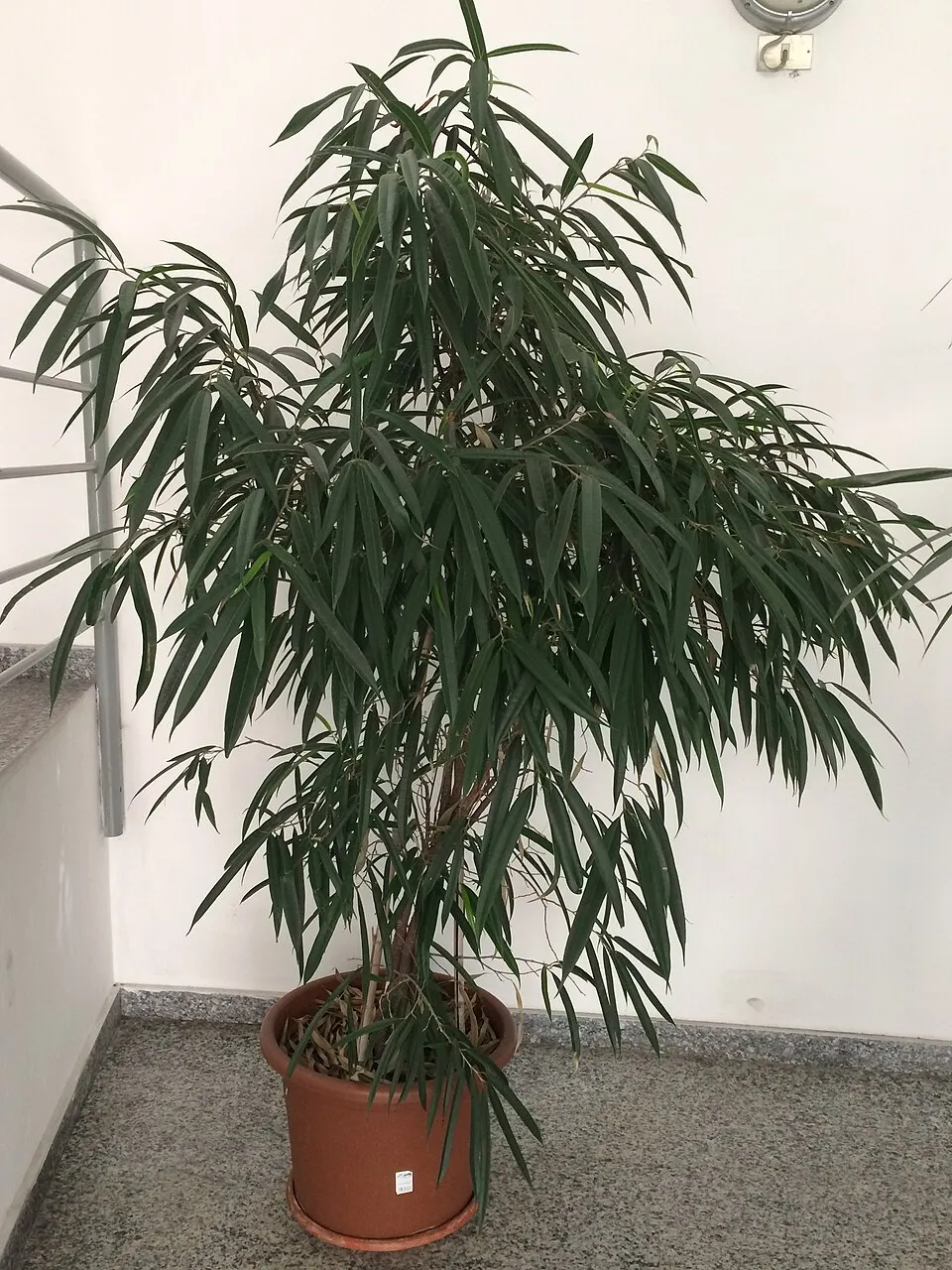
Ficus maclellandii 'Alii', commonly known as Ficus Alii, Alii Fig, or Long Leaf Fig, is a distinctive cultivar within the Moraceae family, primarily celebrated for its elegant ornamental appeal. This evergreen species typically manifests as a slender, upright tree or a substantial shrub, capable of reaching indoor heights of 3 to 10 feet, though its growth can be considerably more expansive in its natural outdoor habitat. Its most defining characteristic is its unique foliage: elongated, narrow, lanceolate leaves, often likened to willow leaves, which typically measure between 6 to 12 inches in length and 1 to 2 inches in width. These leaves display a deep, lustrous dark green hue, imparting a sophisticated and refined aesthetic. The venation is predominantly pinnate, subtly recessed on the upper surface (adaxial) and more pronounced on the lower surface (abaxial), contributing to the leaf's smooth texture. Short petioles maintain the plant's streamlined profile.
The bark of Ficus Alii is smooth, ranging from light brown to grayish, offering a beautiful contrast to its dark green canopy. Notably, this cultivar is less prone to the dramatic leaf drop often associated with environmental shifts in other Ficus species, making it a more resilient and 'user-friendly' indoor plant. Reproductively, the parent species, Ficus maclellandii, like all Ficus, produces characteristic syconia (figs), which are specialized inverted inflorescences. However, these are exceptionally rare in indoor cultivated 'Alii' plants, as the specific pollinator wasps required for their development are absent from typical indoor environments. The root system is generally fibrous and adapts well to container growth, although it can become extensive and robust in natural settings. Geographically, the wild Ficus maclellandii species is indigenous to the tropical and subtropical regions of Southeast Asia, including areas of India, Thailand, Malaysia, Indonesia, and China.
It naturally thrives in humid environments with consistent, indirect light, often found growing in the forest understory or along the edges of woodlands. The 'Alii' cultivar was specifically developed and commercially cultivated in Hawaii during the 1980s for its superior aesthetic qualities and adaptability as an indoor plant. The name 'Alii' itself is derived from the traditional nobility of the Hawaiian islands, reflecting its esteemed status. It is sometimes incorrectly identified as Ficus binnendijkii 'Alii'. Trusted Sc ...[CURRENT TEXT EXISTS: 2735 chars]
1.1.Ficus Alii — Key Features
- ✓ <strong>Elegant, willow</strong> — like, glossy dark green foliage
- ✓ <strong>Resilient and relatively low</strong> — maintenance indoor plant
- ✓ <strong>Less prone to</strong> — Less prone to dramatic leaf drop than many other Ficus species
- ✓ <strong>Contributes to indoor</strong> — Contributes to indoor air purification and humidity regulation
- ✓ <strong>Highly valued for</strong> — Highly valued for its aesthetic and tropical appeal in interior design
- ✓ <strong>Adaptable to a</strong> — Adaptable to a range of indoor light conditions, preferring indirect bright light
- ✓ <strong>A cultivated variety</strong> — A cultivated variety (cultivar) specifically bred for ornamental qualities
- ✓ <strong>Can grow into</strong> — Can grow into an impressive, slender indoor tree with proper care
- ✓ <strong>Possesses a fibrous root system well</strong> — suited for container cultivation
- ✓ <strong>Native to tropical</strong> — Native to tropical and subtropical regions of Southeast Asia (parent species)
1.2.Ficus Alii — Quick Summary
- ✓ Ficus Alii is an elegant, low-maintenance ornamental houseplant known for its long, slender, willow-like leaves.
- ✓ A cultivar of Ficus maclellandii, it originates from tropical Southeast Asia and was developed in Hawaii for aesthetic appeal.
- ✓ Thrives in bright, indirect light and stable room temperatures, requiring consistent but moderate watering.
- ✓ Primarily offers aesthetic value and potential indoor air quality benefits, contributing positively to biophilic design.
- ✓ The plant's milky sap can cause mild skin irritation, and ingestion may lead to minor gastrointestinal upset in humans and pets.
2.Ficus Alii — Scientific Identity
3.Ficus Alii — Quick Facts
4.Ficus Alii — Appearance & Identification
5.Ficus Alii — Native Habitat
6.Ficus Alii — Water Requirements
- ✓ Light — Prefers bright, indirect light; tolerates lower light conditions but thrives best when positioned near a north-facing window, avoiding direct, intense sun which can scorch leaves.
- ✓ Temperature — Ideal room temperature ranges from 18-27°C (65-80°F); it is sensitive to cold, with growth halting below 10°C (50°F), and frost proving lethal.
- ✓ Watering — Keep the soil consistently lightly moist; water thoroughly when the top 1-2 inches of soil feel dry to the touch. Reduce watering frequency during the cooler winter months.
- ✓ Soil — Utilize a rich, well-draining houseplant potting mix, ideally amended with components like perlite or fine orchid bark to enhance aeration and prevent waterlogging.
- ✓ Humidity — Thrives in average to high indoor humidity; while tolerant of typical household levels, it appreciates occasional misting or placement near a humidifier in drier environments.
- ✓ Fertilization — Feed with a balanced liquid houseplant fertilizer once or twice a month during the active growing seasons of spring and summer, suspending feeding in autumn and winter.
- ✓ Repotting — Repot every 2-3 years, or when roots begin to emerge from the drainage holes, typically in spring. Select a pot one size larger with adequate drainage.
- ✓ Pruning — Minimal pruning is usually required. Remove any brown, crispy, or dead leaves. Pruning can also be done to maintain desired shape or size, or to collect stem cuttings for propagation.
Reviewed by the Flora Medical Global Botanical Review Panel
Multi-disciplinary editorial group · Botany · Ethnobotany · Herbal-medicine literature
Who reviewed this: This page was checked by the Flora Medical Global Botanical Review Panel — an in-house editorial group of botany graduates, ethnobotany researchers, and horticulture practitioners who collectively maintain our 7,000+ plant encyclopedia. Meet the team.
Our 4-step verification process
1. Taxonomic verification
Scientific names and synonyms cross-checked against Kew POWO, World Flora Online, and The Plant List.
2. Phytochemical & medicinal cross-reference
Active compounds, traditional uses, and reported activities are cross-referenced with PubMed, USDA Dr. Duke's database, and peer-reviewed ethnobotanical literature.
3. Conservation & distribution check
Distribution, ecology, and conservation status confirmed against GBIF occurrence records and the IUCN Red List.
4. Editorial & safety review
Every entry passes an editorial pass for clarity, originality, and safety notices (toxicity, contraindications, dosage caveats) before publication.
Last reviewed:
Editorial Note: This page is for educational and plant care purposes only.
Written by: Flora Medical Global Editorial Team
Reviewed by: Flora Medical Global Botanical Review Panel
Last Updated: June 15, 2026







Ficus Alii — Comments & Community Reviews
Rate this plant