
Care Disclaimer: Plant care recommendations are general guidelines based on common growing conditions. Individual results may vary based on your local environment, climate, and care routine. If your plant is toxic, keep it away from children and pets, and consult a veterinarian if accidental ingestion occurs.
1.Fittonia White Anne — Overview
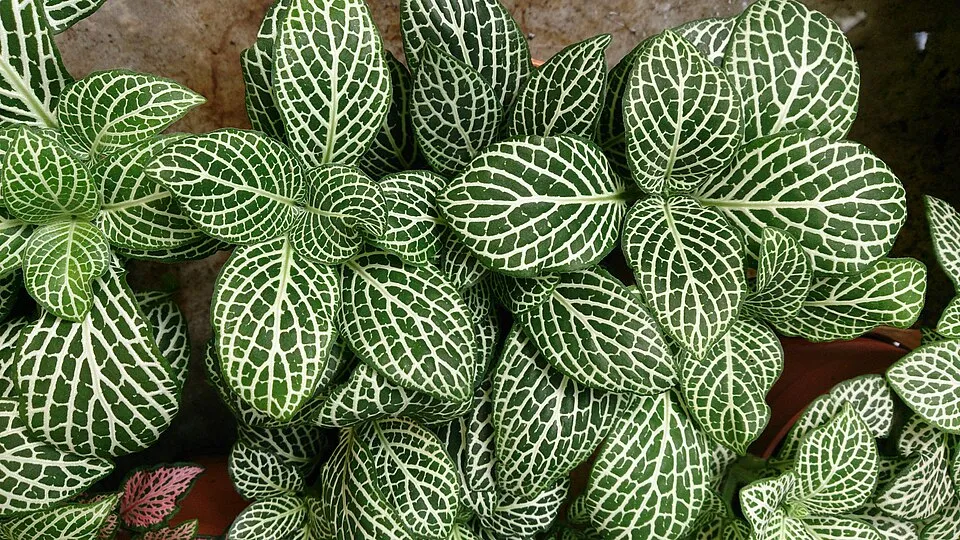
Fittonia White Anne, scientifically known as Fittonia albivenis 'White Anne,' is a distinctive cultivar of the Nerve Plant, belonging to the diverse and widespread Acanthaceae family. This captivating perennial exhibits a low-growing, creeping habit, typically reaching a modest height of 10 to 15 centimeters (4 to 6 inches) and spreading horizontally up to 30 centimeters (12 inches). Its slender, herbaceous stems are somewhat succulent and readily root at nodes where they contact moist soil, contributing to its effective groundcover potential.
The most striking characteristic of Fittonia White Anne is its foliage: ovate to elliptic leaves, approximately 7 to 10 centimeters long and 3 to 5 centimeters wide. These leaves feature a vibrant, deep green base, dramatically contrasted by an intricate, prominent network of bright white or silvery-white veins, which inspired its common names like 'Nerve Plant' or 'Mosaic Plant' and the 'White Anne' epithet. The leaf surface is typically smooth, often displaying a slight puckering along the veins, enhancing its visual appeal.
Unlike many plants, Fittonia albivenis 'White Anne' does not develop robust, woody stems, remaining flexible and herbaceous throughout its life cycle. Its shallow, fibrous root system is well-adapted for nutrient uptake in the humus-rich understory of its native habitat. While primarily cultivated for its ornamental foliage, Fittonia albivenis does produce small, inconspicuous tubular flowers.
These blossoms, ranging from white to pale violet, emerge on slender spikes, but they are generally overshadowed by the plant's highly decorative leaves and are rarely the focus of cultivation. Native to the tropical rainforests of Peru, particularly thriving in the humid, dappled light conditions of the forest floor, Fittonia White Anne is naturally adapted to environments characterized by high humidity, consistent moisture, and indirect light. This ecological background dictates its specific cultivation requirements, making it an ideal and popular choice for terrariums, vivariums, and as an indoor ornamental plant.
Trusted Scientific References
1. Authoritative external sources for Fittonia albivenis white
1.1 Wikipedia — Fittonia albivenis white
1.2 Kew POWO (Plants of the World Online)
1.3 PubMed — peer-reviewed research
1.4 NCBI Taxonomy Browser
1.5 GBIF — Global Biodiversity
1.1.Fittonia White Anne — Key Features
- ✓ <strong>Striking White Veins</strong> — Deep green leaves intricately veined with bright white or silvery-white.
- ✓ <strong>Low</strong> — Growing Habit — Reaches a modest height of 10-15 cm, ideal for groundcover or small spaces.
- ✓ <strong>Creeping Growth Pattern</strong> — Stems spread horizontally and root at nodes, creating a dense mat.
- ✓ <strong>High Humidity Lover</strong> — Thrives in moist, humid environments, perfect for bathrooms or terrariums.
- ✓ <strong>Indirect Light Preference</strong> — Best suited for bright, indirect light conditions, avoiding direct sun.
- ✓ <strong>Non</strong> — Toxic to Pets — Safe for households with cats, dogs, and other common pets.
- ✓ <strong>Herbaceous Stems</strong> — Flexible, non-woody stems that contribute to its spreading nature.
- ✓ <strong>Shallow Fibrous Roots</strong> — Adapted for surface nutrient uptake in its native habitat.
- ✓ <strong>Ornamental Foliage</strong> — Primarily cultivated for its decorative leaf patterns rather than flowers.
- ✓ <strong>Terrarium & Vivarium Favorite</strong> — Excellent choice for enclosed environments due to specific needs.
1.2.Fittonia White Anne — Quick Summary
- ✓ Fittonia 'White Anne' is a stunning tropical houseplant known for its distinctive white-veined foliage.
- ✓ It thrives in high humidity and indirect light, making it perfect for terrariums and indoor spaces.
- ✓ This low-growing, creeping perennial is non-toxic to pets and humans, enhancing its appeal as an ornamental.
- ✓ Regular watering and pinching promote a bushy, vibrant appearance.
- ✓ Primarily valued for aesthetic and indirect environmental benefits, not traditional medicinal uses.
2.Fittonia White Anne — Scientific Identity
3.Fittonia White Anne — Quick Facts
4.Fittonia White Anne — Appearance & Identification
5.Fittonia White Anne — Native Habitat
6.Fittonia White Anne — Water Requirements
- ✓ High Humidity — Maintain consistently high ambient humidity, ideally above 60%, to mimic its native rainforest environment; misting or pebble trays can be beneficial.
- ✓ Indirect Light — Provide bright, indirect light; direct sunlight will scorch the delicate leaves of Fittonia White Anne, while too little light can cause leggy growth and dull coloration.
- ✓ Consistent Moisture — Keep the soil consistently moist but not waterlogged; Fittonia albivenis is prone to dramatic wilting if allowed to dry out completely, though it often recovers quickly after watering.
- ✓ Well-Drained Soil — Use a light, well-draining potting mix rich in organic matter to prevent root rot, ensuring aeration while retaining adequate moisture.
- ✓ Warm Temperatures — Thrive in average to warm room temperatures, ideally between 18-24°C (65-75°F); avoid cold drafts or sudden temperature fluctuations.
- ✓ Pinching for Bushiness — Regularly pinch back the stem tips to encourage a bushier, more compact growth habit and prevent the plant from becoming leggy.
- ✓ Shallow Root System — Due to its shallow roots, Fittonia White Anne can be maintained in relatively small pots or used effectively as a groundcover in larger containers.
- ✓ Fertilization — Feed sparingly during the growing season (spring and summer) with a diluted balanced liquid fertilizer, reducing frequency in cooler months.
Reviewed by the Flora Medical Global Botanical Review Panel
Multi-disciplinary editorial group · Botany · Ethnobotany · Herbal-medicine literature
Who reviewed this: This page was checked by the Flora Medical Global Botanical Review Panel — an in-house editorial group of botany graduates, ethnobotany researchers, and horticulture practitioners who collectively maintain our 7,000+ plant encyclopedia. Meet the team.
Our 4-step verification process
1. Taxonomic verification
Scientific names and synonyms cross-checked against Kew POWO, World Flora Online, and The Plant List.
2. Phytochemical & medicinal cross-reference
Active compounds, traditional uses, and reported activities are cross-referenced with PubMed, USDA Dr. Duke's database, and peer-reviewed ethnobotanical literature.
3. Conservation & distribution check
Distribution, ecology, and conservation status confirmed against GBIF occurrence records and the IUCN Red List.
4. Editorial & safety review
Every entry passes an editorial pass for clarity, originality, and safety notices (toxicity, contraindications, dosage caveats) before publication.
Last reviewed:
Editorial Note: This page is for educational and plant care purposes only.
Written by: Flora Medical Global Editorial Team
Reviewed by: Flora Medical Global Botanical Review Panel
Last Updated: June 15, 2026







Fittonia White Anne — Comments & Community Reviews
Rate this plant