
Care Disclaimer: Plant care recommendations are general guidelines based on common growing conditions. Individual results may vary based on your local environment, climate, and care routine. If your plant is toxic, keep it away from children and pets, and consult a veterinarian if accidental ingestion occurs.
1.Frithia Pulchra — Overview
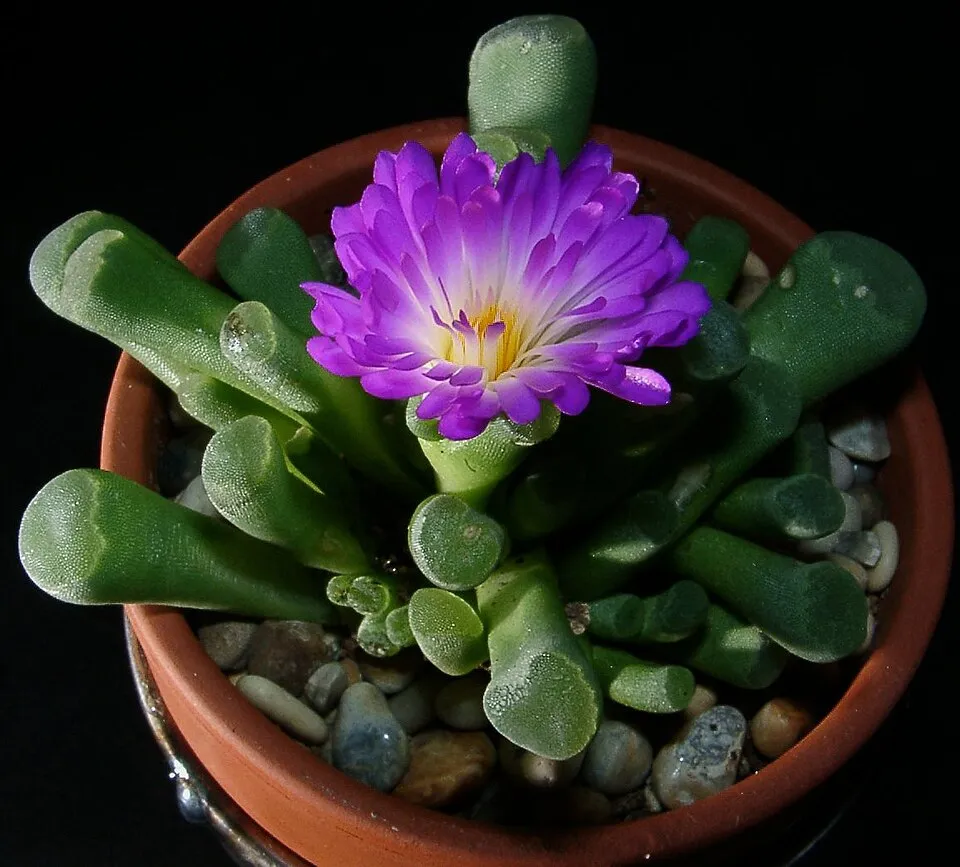
Frithia pulchra, commonly known as 'Fairy Elephant's Feet' or 'Purple Baby Tears', is a captivating succulent subshrub native to the arid and rocky slopes of Gauteng Province, South Africa. This diminutive plant typically reaches a modest height of 3 to 4 inches (approximately 7-10 centimeters) and spreads about 7 to 8 inches (18-20 centimeters) wide, forming a compact, stemless rosette. Its most striking feature is its thick, cylindrical leaves, which can extend up to 5 centimeters in length. The leaves are predominantly green but possess remarkable translucent, window-like areas at their tips.
These 'windows' are a specialized adaptation, allowing light to penetrate into the subterranean parts of the leaf, enabling photosynthesis even when the plant is partially buried or during periods of low light intensity, a common survival strategy in its native habitat. When in bloom, usually during late summer or winter, Frithia pulchra produces small, star-shaped flowers that emerge above the foliage. These flowers can vary in color, appearing in shades of yellow, magenta, or white, adding a vibrant contrast to its unique foliage. The plant's fleshy stems contribute to its robust texture, while its bark remains soft and pliable, characteristic of many succulents within the Aizoaceae family.
Phytogeographically, it is a member of the ice plant family, Aizoaceae, a group renowned for its specialized adaptations for water conservation in harsh desert environments. Frithia pulchra is listed as vulnerable in its native habitat, partly due to its ability to shrink below the ground surface to protect itself from desiccation, making it challenging to locate. As an indoor plant, it is valued for its sculptural beauty and low-maintenance requirements, making it a favorite among horticulturists and succulent enthusiasts.
Trusted Scientific References
1. Authoritative external sources for Frithia pulchra
1.1 Wikipedia — Frithia pulchra
1.2 Kew POWO (Plants of the World Online)
1.3 PubMed — peer-reviewed research
1.4 NCBI Taxonomy Browser
1.5 GBIF — Global Biodiversity
1.1.Frithia Pulchra — Key Features
- ✓ <strong>Species</strong> — Frithia pulchra
- ✓ <strong>Common Names</strong> — Fairy Elephant's Feet, Purple Baby Tears
- ✓ <strong>Family</strong> — Aizoaceae (Ice Plant Family)
- ✓ <strong>Native Region</strong> — Gauteng Province, South Africa
- ✓ <strong>Distinctive Feature</strong> — Translucent 'window' tips on leaves for light capture.
- ✓ <strong>Growth Habit</strong> — Small, stemless succulent subshrub, forming rosettes.
- ✓ <strong>Flower Color</strong> — Star-shaped yellow, magenta, or white flowers, often blooming in winter.
- ✓ <strong>Water Needs</strong> — Highly drought-tolerant; susceptible to root rot with overwatering.
- ✓ <strong>Light Needs</strong> — Prefers bright, indirect light; avoid intense direct sun.
- ✓ <strong>Toxicity</strong> — Non-toxic to humans, dogs, cats, and horses.
1.2.Frithia Pulchra — Quick Summary
- ✓ Unique South African succulent known for its translucent 'window' leaf tips.
- ✓ Primarily cultivated as an ornamental houseplant for its aesthetic appeal.
- ✓ Requires extremely well-draining soil and careful, infrequent watering to prevent root rot.
- ✓ Documented as non-toxic to humans and common household pets like dogs and cats.
- ✓ Currently, there are no established traditional or modern medicinal uses for this plant.
- ✓ Listed as vulnerable in its native habitat, emphasizing its conservation importance.
2.Frithia Pulchra — Scientific Identity
3.Frithia Pulchra — Quick Facts
4.Frithia Pulchra — Appearance & Identification
5.Frithia Pulchra — Native Habitat
6.Frithia Pulchra — Water Requirements
- ✓ Potting Medium — Requires an extremely well-draining succulent or cactus potting mix, often amended with additional perlite, pumice, or coarse sand to ensure rapid water runoff and aeration.
- ✓ Container Size — Use small pots that closely match the plant's root ball dimensions; oversized containers retain excess moisture, increasing the risk of root rot.
- ✓ Watering Regimen — Water thoroughly only when the soil is completely dry during the active growing season (spring to autumn); significantly reduce or cease watering during its winter dormancy.
- ✓ Light Requirements — Thrives in bright, indirect sunlight; protect from intense, direct afternoon sun, which can scorch its delicate leaves, or provide partial shade in very hot climates.
- ✓ Temperature and Humidity — Maintain warm temperatures, ideally between 18-28°C (65-82°F); it is highly sensitive to frost and extreme cold, requiring protection, and tolerates average indoor humidity.
- ✓ Fertilization — During the active growing season, feed every 2-3 weeks with a diluted, low-nitrogen liquid fertilizer specifically formulated for succulents to support healthy growth and flowering.
- ✓ Propagation — Can be propagated effectively through the division of offsets or by sowing seeds, with specific germination requirements often needed for successful propagation.
- ✓ Pest and Disease Management — Generally robust, but susceptible to root rot from overwatering; monitor for common succulent pests like mealybugs or spider mites, treating promptly with appropriate methods if observed.
Reviewed by the Flora Medical Global Botanical Review Panel
Multi-disciplinary editorial group · Botany · Ethnobotany · Herbal-medicine literature
Who reviewed this: This page was checked by the Flora Medical Global Botanical Review Panel — an in-house editorial group of botany graduates, ethnobotany researchers, and horticulture practitioners who collectively maintain our 7,000+ plant encyclopedia. Meet the team.
Our 4-step verification process
1. Taxonomic verification
Scientific names and synonyms cross-checked against Kew POWO, World Flora Online, and The Plant List.
2. Phytochemical & medicinal cross-reference
Active compounds, traditional uses, and reported activities are cross-referenced with PubMed, USDA Dr. Duke's database, and peer-reviewed ethnobotanical literature.
3. Conservation & distribution check
Distribution, ecology, and conservation status confirmed against GBIF occurrence records and the IUCN Red List.
4. Editorial & safety review
Every entry passes an editorial pass for clarity, originality, and safety notices (toxicity, contraindications, dosage caveats) before publication.
Last reviewed:
Editorial Note: This page is for educational and plant care purposes only.
Written by: Flora Medical Global Editorial Team
Reviewed by: Flora Medical Global Botanical Review Panel
Last Updated: June 15, 2026







Frithia Pulchra — Comments & Community Reviews
Rate this plant