
Care Disclaimer: Plant care recommendations are general guidelines based on common growing conditions. Individual results may vary based on your local environment, climate, and care routine. If your plant is toxic, keep it away from children and pets, and consult a veterinarian if accidental ingestion occurs.
1.Gibbaeum Heathii — Overview
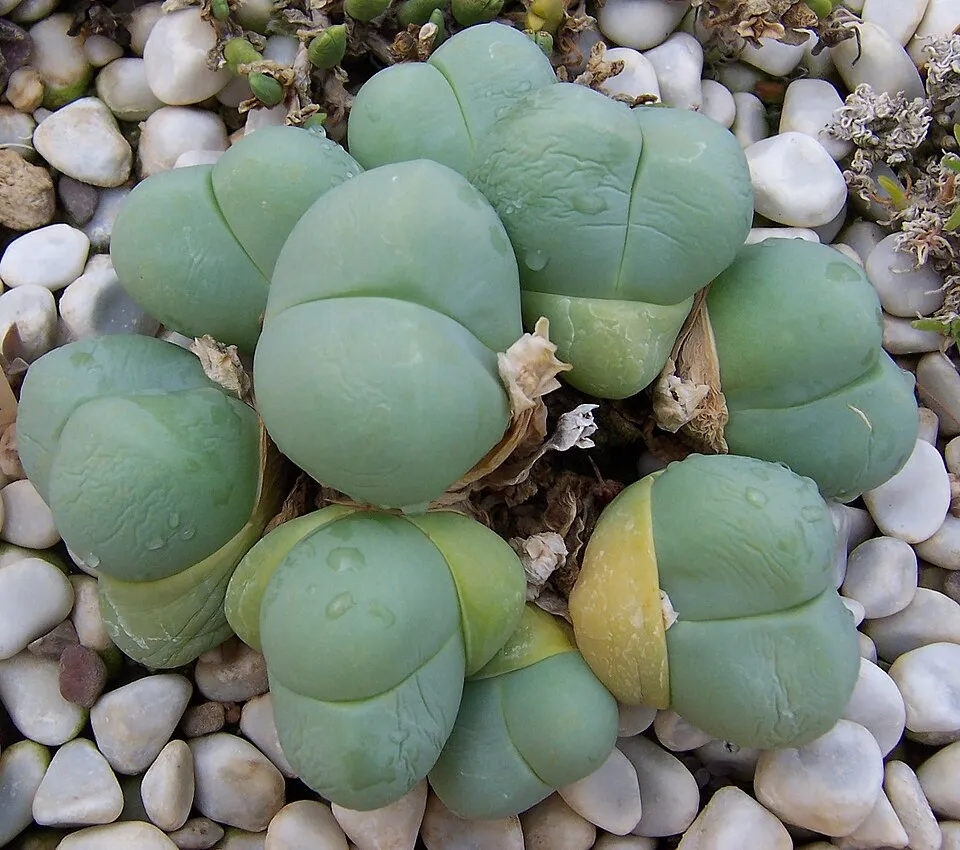
Gibbaeum heathii, commonly known as the South African plant or sometimes referred to as Gibbaeum comptonii, is a distinctive succulent native to the arid regions of the Western Cape in South Africa. This charming member of the Aizoaceae family, which is known for its adaptation to harsh, dry environments, typically forms compact rosettes, reaching a modest height of 10 to 15 cm.
Its unique morphology features fleshy, ovate leaves, usually 2 to 5 cm in length, exhibiting a captivating grayish-green hue that can develop reddish tints under stress or strong sunlight. The leaves are often fused at the base, giving the plant a 'pebble' or 'living stone' appearance, a characteristic adaptation for moisture retention and camouflage in its rocky habitat.
During mid to late summer, Gibbaeum heathii produces delicate, tubular flowers that emerge from between the leaves. These blossoms typically range from pale yellow to creamy white, adding a subtle splash of color and attracting various pollinators in its natural environment. The stems are robust yet often appear partially hidden by the dense foliage, and their surface can feel slightly bumpy or textured.
Thriving in well-drained, mineral-rich soils, this resilient succulent is perfectly adapted to desert-like conditions, making it a popular choice for xeriscaping and indoor cultivation among succulent enthusiasts. Its ability to endure periods of neglect, coupled with its intriguing form, makes Gibbaeum heathii a fascinating botanical specimen.
Trusted Scientific References
1. Authoritative external sources for Gibbaeum heathii
1.1 Wikipedia — Gibbaeum heathii
1.2 Kew POWO (Plants of the World Online)
1.3 PubMed — peer-reviewed research
1.4 NCBI Taxonomy Browser
1.5 GBIF — Global Biodiversity
1.6Gibbaeum Heathii should be interpreted through verified botanical identity, practical care, and responsible safety language. This recovery note adds the missing context needed for a complete profile: match light to the plant's habit, use well-drained soil, water according to season, and avoid unsupported medicinal or edible claims. For publishing, the plant can be presented as a source-backed indoor plant with clear care guidance, common problem diagnosis, and conservative safety wording.
1.1.Gibbaeum Heathii — Key Features
- ✓ <strong>Fleshy, ovate, grayish</strong> — green leaves, often fused at the base.
- ✓ <strong>Compact, rosette growth</strong> — Compact, rosette growth habit, resembling pebbles or stones.
- ✓ <strong>Native to the</strong> — Native to the Western Cape region of South Africa.
- ✓ <strong>Highly drought</strong> — tolerant, adapted to arid environments.
- ✓ <strong>Produces pale yellow</strong> — Produces pale yellow to creamy white tubular flowers in summer.
- ✓ <strong>Belongs to the</strong> — Belongs to the Aizoaceae family (Mesembryanthemaceae).
- ✓ <strong>Prized for its</strong> — Prized for its unique ornamental and aesthetic qualities.
- ✓ <strong>Contains phytochemicals such</strong> — Contains phytochemicals such as alkaloids, flavonoids, and terpenoids.
- ✓ <strong>Ideal for succulent</strong> — Ideal for succulent collections, rock gardens, and xeriscaping.
- ✓ <strong>Requires bright, direct sunlight and well</strong> — draining soil.
1.2.Gibbaeum Heathii — Quick Summary
- ✓ Unique South African succulent, Gibbaeum heathii, known for its distinctive 'living stone' appearance.
- ✓ Primarily valued for its ornamental appeal and resilience in arid conditions.
- ✓ Belongs to the Aizoaceae family, adapted for water retention and camouflage.
- ✓ Contains general plant compounds like alkaloids, flavonoids, and terpenoids, with no specific medicinal uses documented.
- ✓ Contributes to psychological well-being and aesthetic enhancement as an indoor plant.
- ✓ Requires bright light and minimal watering, challenging for novice growers.
2.Gibbaeum Heathii — Scientific Identity
3.Gibbaeum Heathii — Quick Facts
4.Gibbaeum Heathii — Appearance & Identification
5.Gibbaeum Heathii — Native Habitat
6.Gibbaeum Heathii — Water Requirements
- ✓ Soil Requirements — Utilize a highly porous, well-draining potting mix specifically formulated for succulents and cacti, typically composed of pumice, perlite, coarse sand, and a small amount of organic matter.
- ✓ Light Exposure — Provide ample bright, direct sunlight for at least 6 hours daily; a south-facing window is ideal for indoor cultivation to maximize growth and flowering potential.
- ✓ Watering Schedule — Water sparingly and deeply only when the soil is completely dry, typically every 10-14 days during the active growing season (fall to spring), and significantly reduce watering in summer dormancy.
- ✓ Temperature & Humidity — Maintain warm temperatures between 18-28°C (65-82°F) and low humidity, mimicking its native arid environment; protect from frost.
- ✓ Fertilization — Fertilize minimally with a diluted, low-nitrogen succulent fertilizer once or twice during the active growing season (fall/winter), avoiding over-fertilization.
- ✓ Potting & Repotting — Repot every 1-2 years or when the plant has significantly outgrown its container, opting for a pot only slightly larger than the root ball to prevent excess moisture.
- ✓ Propagation — Propagate primarily from seeds, which can be challenging, or occasionally from offsets if the plant produces them, allowing cuttings to callus before planting.
- ✓ Air Circulation — Ensure good air circulation around the plant to prevent fungal issues, especially in humid environments.
Reviewed by the Flora Medical Global Botanical Review Panel
Multi-disciplinary editorial group · Botany · Ethnobotany · Herbal-medicine literature
Who reviewed this: This page was checked by the Flora Medical Global Botanical Review Panel — an in-house editorial group of botany graduates, ethnobotany researchers, and horticulture practitioners who collectively maintain our 7,000+ plant encyclopedia. Meet the team.
Our 4-step verification process
1. Taxonomic verification
Scientific names and synonyms cross-checked against Kew POWO, World Flora Online, and The Plant List.
2. Phytochemical & medicinal cross-reference
Active compounds, traditional uses, and reported activities are cross-referenced with PubMed, USDA Dr. Duke's database, and peer-reviewed ethnobotanical literature.
3. Conservation & distribution check
Distribution, ecology, and conservation status confirmed against GBIF occurrence records and the IUCN Red List.
4. Editorial & safety review
Every entry passes an editorial pass for clarity, originality, and safety notices (toxicity, contraindications, dosage caveats) before publication.
Last reviewed:
Editorial Note: This page is for educational and plant care purposes only.
Written by: Flora Medical Global Editorial Team
Reviewed by: Flora Medical Global Botanical Review Panel
Last Updated: June 15, 2026







Gibbaeum Heathii — Comments & Community Reviews
Rate this plant