
Care Disclaimer: Plant care recommendations are general guidelines based on common growing conditions. Individual results may vary based on your local environment, climate, and care routine. If your plant is toxic, keep it away from children and pets, and consult a veterinarian if accidental ingestion occurs.
1.Heliamphora — Overview
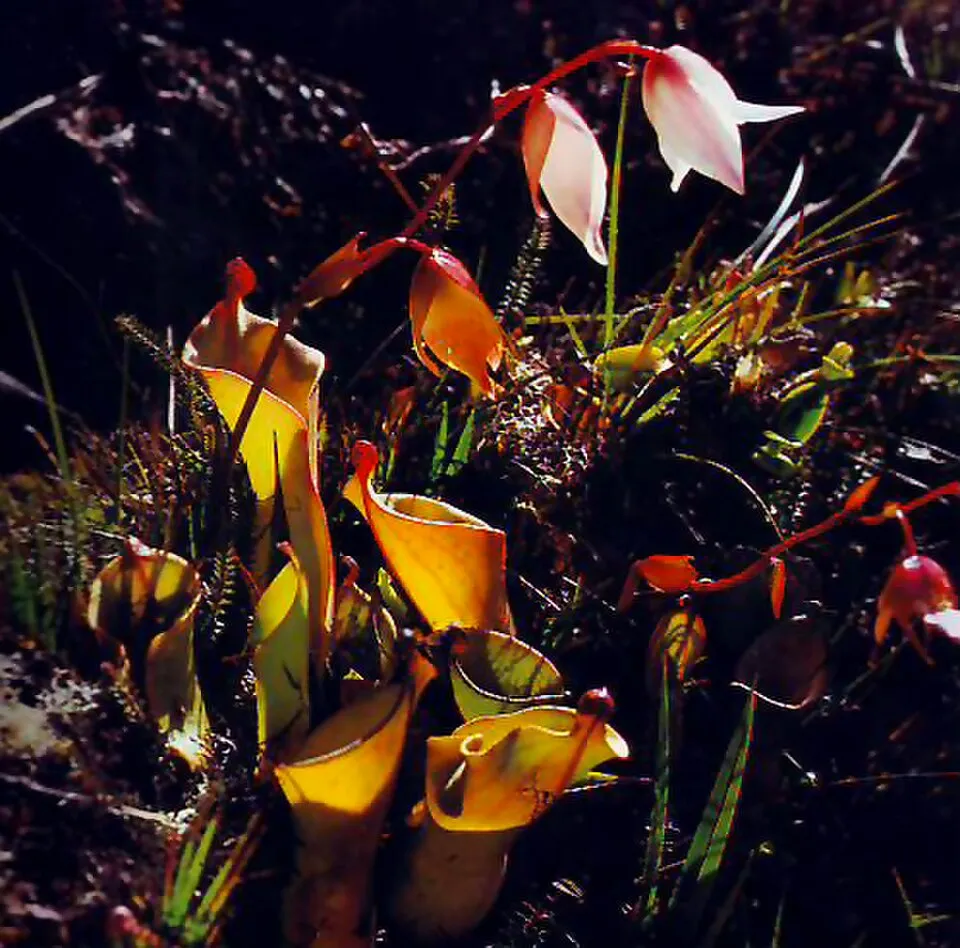
Heliamphora nutans, commonly known as the marsh pitcher plant or sun pitcher, is a captivating carnivorous species belonging to the family Sarraceniaceae. This remarkable plant typically reaches heights of up to 30 centimeters, though its elongated, tubular leaves, forming a distinctive rosette, can extend up to 40 centimeters.
These vibrant green pitchers often develop reddish hues when exposed to intense sunlight, contributing to their allure. The upper portion of each pitcher flares into a cup-like structure, which serves as an ingenious trap for insects.
Its inflorescences are equally striking, producing delicate, nodding white to pale lavender flowers, usually observed during the summer months. The specific epithet "nutans" itself means 'nodding' in Latin, referring to its characteristic flower presentation.
Heliamphora nutans thrives in the unique, nutrient-poor, acidic soils characteristic of the wet, tropical highlands (tepuis) found along the border regions of Venezuela, Brazil, and Guyana. Notable habitats include Mount Roraima, Kukenán, and Yuruaní tepuis, where it forms a crucial part of the bog-like ecosystems.
First discovered in 1839 on Mount Roraima by the Schomburgk brothers and formally described by George Bentham in 1840, H. nutans holds the distinction of being the type species for its genus.
Its specialized adaptations, including an 'aquaplaning' trapping mechanism where prey slips into the pitchers on downward-pointing, slippery hairs, highlight its evolutionary success in low-nutrient environments. Beyond its visual appeal, Heliamphora nutans plays a vital ecological role by naturally controlling insect populations in its pristine, remote habitats.
Trusted Scientific References
1. Authoritative external sources for Heliamphora nutans
1.1 Wikipedia — Heliamphora nutans
1.2 Kew POWO (Plants of the World Online)
1.3 PubMed — peer-reviewed research
1.4 NCBI Taxonomy Browser
1.5 GBIF — Global Biodiversity
1.6Heliamphora should be interpreted through verified botanical identity, practical care, and responsible safety language. This recovery note adds the missing context needed for a complete profile: match light to the plant's habit, use well-drained soil, water according to season, and avoid unsupported medicinal or edible claims. For publishing, the plant can be presented as a source-backed indoor plant with clear care guidance, common problem diagnosis, and conservative safety wording.
1.1.Heliamphora — Key Features
- ✓ <strong>Carnivorous Adaptation</strong> — Features unique pitcher-shaped leaves for trapping insects.
- ✓ <strong>Tepui Endemic</strong> — Native to the isolated, high-altitude plateaus (tepuis) of Venezuela, Brazil, and Guyana.
- ✓ <strong>Aquaplaning Trap</strong> — Employs a slippery, downward-pointing hair mechanism for prey capture.
- ✓ <strong>Rosette Growth Habit</strong> — Leaves form a distinctive basal rosette structure.
- ✓ <strong>Vibrant Coloration</strong> — Pitchers often display green with reddish hues under strong light.
- ✓ <strong>Delicate Flowers</strong> — Produces nodding white to pale lavender flowers during summer.
- ✓ <strong>Acidic Soil Specialist</strong> — Thrives in highly acidic, nutrient-poor, bog-like environments.
- ✓ <strong>Sarraceniaceae Family</strong> — Belongs to the North American pitcher plant family, despite its South American origin.
- ✓ <strong>Type Species</strong> — Heliamphora nutans is the first and best-known species of its genus.
- ✓ <strong>Ecological Role</strong> — Contributes to natural insect control in its native habitat.
1.2.Heliamphora — Quick Summary
- ✓ Carnivorous pitcher plant from South American tepuis.
- ✓ Traps insects using specialized pitcher leaves.
- ✓ Requires high humidity, bright light, and acidic, nutrient-poor soil.
- ✓ Valued for ornamental, educational, and bioprospecting purposes.
- ✓ No established traditional medicinal uses; focus is on ecological role and research potential.
- ✓ Conservation of its unique habitat is crucial for its survival.
2.Heliamphora — Scientific Identity
3.Heliamphora — Quick Facts
4.Heliamphora — Appearance & Identification
5.Heliamphora — Native Habitat
6.Heliamphora — Water Requirements
- ✓ Substrate Requirements — Use a highly acidic, nutrient-poor, well-draining potting mix, typically a blend of long-fiber sphagnum moss and perlite or coarse sand (e.g., 1:1 ratio).
- ✓ Water Quality — Water with distilled water, reverse osmosis water, or rainwater exclusively; tap water with high mineral content is detrimental.
- ✓ High Humidity — Maintain high humidity levels, ideally above 70%, which is critical for its health and proper pitcher development.
- ✓ Bright Light — Provide very bright, indirect light for at least 12-14 hours daily; direct, intense sunlight can scorch leaves without adequate humidity.
- ✓ Temperature Control — Keep daytime temperatures between 18-28°C (65-82°F) and nighttime temperatures cooler, around 10-18°C (50-65°F), mimicking its highland habitat.
- ✓ Air Circulation — Ensure good air circulation to prevent fungal issues, especially in high humidity environments.
- ✓ Feeding (Optional) — In indoor cultivation, supplemental feeding of small insects (e.g., fruit flies, gnats) once a month can be beneficial but is not strictly necessary if other conditions are met.
- ✓ Repotting — Repot only when necessary, typically every 1-2 years, to refresh the substrate and accommodate growth, being careful with its delicate root system.
Reviewed by the Flora Medical Global Botanical Review Panel
Multi-disciplinary editorial group · Botany · Ethnobotany · Herbal-medicine literature
Who reviewed this: This page was checked by the Flora Medical Global Botanical Review Panel — an in-house editorial group of botany graduates, ethnobotany researchers, and horticulture practitioners who collectively maintain our 7,000+ plant encyclopedia. Meet the team.
Our 4-step verification process
1. Taxonomic verification
Scientific names and synonyms cross-checked against Kew POWO, World Flora Online, and The Plant List.
2. Phytochemical & medicinal cross-reference
Active compounds, traditional uses, and reported activities are cross-referenced with PubMed, USDA Dr. Duke's database, and peer-reviewed ethnobotanical literature.
3. Conservation & distribution check
Distribution, ecology, and conservation status confirmed against GBIF occurrence records and the IUCN Red List.
4. Editorial & safety review
Every entry passes an editorial pass for clarity, originality, and safety notices (toxicity, contraindications, dosage caveats) before publication.
Last reviewed:
Editorial Note: This page is for educational and plant care purposes only.
Written by: Flora Medical Global Editorial Team
Reviewed by: Flora Medical Global Botanical Review Panel
Last Updated: June 15, 2026







Heliamphora — Comments & Community Reviews
Rate this plant