
Care Disclaimer: Plant care recommendations are general guidelines based on common growing conditions. Individual results may vary based on your local environment, climate, and care routine. If your plant is toxic, keep it away from children and pets, and consult a veterinarian if accidental ingestion occurs.
1.Hildewintera Colademononis — Overview
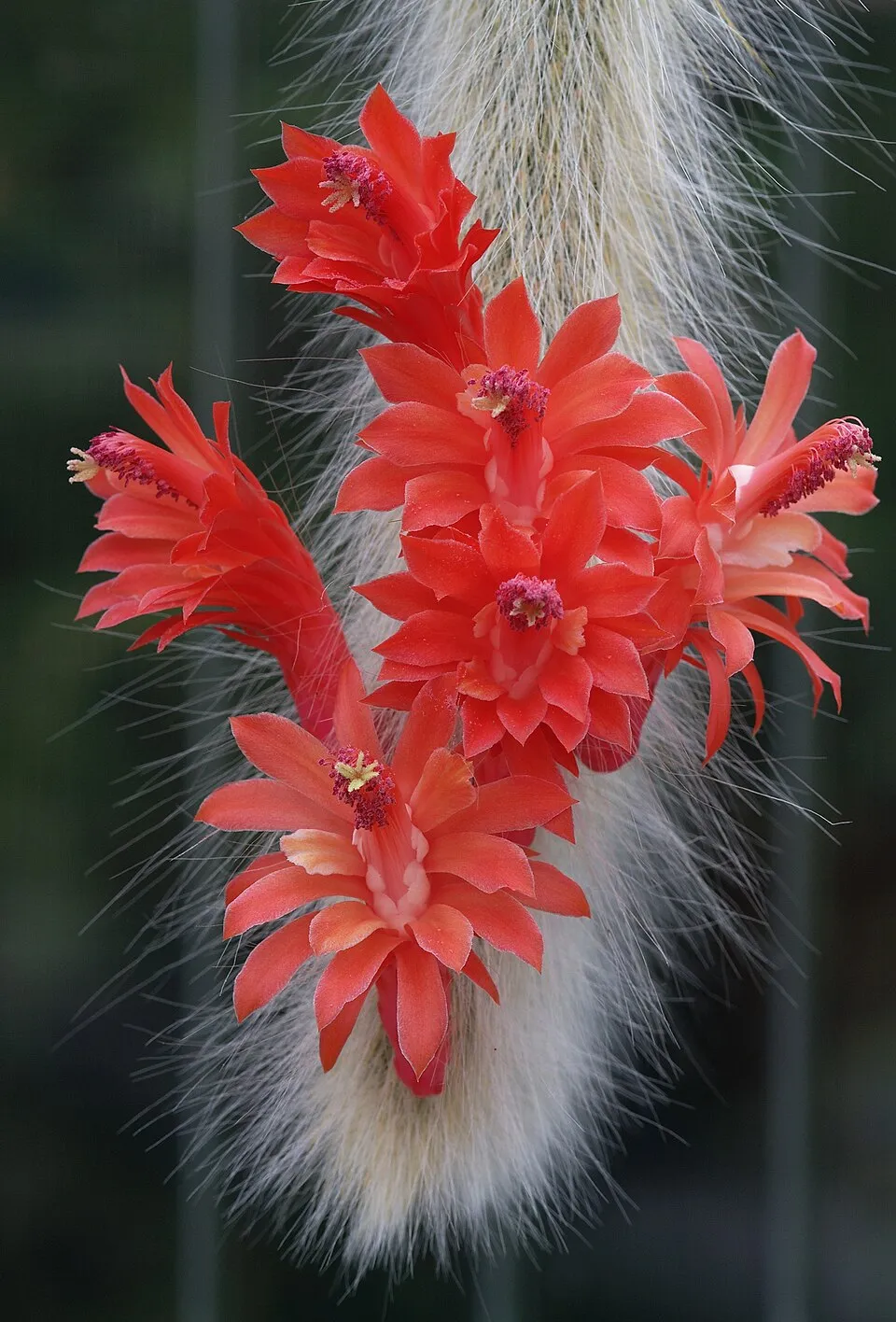
Hildewintera colademononis, widely recognized as the Monkey Tail Cactus, is a captivating member of the Cactaceae family, celebrated for its distinctively pendulous growth habit and characteristic soft, hair-like spines. Originating from the mountainous regions of Bolivia, specifically within the Santa Cruz department, this fascinating plant thrives as an epiphyte or lithophyte, often found gracefully clinging to rocky outcrops or trees in its native arid to semi-arid environments. Its unique morphology is defined by long, cylindrical, segmented stems that can achieve impressive lengths of up to 2.5 meters in mature specimens, sometimes reaching 8 feet in the wild. These stems typically display a vibrant green hue when young, gradually maturing to a more grayish-green or yellow-green with age.
Individual segments are fleshy, ranging from 30 to 60 cm in length and 5 to 7 cm in diameter, becoming increasingly enveloped in dense, flexible, white, hair-like spines. These spines, though appearing soft to the touch, are modified glochids, forming a crucial protective layer against intense sun exposure and potential herbivores. Shallow ridges run vertically along the stems, punctuated by numerous small areoles from which the spines emerge. The floral display of Hildewintera colademononis is particularly striking, producing bright, tubular blooms that are typically a dazzling shade of orange to red, with occasional yellow variations.
These showy flowers, measuring approximately 5 to 7 cm in length, typically emerge in late spring to early summer, often appearing in clusters along the length of the mature stems, adding a vibrant splash of color that can last for days with continuous reblooming. The fruits are small, spherical, and reddish-purple, containing tiny black seeds. Taxonomically, it was initially described as Cleistocactus colademononis but has since been reclassified into the genus Hildewintera, which itself is sometimes considered a subgenus of Cleistocactus, reflecting ongoing phylogenetic studies within the diverse cactus family.
Trusted Scientific References
1. Authoritative external sources for Hildewintera colademononis
1.1 Wikipedia — Hildewintera colademononis
1.2 Kew POWO (Plants of the World Online)
1.3 PubMed — peer-reviewed research
1.4 NCBI Taxonomy Browser
1.5 GBIF — Global Biodiversity
1.1.Hildewintera Colademononis — Key Features
- ✓ <strong>Unique pendulous, cascading</strong> — Unique pendulous, cascading stems resembling a monkey's tail, reaching several feet in length.
- ✓ <strong>Covered in dense, soft, white, hair</strong> — like spines (glochids) that provide a distinctive fuzzy texture.
- ✓ <strong>Produces vibrant, tubular orange</strong> — red to yellow flowers that bloom prolifically from spring to late summer.
- ✓ <strong>Epiphytic or lithophytic</strong> — Epiphytic or lithophytic growth habit, naturally clinging to rocks or trees in its native habitat.
- ✓ <strong>Drought</strong> — tolerant succulent, adapted to store water efficiently within its fleshy stems.
- ✓ <strong>Relatively easy to</strong> — Relatively easy to cultivate as a houseplant or outdoor ornamental in appropriate climates.
- ✓ <strong>Originates from the high</strong> — altitude, mountainous regions of Santa Cruz, Bolivia.
- ✓ <strong>Taxonomically reclassified from</strong> — Taxonomically reclassified from *Cleistocactus* to its current genus, *Hildewintera*.
- ✓ <strong>Excellent choice for</strong> — Excellent choice for hanging baskets, elevated planters, and trailing displays.
- ✓ <strong>Known for its</strong> — Known for its long blooming season, offering continuous bursts of color.
1.2.Hildewintera Colademononis — Quick Summary
- ✓ Iconic Monkey Tail Cactus known for long, pendulous, fuzzy stems and vibrant red-orange flowers.
- ✓ Native to the mountainous regions of Bolivia, growing epiphytically or lithophytically.
- ✓ Primarily an ornamental plant, highly prized for its unique aesthetic and continuous blooming.
- ✓ Requires bright light, well-draining soil, and careful watering to thrive.
- ✓ Considered toxic if ingested by humans or pets; handle with care due to soft but irritating spines.
2.Hildewintera Colademononis — Scientific Identity
3.Hildewintera Colademononis — Quick Facts
4.Hildewintera Colademononis — Appearance & Identification
5.Hildewintera Colademononis — Native Habitat
6.Hildewintera Colademononis — Water Requirements
- ✓ Soil — Use a fast-draining cactus or succulent potting mix; its shallow root system requires excellent aeration and minimal water retention to prevent root rot.
- ✓ Light — Provide bright light, ideally with several hours of direct sunlight. In hotter climates, bright indirect light may be preferred to prevent scorching. Adequate light promotes robust growth and prolific flowering.
- ✓ Water — During the active growing season (spring and summer), water thoroughly when the soil is completely dry. Reduce watering significantly in fall and winter, allowing for longer dry periods to mimic its natural dormancy.
- ✓ Temperature — Thrives in warm temperatures, ideally between 60-80°F (15-27°C). It can tolerate temperatures as low as 20°F (-6°C) for short periods but should be brought indoors before freezing temperatures.
- ✓ Humidity — Tolerates average indoor humidity and can handle higher humidity than many cacti. In humid environments, adjust watering frequency downwards as the plant can absorb some atmospheric moisture.
- ✓ Fertilization — Fertilize lightly once a month during the growing season with a balanced, diluted succulent fertilizer to encourage growth and flowering. Avoid fertilizing during dormancy.
- ✓ Potting — Select a heavy, relatively small, square pot to prevent tipping from the weight of its trailing stems and to avoid excess soil that retains too much moisture. Ensure drainage holes are present.
- ✓ Propagation — Easily propagated from stem cuttings. Allow cut segments to callus for several days before planting them in well-draining soil; humidity can aid root development. Seeds can also be used.
Reviewed by the Flora Medical Global Botanical Review Panel
Multi-disciplinary editorial group · Botany · Ethnobotany · Herbal-medicine literature
Who reviewed this: This page was checked by the Flora Medical Global Botanical Review Panel — an in-house editorial group of botany graduates, ethnobotany researchers, and horticulture practitioners who collectively maintain our 7,000+ plant encyclopedia. Meet the team.
Our 4-step verification process
1. Taxonomic verification
Scientific names and synonyms cross-checked against Kew POWO, World Flora Online, and The Plant List.
2. Phytochemical & medicinal cross-reference
Active compounds, traditional uses, and reported activities are cross-referenced with PubMed, USDA Dr. Duke's database, and peer-reviewed ethnobotanical literature.
3. Conservation & distribution check
Distribution, ecology, and conservation status confirmed against GBIF occurrence records and the IUCN Red List.
4. Editorial & safety review
Every entry passes an editorial pass for clarity, originality, and safety notices (toxicity, contraindications, dosage caveats) before publication.
Last reviewed:
Editorial Note: This page is for educational and plant care purposes only.
Written by: Flora Medical Global Editorial Team
Reviewed by: Flora Medical Global Botanical Review Panel
Last Updated: June 15, 2026







Hildewintera Colademononis — Comments & Community Reviews
Rate this plant