
Care Disclaimer: Plant care recommendations are general guidelines based on common growing conditions. Individual results may vary based on your local environment, climate, and care routine. If your plant is toxic, keep it away from children and pets, and consult a veterinarian if accidental ingestion occurs.
1.Homalomena Rubescens — Overview
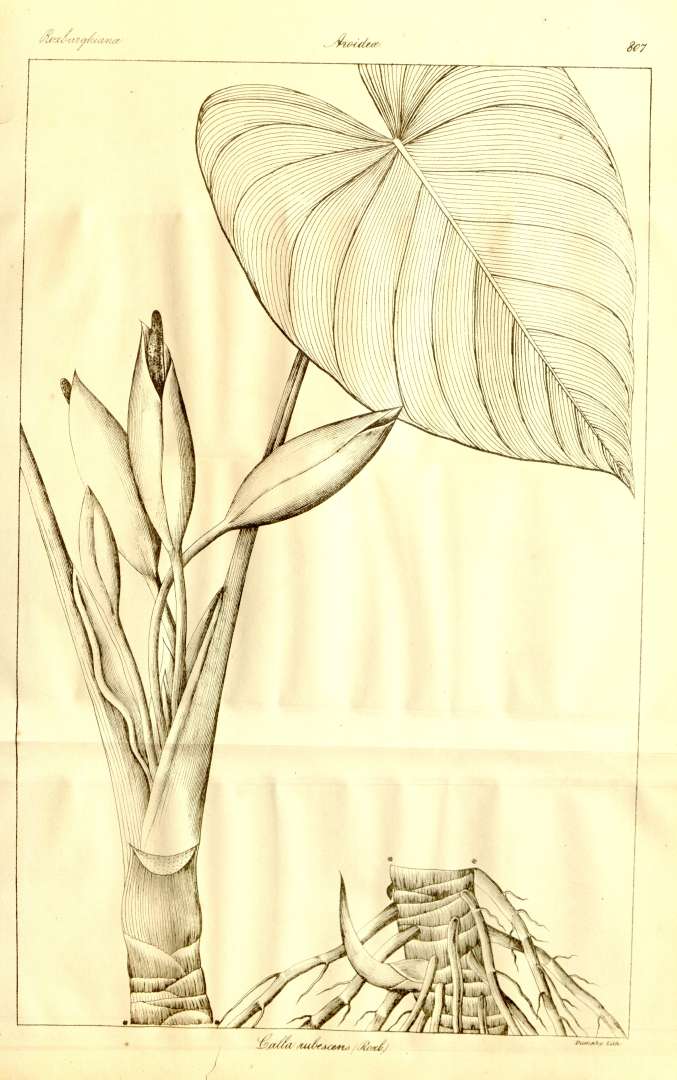
Homalomena rubescens, affectionately known as the King of Hearts or Red Homalomena, is a captivating evergreen perennial nestled within the diverse Araceae family. This species is native to the lush, humid tropical rainforests of Southeast Asia, thriving particularly across Malaysia, Indonesia, Thailand, and the Philippines.
In its natural understory environment, Homalomena rubescens flourishes in deep shade, commonly found growing terrestrially or occasionally as a lithophyte on mossy rocks, benefiting from the consistent moisture and high humidity characteristic of its habitat. The plant typically reaches a modest height of 45-90 cm (18-36 inches), forming a dense clump of striking foliage that enhances its appeal as an ornamental specimen.
The most distinctive feature of Homalomena rubescens is its magnificent leaves. They are characteristically large, glossy, and distinctly heart-shaped (cordate), often measuring up to 30 cm (11.8 inches) in length and around 15 cm (5.9 inches) in width. The adaxial (upper) surface displays a rich, deep green, frequently accented by a subtle reddish tint on the abaxial (lower) surface and along the petioles, which gives rise to its 'Red Homalomena' moniker.
The texture is notably leathery and somewhat corrugated, with prominent venation contributing to its sculptural quality. The robust, reddish-brown petioles, typically 20-30 cm (7.9-11.8 inches) long, elegantly support the leaves, emerging from a thick, often subterranean or creeping rhizomatous stem. This rhizomatous growth habit allows the plant to gradually form dense colonies.
Like other members of the Araceae family, Homalomena rubescens produces a characteristic inflorescence comprising a spadix, a fleshy spike covered in tiny flowers, enveloped by a spathe, a modified leaf-like structure. While the spathe and spadix are usually white or cream-colored, their appearance is infrequent in cultivated settings.
Trusted Scientific References
1. Authoritative external sources for Homalomena rubescens
1.1 Wikipedia — Homalomena rubescens
1.2 Kew POWO (Plants of the World Online)
1.3 PubMed — peer-reviewed research
1.4 NCBI Taxonomy Browser
1.5 GBIF — Global Biodiversity
1.1.Homalomena Rubescens — Key Features
- ✓ <strong>Distinctive heart</strong> — shaped, glossy, deep green leaves.
- ✓ <strong>Prominent reddish petioles</strong> — Prominent reddish petioles and often reddish undersides of leaves.
- ✓ <strong>Native to the</strong> — Native to the humid tropical rainforests of Southeast Asia.
- ✓ <strong>Rhizomatous growth habit,</strong> — Rhizomatous growth habit, forming dense clumps.
- ✓ <strong>Adaptable to low</strong> — Adaptable to low light conditions, making it an ideal houseplant.
- ✓ <strong>Belongs to the</strong> — Belongs to the Araceae family, known for its unique inflorescence structure.
- ✓ <strong>Exhibits toxicity due</strong> — Exhibits toxicity due to the presence of calcium oxalate crystals.
- ✓ <strong>Common names include</strong> — Common names include 'King of Hearts' and 'Red Homalomena'.
- ✓ <strong>Moderate size, typically reaching 45</strong> — 90 cm in height.
- ✓ <strong>Requires high humidity</strong> — Requires high humidity and warm temperatures for optimal growth.
1.2.Homalomena Rubescens — Quick Summary
- ✓ Homalomena rubescens, the King of Hearts, is a tropical evergreen perennial from Southeast Asia.
- ✓ Valued for its large, glossy, heart-shaped leaves with reddish petioles.
- ✓ Thrives in warm, humid, low-light conditions as an ornamental houseplant.
- ✓ Contains calcium oxalate crystals, making all parts toxic if ingested.
- ✓ Possesses traditional medicinal uses for inflammation, pain, and infections, primarily for external application.
- ✓ Requires careful handling and is not recommended for unsupervised internal consumption.
2.Homalomena Rubescens — Scientific Identity
3.Homalomena Rubescens — Quick Facts
4.Homalomena Rubescens — Appearance & Identification
5.Homalomena Rubescens — Native Habitat
6.Homalomena Rubescens — Water Requirements
- ✓ Light — Provide medium, indirect, dappled light; direct sun causes scorching and fading.
- ✓ Soil — Use a light, loamy, well-drained, acidic potting mix, ideally containing peat moss.
- ✓ Watering — Allow the top inch of soil to dry before watering thoroughly with lukewarm water; prevent standing water.
- ✓ Temperature — Maintain consistent room temperatures above 21°C (70°F) during the day and no lower than 15°C (60°F) at night.
- ✓ Humidity — Ensure high humidity; mist leaves weekly or use a pebble tray with water to prevent brown tips.
- ✓ Fertilizer — Feed every two weeks in spring and summer with a slow-release organic fertilizer; suspend feeding in winter.
- ✓ Pruning — Only remove dried or unsightly leaves at the base using sharp, clean scissors or pruners.
- ✓ Propagation — Easily propagated by dividing the rhizomatous roots during repotting in spring once the plant is established.
Reviewed by the Flora Medical Global Botanical Review Panel
Multi-disciplinary editorial group · Botany · Ethnobotany · Herbal-medicine literature
Who reviewed this: This page was checked by the Flora Medical Global Botanical Review Panel — an in-house editorial group of botany graduates, ethnobotany researchers, and horticulture practitioners who collectively maintain our 7,000+ plant encyclopedia. Meet the team.
Our 4-step verification process
1. Taxonomic verification
Scientific names and synonyms cross-checked against Kew POWO, World Flora Online, and The Plant List.
2. Phytochemical & medicinal cross-reference
Active compounds, traditional uses, and reported activities are cross-referenced with PubMed, USDA Dr. Duke's database, and peer-reviewed ethnobotanical literature.
3. Conservation & distribution check
Distribution, ecology, and conservation status confirmed against GBIF occurrence records and the IUCN Red List.
4. Editorial & safety review
Every entry passes an editorial pass for clarity, originality, and safety notices (toxicity, contraindications, dosage caveats) before publication.
Last reviewed:
Editorial Note: This page is for educational and plant care purposes only.
Written by: Flora Medical Global Editorial Team
Reviewed by: Flora Medical Global Botanical Review Panel
Last Updated: June 15, 2026







Homalomena Rubescens — Comments & Community Reviews
Rate this plant