
Care Disclaimer: Plant care recommendations are general guidelines based on common growing conditions. Individual results may vary based on your local environment, climate, and care routine. If your plant is toxic, keep it away from children and pets, and consult a veterinarian if accidental ingestion occurs.
1.Hoya Krimson Queen — Overview
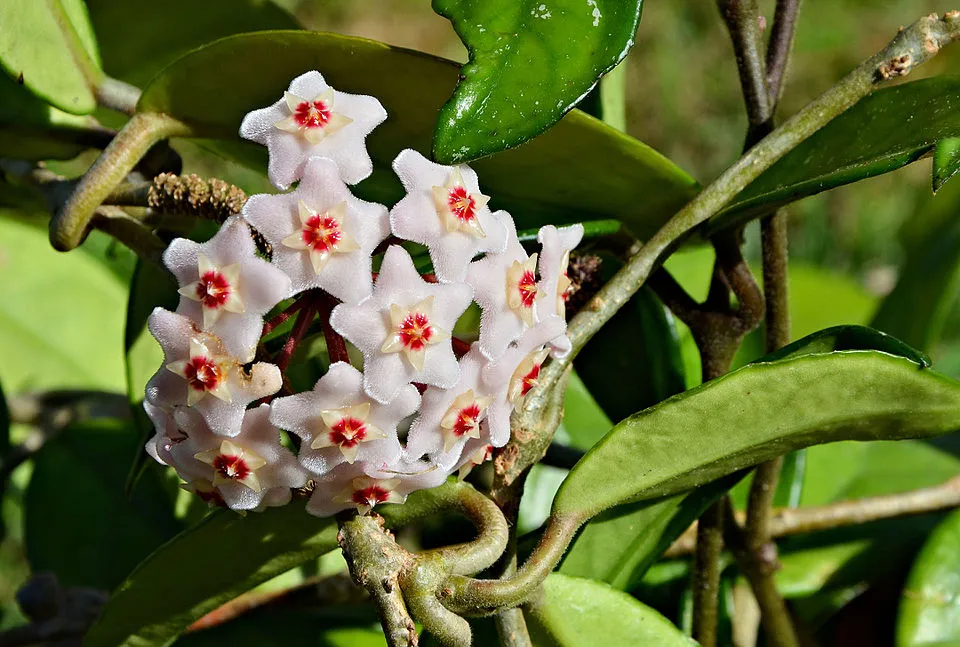
Hoya carnosa 'Krimson Queen' is a captivating cultivar of the genus Hoya, renowned for its striking ornamental appeal. This epiphytic, perennial vine, a member of the diverse Apocynaceae family, typically forms trailing or climbing stems reaching 2 to 4 feet in length, making it ideal for hanging baskets or trellises. Its most distinguishing feature lies in its thick, succulent-like leaves, which are broadly ovate to elliptical, measuring approximately 2-4 inches long.
These leaves exhibit a dramatic variegation pattern, featuring vibrant green centers bordered by irregular margins of creamy white, soft pink, or even deep magenta, especially on new growth or when exposed to adequate light. The sturdy, woody stems provide a robust framework for the lush foliage. Under optimal conditions, mature plants produce spherical clusters of delicate, star-shaped flowers, often referred to as 'porcelain flowers' or 'wax plants'.
These fragrant blooms, typically appearing in shades of white to pale pink with a contrasting red or dark pink corona, exude a sweet, nectar-like scent, particularly at night. Native to tropical and subtropical regions of East Asia, including Indonesia and Malaysia, the parent species, Hoya carnosa, thrives in the understory of forests, clinging to trees or rocks, where it receives dappled sunlight. 'Krimson Queen' inherits this adaptability, making it a favored choice for indoor cultivation globally, valued not only for its beauty but also for its purported ability to enhance indoor air quality.
Trusted Scientific References
1. Authoritative external sources for Hoya carnosa Krimson Queen
1.1 Wikipedia — Hoya carnosa Krimson Queen
1.2 Kew POWO (Plants of the World Online)
1.3 PubMed — peer-reviewed research
1.4 NCBI Taxonomy Browser
1.5 GBIF — Global Biodiversity
1.6Hoya Krimson Queen should be interpreted through verified botanical identity, practical care, and responsible safety language. This recovery note adds the missing context needed for a complete profile: match light to the plant's habit, use well-drained soil, water according to season, and avoid unsupported medicinal or edible claims. For publishing, the plant can be presented as a source-backed indoor plant with clear care guidance, common problem diagnosis, and conservative safety wording.
1.1.Hoya Krimson Queen — Key Features
- ✓ <strong>Striking Variegated Foliage</strong> — Deep green leaves with prominent cream, white, or pink margins.
- ✓ <strong>Waxy, Succulent</strong> — like Leaves — Thick, glossy leaves that store water, contributing to drought tolerance.
- ✓ <strong>Fragrant 'Porcelain' Flowers</strong> — Clusters of star-shaped, often pink-white blooms with a sweet scent.
- ✓ <strong>Epiphytic Growth Habit</strong> — Naturally climbs or trails, suitable for hanging baskets or trellises.
- ✓ <strong>Low Maintenance Houseplant</strong> — Adaptable to various indoor conditions, making it beginner-friendly.
- ✓ <strong>Air Purifying Benefits</strong> — Helps to filter indoor air pollutants for a healthier environment.
- ✓ <strong>Member of Apocynaceae Family</strong> — Shares botanical characteristics with other milkweed relatives.
- ✓ <strong>Native to Tropical Asia</strong> — Thrives in warm, humid conditions with dappled light.
- ✓ <strong>Woody Stems</strong> — Develops sturdy, somewhat rough stems as it matures.
- ✓ <strong>Distinctive Cultivar</strong> — A prized ornamental variety of the Hoya carnosa species.
1.2.Hoya Krimson Queen — Quick Summary
- ✓ Ornamental Variegated Vine — Hoya carnosa 'Krimson Queen' is a stunning cultivar known for its green, cream, and pink variegated leaves.
- ✓ Fragrant, Star-shaped Flowers — Produces clusters of waxy, sweet-scented flowers, typically pink and white with a red center.
- ✓ Epiphytic & Easy Care — A low-maintenance, trailing houseplant thriving in indirect light and well-draining soil.
- ✓ Air Purifying Qualities — Contributes to improved indoor air quality by filtering common airborne toxins.
- ✓ Traditional Topical Uses — Sap from related Hoya species has anecdotal use for skin irritations and minor wounds.
- ✓ Caution Against Ingestion — Contains compounds, common to the Apocynaceae family, that are considered toxic if consumed.
2.Hoya Krimson Queen — Scientific Identity
3.Hoya Krimson Queen — Quick Facts
4.Hoya Krimson Queen — Appearance & Identification
5.Hoya Krimson Queen — Native Habitat
6.Hoya Krimson Queen — Water Requirements
- ✓ Light — Provide bright, indirect light; direct sun can scorch leaves, while too little light inhibits flowering and variegation.
- ✓ Watering — Allow the top 1-2 inches of soil to dry out completely between waterings; overwatering is a common cause of root rot.
- ✓ Soil — Use a well-draining, airy potting mix, such as an orchid mix or a blend with perlite and bark, to prevent waterlogging.
- ✓ Humidity — Prefers high humidity (60-80%); misting, a pebble tray, or a humidifier can be beneficial, especially in dry indoor environments.
- ✓ Temperature — Thrives in warm temperatures between 60-85°F (15-29°C); avoid sudden temperature drops or cold drafts.
- ✓ Fertilization — Feed sparingly during the growing season (spring and summer) with a balanced liquid fertilizer diluted to half strength, once every 2-4 weeks.
- ✓ Propagation — Easily propagated from stem cuttings, which can be rooted in water or directly in a moist, well-draining substrate.
- ✓ Support — As an epiphytic vine, it benefits from a trellis, moss pole, or hanging planter to allow its stems to trail or climb naturally.
Reviewed by the Flora Medical Global Botanical Review Panel
Multi-disciplinary editorial group · Botany · Ethnobotany · Herbal-medicine literature
Who reviewed this: This page was checked by the Flora Medical Global Botanical Review Panel — an in-house editorial group of botany graduates, ethnobotany researchers, and horticulture practitioners who collectively maintain our 7,000+ plant encyclopedia. Meet the team.
Our 4-step verification process
1. Taxonomic verification
Scientific names and synonyms cross-checked against Kew POWO, World Flora Online, and The Plant List.
2. Phytochemical & medicinal cross-reference
Active compounds, traditional uses, and reported activities are cross-referenced with PubMed, USDA Dr. Duke's database, and peer-reviewed ethnobotanical literature.
3. Conservation & distribution check
Distribution, ecology, and conservation status confirmed against GBIF occurrence records and the IUCN Red List.
4. Editorial & safety review
Every entry passes an editorial pass for clarity, originality, and safety notices (toxicity, contraindications, dosage caveats) before publication.
Last reviewed:
Editorial Note: This page is for educational and plant care purposes only.
Written by: Flora Medical Global Editorial Team
Reviewed by: Flora Medical Global Botanical Review Panel
Last Updated: June 15, 2026







Hoya Krimson Queen — Comments & Community Reviews
Rate this plant