
Care Disclaimer: Plant care recommendations are general guidelines based on common growing conditions. Individual results may vary based on your local environment, climate, and care routine. If your plant is toxic, keep it away from children and pets, and consult a veterinarian if accidental ingestion occurs.
1.Hoya Macrophylla — Overview
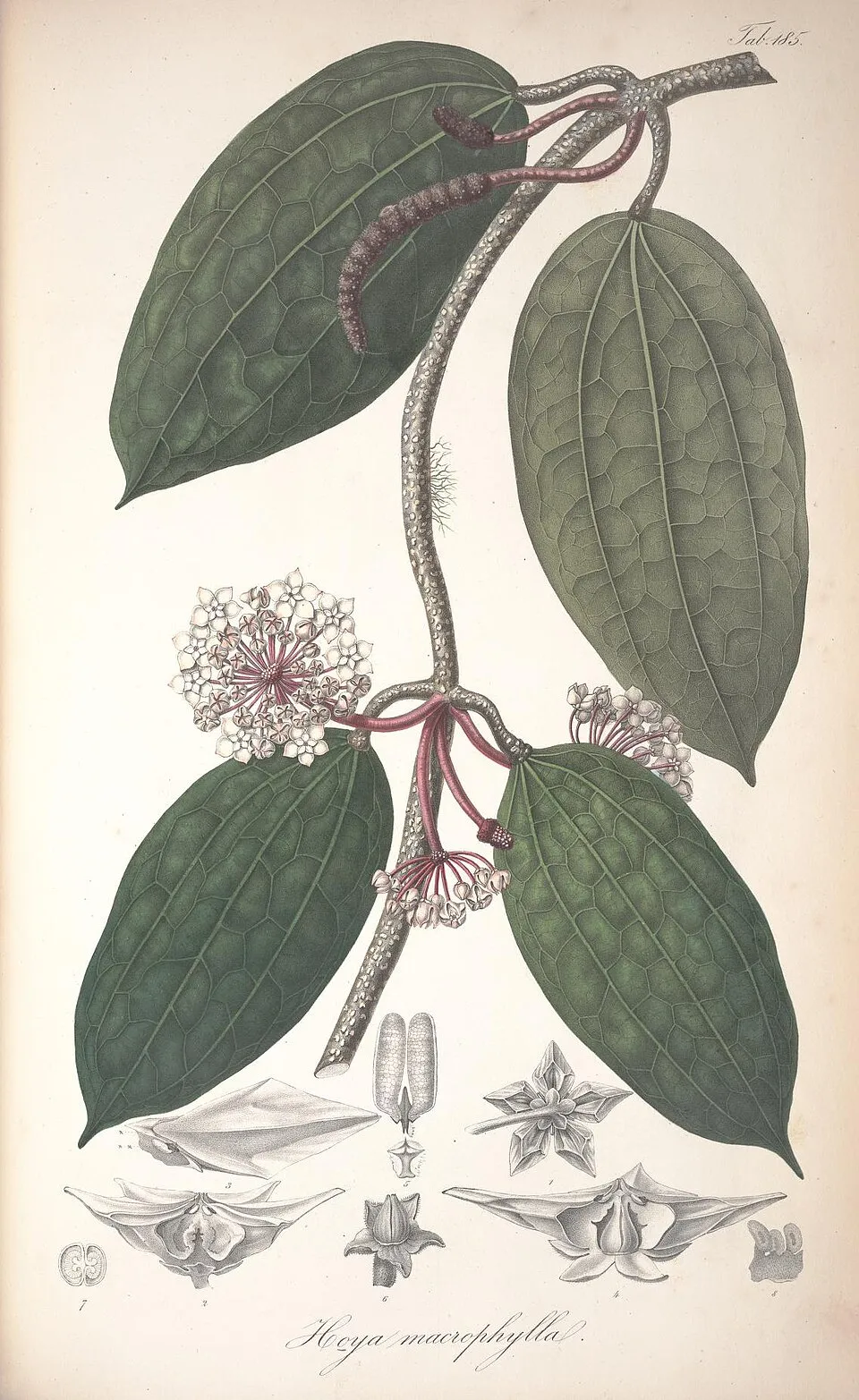
Hoya macrophylla, commonly known as the Big Leaf Hoya or Wax Plant, is an evergreen climbing species belonging to the diverse Apocynaceae family, a botanical group renowned for its ornamental and sometimes medicinally active members, including genera like Asclepias and Vinca. This captivating plant is indigenous to the lush, high-humidity tropical rainforests of Southeast Asia, with its natural distribution spanning regions such as the Philippines, Malaysia, New Guinea, and Australia. In its native habitat, Hoya macrophylla typically adopts an epiphytic or lithophytic growth strategy, robustly clinging to the trunks of trees or rock formations, absorbing nutrients and moisture from the ambient environment and accumulated organic matter. When cultivated indoors, with appropriate structural support, it can elegantly trail or climb, achieving impressive lengths of up to 4-6 feet (1.2-1.8 meters). The most distinctive morphological characteristic of Hoya macrophylla is its striking foliage.
The leaves are thick, succulent, and possess a pronounced waxy texture, contributing to the plant's common name, 'Wax Plant.' These leaves are typically elliptical to broadly ovate, often displaying intricate, raised venation patterns. They are substantial in size, capable of reaching 6-8 inches (15-20 cm) in length and 4-6 inches (10-15 cm) in width, presenting a deep, lustrous green hue with a highly glossy surface that beautifully reflects ambient light. Certain cultivated varieties exhibit attractive variegation, featuring creamy white, yellow, or pink margins, or speckled 'splash' patterns, enhancing their ornamental appeal. Young stems are fleshy and succulent, gradually developing a more lignified, rougher, and textured bark as they mature, providing sturdy support for the climbing structure. The root system is fibrous, expertly adapted for clinging and efficient nutrient uptake from the limited organic substrates typical of its epiphytic lifestyle.
Hoya macrophylla is also highly valued for its fragrant inflorescences, which emerge from persistent peduncles capable of re-flowering over multiple seasons. These pendulous clusters comprise numerous small, perfectly star-shaped flowers, typically exhibiting creamy white to pale yellow coloration, often subtly edged with delicate pink or reddish tones, and featuring a contrasting central corona. These blooms are not only visually appealing but frequently emit a subtle, sweet, and sometimes spicy fragrance, particularly n ...[CURRENT TEXT EXISTS: 2998 chars]
1.1.Hoya Macrophylla — Key Features
- ✓ <strong>Large, Succulent, Waxy Leaves</strong> — Distinctive, thick foliage up to 8 inches long.
- ✓ <strong>Glossy Green Appearance</strong> — Highly reflective, deep green leaves, sometimes variegated.
- ✓ <strong>Fragrant Star</strong> — Shaped Flowers — Clusters of small, waxy, cream to pink blooms, often fragrant at night.
- ✓ <strong>Epiphytic/Lithophytic Growth</strong> — Naturally clings to trees or rocks in tropical rainforests.
- ✓ <strong>Climbing or Trailing Habit</strong> — Adaptable for hanging baskets or trellises indoors.
- ✓ <strong>Low Maintenance Houseplant</strong> — Relatively easy to care for with proper conditions.
- ✓ <strong>Native to Southeast Asia</strong> — Found in tropical regions like the Philippines and Malaysia.
- ✓ <strong>Apocynaceae Family Member</strong> — Belongs to the Dogbane family, known for diverse species.
- ✓ <strong>Toxicity Warning</strong> — Contains compounds that are toxic if ingested by humans or pets.
- ✓ <strong>Long</strong> — Lived Specimen — Can thrive for many years with appropriate care.
1.2.Hoya Macrophylla — Quick Summary
- ✓ Hoya macrophylla is an ornamental, epiphytic 'Wax Plant' from Southeast Asia.
- ✓ Features large, waxy, glossy green leaves and fragrant, star-shaped flowers.
- ✓ Primarily grown as a houseplant; thrives in bright, indirect light and high humidity.
- ✓ Known to be toxic if ingested by humans or animals, requiring careful placement.
- ✓ No documented traditional or modern medicinal uses; mainly valued for its aesthetic appeal.
- ✓ Requires well-draining soil and careful watering to prevent root rot.
2.Hoya Macrophylla — Scientific Identity
3.Hoya Macrophylla — Quick Facts
4.Hoya Macrophylla — Appearance & Identification
5.Hoya Macrophylla — Native Habitat
6.Hoya Macrophylla — Water Requirements
- ✓ Soil and Potting — Hoya macrophylla thrives in a very loose, well-aerated, and fast-draining potting mix, ideally slightly alkaline. A blend of cactus mix, perlite, and orchid bark is excellent, mimicking its epiphytic substrate.
- ✓ Light Requirements — Provide bright, indirect sunlight. East-facing windows are ideal, or a few feet from west/south-facing windows with filtered light. Direct, harsh sun will scorch the leaves.
- ✓ Temperature Range — Maintain warm temperatures between 60-80°F (15-27°C), consistent with its tropical origins. Avoid sudden temperature fluctuations.
- ✓ Humidity Levels — Prefers high humidity (60-80%) but requires good airflow to prevent fungal issues. Use a humidifier or pebble tray, but avoid misting directly on leaves or tightly grouping plants.
- ✓ Watering Schedule — Allow the soil to thoroughly dry out between waterings. Overwatering is a common cause of root rot. Check soil moisture with a finger or meter before re-watering.
- ✓ Fertilization — Feed sparingly during the growing season (spring/summer) with a balanced liquid fertilizer diluted to half strength. Reduce or cease fertilization in fall and winter.
- ✓ Pruning and Support — Prune to maintain shape or encourage bushiness. Provide a trellis or allow it to trail from a hanging basket. Avoid cutting peduncles as they re-flower.
- ✓ Propagation — Easily propagated from stem cuttings in water or a well-draining soil mix, ideally with at least one node and a few leaves.
Reviewed by the Flora Medical Global Botanical Review Panel
Multi-disciplinary editorial group · Botany · Ethnobotany · Herbal-medicine literature
Who reviewed this: This page was checked by the Flora Medical Global Botanical Review Panel — an in-house editorial group of botany graduates, ethnobotany researchers, and horticulture practitioners who collectively maintain our 7,000+ plant encyclopedia. Meet the team.
Our 4-step verification process
1. Taxonomic verification
Scientific names and synonyms cross-checked against Kew POWO, World Flora Online, and The Plant List.
2. Phytochemical & medicinal cross-reference
Active compounds, traditional uses, and reported activities are cross-referenced with PubMed, USDA Dr. Duke's database, and peer-reviewed ethnobotanical literature.
3. Conservation & distribution check
Distribution, ecology, and conservation status confirmed against GBIF occurrence records and the IUCN Red List.
4. Editorial & safety review
Every entry passes an editorial pass for clarity, originality, and safety notices (toxicity, contraindications, dosage caveats) before publication.
Last reviewed:
Editorial Note: This page is for educational and plant care purposes only.
Written by: Flora Medical Global Editorial Team
Reviewed by: Flora Medical Global Botanical Review Panel
Last Updated: June 15, 2026







Hoya Macrophylla — Comments & Community Reviews
Rate this plant