
Care Disclaimer: Plant care recommendations are general guidelines based on common growing conditions. Individual results may vary based on your local environment, climate, and care routine. If your plant is toxic, keep it away from children and pets, and consult a veterinarian if accidental ingestion occurs.
1.Hoya Multiflora — Overview
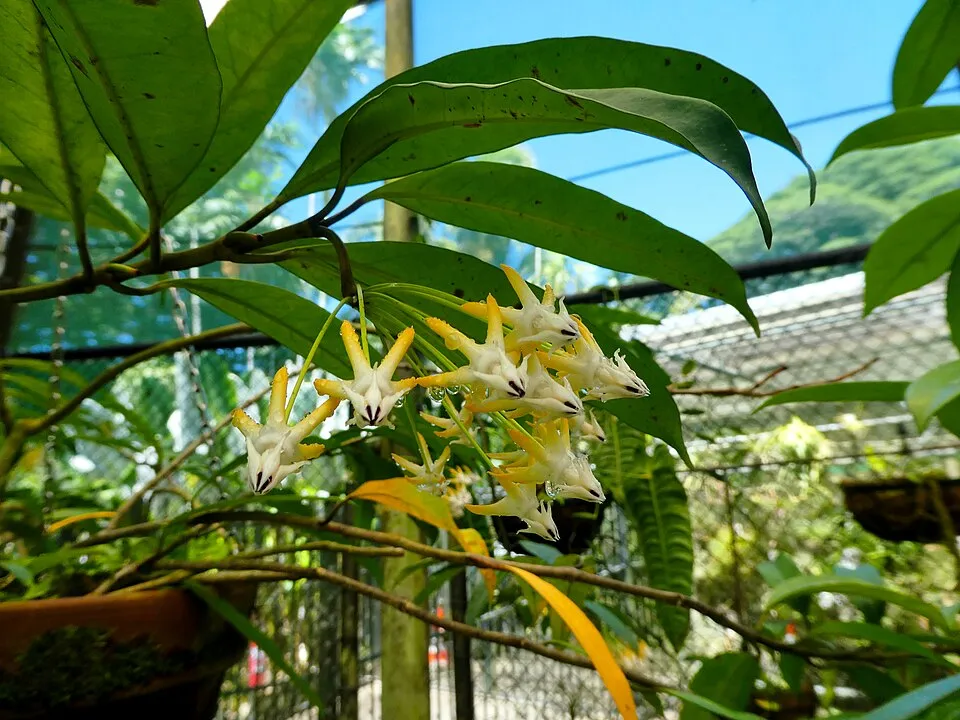
Hoya multiflora, affectionately known as the Shooting Star Hoya, is an enchanting epiphytic or lithophytic climbing vine native to the diverse tropical and subtropical regions of Southeast Asia, specifically spanning from southeast China across various parts of tropical Asia. As a member of the extensive Apocynaceae family, this species typically achieves a mature height of 1 to 3 meters, exhibiting a distinctive upright or spreading growth habit. Its foliage consists of striking, glossy ovate leaves, which can extend up to 10 centimeters in length. These leaves present a deep emerald green hue and a leathery, somewhat succulent texture, maintaining their ornamental appeal even when the plant is not in bloom.
The plant's most captivating feature is its unique inflorescence—dense clusters of flowers that genuinely resemble shooting stars in motion. Individual blooms are typically a pristine white to pale yellow, characterized by a central corolla encircled by five acutely pointed petals, often highlighted by dark red or maroon markings at their core. These vibrant flower clusters can reach up to 15 centimeters in diameter, creating a spectacular display that frequently attracts a variety of pollinators. Hoya multiflora thrives in well-draining substrates and flourishes under bright, indirect light, making it a highly sought-after specimen for indoor cultivation.
Its adaptability allows it to tolerate a range of indoor environments, provided it is kept within a warm temperature range of 20°C to 30°C. The bark, which becomes smoother and more woody with age, underscores its natural inclination to climb and seek vertical support.
Trusted Scientific References
1. Authoritative external sources for Hoya multiflora
1.1 Wikipedia — Hoya multiflora
1.2 Kew POWO (Plants of the World Online)
1.3 PubMed — peer-reviewed research
1.4 NCBI Taxonomy Browser
1.5 GBIF — Global Biodiversity
1.6Hoya Multiflora should be interpreted through verified botanical identity, practical care, and responsible safety language. This recovery note adds the missing context needed for a complete profile: match light to the plant's habit, use well-drained soil, water according to season, and avoid unsupported medicinal or edible claims. For publishing, the plant can be presented as a source-backed indoor plant with clear care guidance, common problem diagnosis, and conservative safety wording.
1.1.Hoya Multiflora — Key Features
- ✓ <strong>Shooting Star Flowers</strong> — Distinctive white to pale yellow, star-shaped blooms with dark centers, appearing in dense clusters.
- ✓ <strong>Prolific Bloomer</strong> — One of the freest-blooming Hoya species, often flowering multiple times a year, even from young cuttings.
- ✓ <strong>Succulent Foliage</strong> — Glossy, leathery, ovate leaves with a deep green hue, providing ornamental value year-round.
- ✓ <strong>Climbing Vine</strong> — A vining or spreading growth habit, reaching 1-3 meters, ideal for trellises or hanging baskets.
- ✓ <strong>Native to Southeast Asia</strong> — Indigenous to tropical and subtropical regions of Southeast China and neighboring Asia.
- ✓ <strong>Traditional Medicinal Uses</strong> — Historically employed in Asian folk medicine for digestive and respiratory ailments.
- ✓ <strong>Nectar Production</strong> — Flowers produce a noticeable amount of sticky nectar, which can drip but is easily cleaned.
- ✓ <strong>Easy Propagation</strong> — Readily propagates from stem cuttings in water or moist substrate.
- ✓ <strong>Low Maintenance</strong> — Relatively easy to care for as an indoor plant, tolerant of various home environments.
- ✓ <strong>Apocynaceae Family Member</strong> — Part of a large family known for diverse plant forms and chemical compounds.
1.2.Hoya Multiflora — Quick Summary
- ✓ Hoya multiflora, or Shooting Star Hoya, is a captivating tropical vine from Apocynaceae.
- ✓ Known for its unique, star-shaped flower clusters and succulent foliage.
- ✓ Traditionally used in Asia for digestive and respiratory support, although scientific evidence is limited.
- ✓ Rich in saponins and flavonoids, contributing to potential anti-inflammatory and antioxidant effects.
- ✓ Requires bright indirect light, well-draining soil, and warm temperatures for optimal growth.
- ✓ Exercise caution due to limited scientific safety data; not recommended for pregnant/nursing individuals.
2.Hoya Multiflora — Scientific Identity
3.Hoya Multiflora — Quick Facts
4.Hoya Multiflora — Appearance & Identification
5.Hoya Multiflora — Native Habitat
6.Hoya Multiflora — Water Requirements
- ✓ Light — Provide bright, indirect light; east or west-facing windows are ideal, or supplement with T5 grow lights for 12 hours daily to encourage robust growth and prolific flowering.
- ✓ Watering — Water thoroughly, allowing excess to drain. Let the top 1-2 inches of soil dry before re-watering, but avoid letting the soil become completely dry, especially when in bud.
- ✓ Soil — Use a well-draining, airy potting mix, typically a blend of 2 parts cactus/succulent mix with 1 part ¼" pumice or perlite to prevent root rot.
- ✓ Pot Size — Keep Hoya multiflora in relatively small pots. Repot only when root-bound, upsizing to just the next larger pot size (e.g., 4-inch to 6-inch) to promote blooming.
- ✓ Fertilizing — Fertilize regularly during the active growing season (spring and summer) using a balanced liquid fertilizer diluted to ¼-½ teaspoon per gallon of water with every watering.
- ✓ Flowering — Do not remove old flower spurs (peduncles), as new blooms will emerge from these. Inconsistent soil moisture can lead to bud drop, so maintain steady hydration.
- ✓ Temperature & Humidity — Maintain warm temperatures between 60-85°F (15-30°C) for optimal growth. Average indoor humidity is acceptable, but higher humidity (e.g., with a humidifier) is beneficial.
Reviewed by the Flora Medical Global Botanical Review Panel
Multi-disciplinary editorial group · Botany · Ethnobotany · Herbal-medicine literature
Who reviewed this: This page was checked by the Flora Medical Global Botanical Review Panel — an in-house editorial group of botany graduates, ethnobotany researchers, and horticulture practitioners who collectively maintain our 7,000+ plant encyclopedia. Meet the team.
Our 4-step verification process
1. Taxonomic verification
Scientific names and synonyms cross-checked against Kew POWO, World Flora Online, and The Plant List.
2. Phytochemical & medicinal cross-reference
Active compounds, traditional uses, and reported activities are cross-referenced with PubMed, USDA Dr. Duke's database, and peer-reviewed ethnobotanical literature.
3. Conservation & distribution check
Distribution, ecology, and conservation status confirmed against GBIF occurrence records and the IUCN Red List.
4. Editorial & safety review
Every entry passes an editorial pass for clarity, originality, and safety notices (toxicity, contraindications, dosage caveats) before publication.
Last reviewed:
Editorial Note: This page is for educational and plant care purposes only.
Written by: Flora Medical Global Editorial Team
Reviewed by: Flora Medical Global Botanical Review Panel
Last Updated: June 15, 2026







Hoya Multiflora — Comments & Community Reviews
Rate this plant