


Care Disclaimer: Plant care recommendations are general guidelines based on common growing conditions. Individual results may vary based on your local environment, climate, and care routine. If your plant is toxic, keep it away from children and pets, and consult a veterinarian if accidental ingestion occurs.
1.Hoya (Wax Plant) — Overview
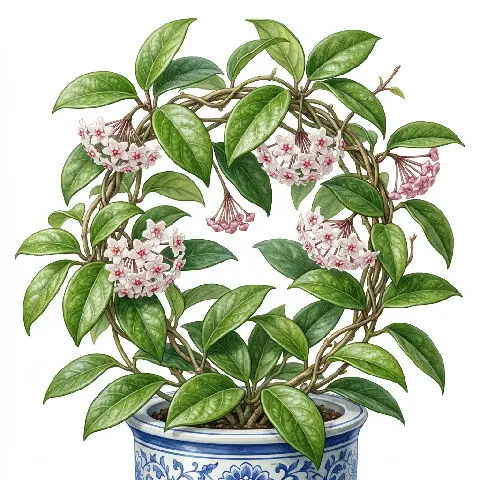
Hoya carnosa, commonly known as the Wax Plant, Porcelain Flower, or Honey Plant, is an evergreen perennial vine belonging to the Apocynaceae family. This species is characterized by its robust, often woody stems that can extend from 1 to 3 meters in indoor cultivation, and significantly more in its native outdoor environments, reaching up to 6 meters (20 feet) or more when provided with support. The foliage is a key feature, comprising thick, succulent, oval-shaped leaves that typically measure 5 to 10 centimeters in length. These leaves possess a distinct waxy texture and a glossy, dark green surface, which can sometimes acquire a reddish or bronze tint under intense light exposure.
Hoya carnosa is celebrated for its exquisite star-shaped flowers, which are arranged in dense umbels. Each flower consists of five pointed, waxy petals, usually appearing in shades of creamy white or soft pink, often with a contrasting darker pink or red center. These clusters bloom predominantly from late spring through summer, releasing a sweet, captivating fragrance, especially noticeable in the evening. The plant's stems are flexible, allowing it to either trail gracefully from hanging baskets or climb with the aid of a trellis.
Native to the warm, humid forests of Eastern Asia and Australia, Hoya carnosa typically grows as an epiphytic or semi-epiphytic plant, clinging to trees and rocks. It thrives in well-drained, airy soil and prefers bright, indirect light, adapting well to indoor conditions where it is cherished for its ornamental beauty and long-lasting, showy blooms.
Trusted Scientific References
1. Authoritative external sources for Hoya carnosa
1.1 Wikipedia — Hoya carnosa
1.2 Kew POWO (Plants of the World Online)
1.3 PubMed — peer-reviewed research
1.4 NCBI Taxonomy Browser
1.5 GBIF — Global Biodiversity
1.6Hoya (Wax Plant) should be interpreted through verified botanical identity, practical care, and responsible safety language. This recovery note adds the missing context needed for a complete profile: match light to the plant's habit, use well-drained soil, water according to season, and avoid unsupported medicinal or edible claims. For publishing, the plant can be presented as a source-backed indoor plant with clear care guidance, common problem diagnosis, and conservative safety wording.
1.1.Hoya (Wax Plant) — Key Features
- ✓ <strong>Evergreen perennial climbing</strong> — Evergreen perennial climbing or trailing vine.
- ✓ <strong>Thick, waxy, succulent,</strong> — Thick, waxy, succulent, glossy dark green leaves.
- ✓ <strong>Produces fragrant, star</strong> — shaped flowers in clusters (umbels).
- ✓ <strong>Flowers are typically</strong> — Flowers are typically creamy white or pink with darker centers.
- ✓ <strong>Blooms repeatedly from</strong> — Blooms repeatedly from the same flower spurs (peduncles).
- ✓ <strong>Native to Eastern</strong> — Native to Eastern Asia and Australia, often growing epiphytically.
- ✓ <strong>Contains diverse phytochemicals</strong> — Contains diverse phytochemicals including triterpenoids and flavonoids.
- ✓ <strong>Latex sap is</strong> — Latex sap is a mild skin irritant.
- ✓ <strong>Popular and relatively easy</strong> — to-care-for ornamental houseplant.
- ✓ <strong>Prefers bright, indirect light and well</strong> — draining soil.
1.2.Hoya (Wax Plant) — Quick Summary
- ✓ Hoya carnosa, or Wax Plant, is an evergreen perennial vine native to Eastern Asia and Australia.
- ✓ Features thick, waxy, glossy leaves and fragrant, star-shaped flowers that bloom in clusters.
- ✓ Primarily an ornamental houseplant; not widely used in traditional medicine.
- ✓ Contains triterpenoids, flavonoids, sterols, alkaloids, and glycosides.
- ✓ Its latex sap can cause mild skin irritation; not safe for internal consumption.
- ✓ Requires bright, indirect light and well-draining soil, thriving when slightly root-bound.
2.Hoya (Wax Plant) — Scientific Identity
3.Hoya (Wax Plant) — Quick Facts
4.Hoya (Wax Plant) — Appearance & Identification
5.Hoya (Wax Plant) — Native Habitat
6.Hoya (Wax Plant) — Water Requirements
- Hoya carnosa is a relatively easy-to-grow houseplant, thriving with specific care conditions to encourage its lush growth and beautiful blooms.
- ✓ Light Requirements — Prefers bright, indirect light; direct harsh midday sun can scorch the leaves, while insufficient light may hinder flowering.
- ✓ Soil Composition — Requires a well-draining, airy potting mix, ideally a blend of orchid bark, perlite, and a good quality potting soil to prevent root rot.
- ✓ Watering Schedule — Water thoroughly when the top 2-3 cm (1 inch) of soil feels dry to the touch; allow excess water to drain completely to avoid waterlogging.
- ✓ Humidity Levels — Thrives in medium to high humidity (around 50-70%), which can be achieved with a humidifier or pebble tray.
- ✓ Fertilization — Feed every 4 weeks during the active growing season (spring and summer) with a diluted, balanced liquid fertilizer.
- ✓ Pruning Practices — Trim only for shaping or size control; crucially, do not remove the short, woody flower spurs (peduncles) as new flowers emerge from these year after year.
- ✓ Potting — Prefers to be slightly root-bound, so choose a small pot with excellent drainage; repot only when absolutely necessary, usually every 2-3 years.
- ✓ Propagation — Easily propagated from stem cuttings; allow cuttings to callus for a day or two before planting in a light, airy soil mix or rooting in water.
Reviewed by the Flora Medical Global Botanical Review Panel
Multi-disciplinary editorial group · Botany · Ethnobotany · Herbal-medicine literature
Who reviewed this: This page was checked by the Flora Medical Global Botanical Review Panel — an in-house editorial group of botany graduates, ethnobotany researchers, and horticulture practitioners who collectively maintain our 7,000+ plant encyclopedia. Meet the team.
Our 4-step verification process
1. Taxonomic verification
Scientific names and synonyms cross-checked against Kew POWO, World Flora Online, and The Plant List.
2. Phytochemical & medicinal cross-reference
Active compounds, traditional uses, and reported activities are cross-referenced with PubMed, USDA Dr. Duke's database, and peer-reviewed ethnobotanical literature.
3. Conservation & distribution check
Distribution, ecology, and conservation status confirmed against GBIF occurrence records and the IUCN Red List.
4. Editorial & safety review
Every entry passes an editorial pass for clarity, originality, and safety notices (toxicity, contraindications, dosage caveats) before publication.
Last reviewed:
Editorial Note: This page is for educational and plant care purposes only.
Written by: Flora Medical Global Editorial Team
Reviewed by: Flora Medical Global Botanical Review Panel
Last Updated: June 15, 2026







Hoya (Wax Plant) — Comments & Community Reviews
Rate this plant