
Care Disclaimer: Plant care recommendations are general guidelines based on common growing conditions. Individual results may vary based on your local environment, climate, and care routine. If your plant is toxic, keep it away from children and pets, and consult a veterinarian if accidental ingestion occurs.
1.Hoya Wayetii — Overview
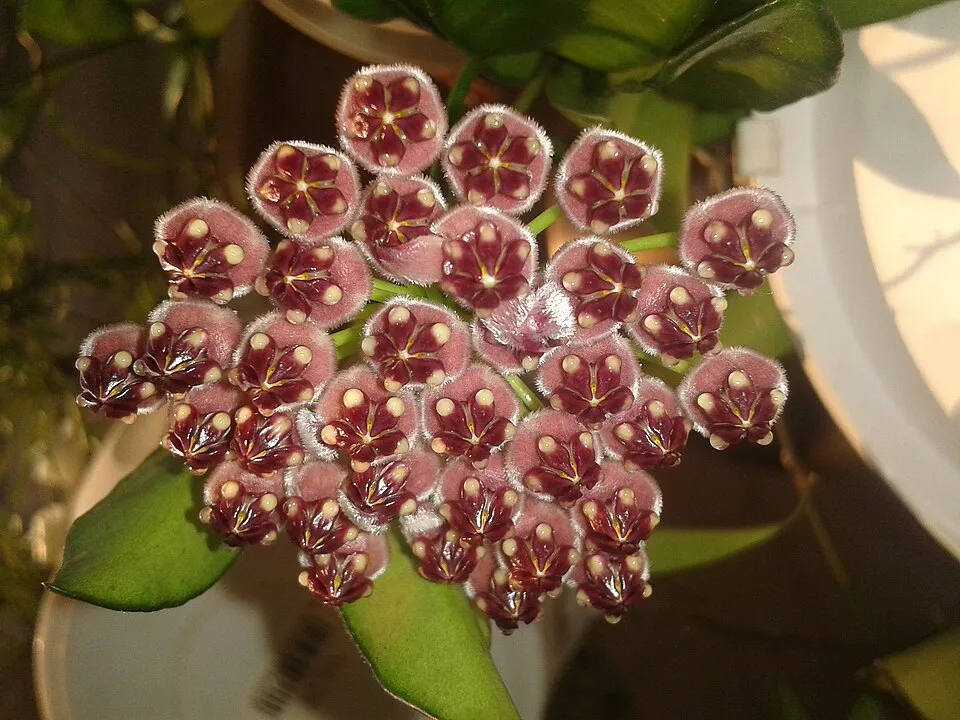
Hoya wayetii, commonly known as the narrow-leaved hoya, is an epiphytic or lithophytic perennial climbing plant celebrated for its distinctive foliage and charming blooms. Belonging to the Apocynaceae family, this species is native to the tropical and subtropical regions of Southeast Asia, particularly thriving in the Philippines where it clings to trees or rocks in humid, shaded environments. Its slender, lanceolate leaves are a deep, vibrant green, typically measuring up to 12 centimeters in length and 3 centimeters in width.
A defining characteristic is the striking dark, often reddish-brown, margins that provide a beautiful contrast and enhance its ornamental appeal. The plant produces clusters of small, star-shaped flowers, usually in creamy white to pale yellow hues, sometimes with a reddish corona, which bloom in dense umbels of 5 to 15 individual flowers. These fragrant blossoms create a mesmerizing display, especially during their peak flowering season.
Hoya wayetii exhibits a robust yet flexible stem structure, allowing it to gracefully trail from hanging baskets or climb supportive structures, reaching lengths of about 1 meter in cultivation. Its adaptability and low-maintenance nature make it a highly favored choice among houseplant enthusiasts globally, primarily valued for its aesthetic qualities rather than traditional uses.
Trusted Scientific References
1. Authoritative external sources for Hoya wayetii
1.1 Wikipedia — Hoya wayetii
1.2 Kew POWO (Plants of the World Online)
1.3 PubMed — peer-reviewed research
1.4 NCBI Taxonomy Browser
1.5 GBIF — Global Biodiversity
1.6Hoya Wayetii should be interpreted through verified botanical identity, practical care, and responsible safety language. This recovery note adds the missing context needed for a complete profile: match light to the plant's habit, use well-drained soil, water according to season, and avoid unsupported medicinal or edible claims. For publishing, the plant can be presented as a source-backed indoor plant with clear care guidance, common problem diagnosis, and conservative safety wording.
1.1.Hoya Wayetii — Key Features
- ✓ <strong>Distinctive Foliage</strong> — Narrow, elongated deep green leaves with prominent dark, reddish-brown margins.
- ✓ <strong>Fragrant Blooms</strong> — Produces clusters of small, star-shaped, creamy white to pale yellow flowers with a subtle fragrance.
- ✓ <strong>Vining/Trailing Growth</strong> — Flexible stems allow for beautiful trailing from hanging baskets or climbing on supports.
- ✓ <strong>Epiphytic Nature</strong> — Naturally grows on other plants or rocks in its native habitat, adapting well to pot culture.
- ✓ <strong>Low Maintenance</strong> — Considered an easy-care plant, suitable for beginners.
- ✓ <strong>Pet</strong> — Friendly — Non-toxic to cats and dogs, enhancing its appeal as a houseplant.
- ✓ <strong>Tropical Origin</strong> — Thrives in warm, humid environments, mimicking its natural Southeast Asian habitat.
- ✓ <strong>Ornamental Appeal</strong> — Highly valued for its aesthetic contribution to indoor spaces.
- ✓ <strong>Semi</strong> — Succulent Leaves — Stores water in its leaves, making it somewhat drought-tolerant.
1.2.Hoya Wayetii — Quick Summary
- ✓ Hoya wayetii is a popular ornamental houseplant, known for its attractive foliage and fragrant, star-shaped flowers.
- ✓ Native to tropical Asia, it thrives in warm, humid conditions with bright, indirect light.
- ✓ The plant is considered low-maintenance and non-toxic to common household pets.
- ✓ There are no widely documented traditional or modern medicinal uses for Hoya wayetii.
- ✓ Research on its specific pharmacological properties and chemical constituents is limited.
- ✓ Primarily valued for its aesthetic appeal and ease of cultivation.
2.Hoya Wayetii — Scientific Identity
3.Hoya Wayetii — Quick Facts
4.Hoya Wayetii — Appearance & Identification
5.Hoya Wayetii — Native Habitat
6.Hoya Wayetii — Water Requirements
- ✓ Light Requirements — Provide bright, indirect sunlight; avoid direct harsh sun which can scorch leaves, and low light which can hinder growth and flowering.
- ✓ Watering Schedule — Water thoroughly when the top 1-2 inches of soil feel dry; allow excess water to drain completely to prevent root rot, as Hoya wayetii is semi-succulent.
- ✓ Soil Composition — Use a well-draining, airy potting mix, such as a blend of orchid bark, perlite, and peat or coco coir, to ensure good aeration and prevent waterlogging.
- ✓ Temperature and Humidity — Thrives in warm temperatures (18-29°C / 65-85°F) and high humidity (60-80%); consider a humidifier or pebble tray in dry environments.
- ✓ Fertilization — Feed with a diluted, balanced liquid houseplant fertilizer once a month during the active growing season (spring and summer); reduce or cease in winter.
- ✓ Repotting — Hoyas prefer to be slightly root-bound; repot only when absolutely necessary, typically every 2-3 years, into a pot only slightly larger than the previous one.
- ✓ Propagation — Easily propagated from stem cuttings with at least two nodes; roots readily in water or a moist, well-draining substrate.
- ✓ Pest Management — Generally resistant, but monitor for common houseplant pests like mealybugs and scale insects; treat with insecticidal soap or neem oil if infestations occur.
Reviewed by the Flora Medical Global Botanical Review Panel
Multi-disciplinary editorial group · Botany · Ethnobotany · Herbal-medicine literature
Who reviewed this: This page was checked by the Flora Medical Global Botanical Review Panel — an in-house editorial group of botany graduates, ethnobotany researchers, and horticulture practitioners who collectively maintain our 7,000+ plant encyclopedia. Meet the team.
Our 4-step verification process
1. Taxonomic verification
Scientific names and synonyms cross-checked against Kew POWO, World Flora Online, and The Plant List.
2. Phytochemical & medicinal cross-reference
Active compounds, traditional uses, and reported activities are cross-referenced with PubMed, USDA Dr. Duke's database, and peer-reviewed ethnobotanical literature.
3. Conservation & distribution check
Distribution, ecology, and conservation status confirmed against GBIF occurrence records and the IUCN Red List.
4. Editorial & safety review
Every entry passes an editorial pass for clarity, originality, and safety notices (toxicity, contraindications, dosage caveats) before publication.
Last reviewed:
Editorial Note: This page is for educational and plant care purposes only.
Written by: Flora Medical Global Editorial Team
Reviewed by: Flora Medical Global Botanical Review Panel
Last Updated: June 15, 2026







Hoya Wayetii — Comments & Community Reviews
Rate this plant