

Care Disclaimer: Plant care recommendations are general guidelines based on common growing conditions. Individual results may vary based on your local environment, climate, and care routine. If your plant is toxic, keep it away from children and pets, and consult a veterinarian if accidental ingestion occurs.
1.Huernia — Overview
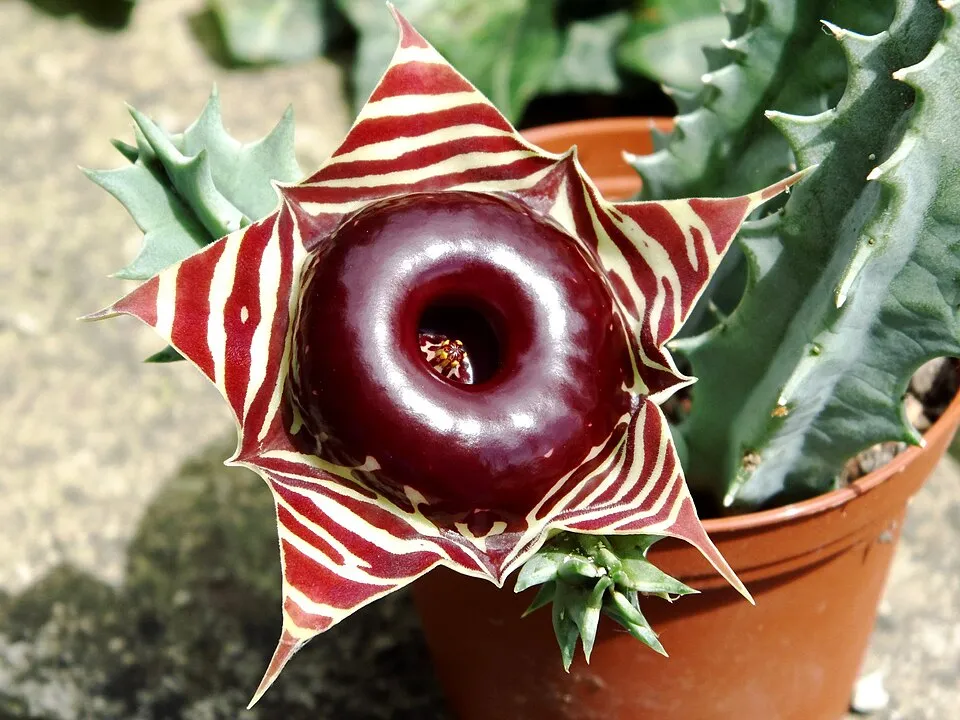
Huernia zebrina, commonly known as the Lifesaver plant or Zebra-striped Huernia, is an intriguing succulent perennial belonging to the Apocynaceae family. This species typically exhibits a creeping growth habit, forming dense clumps that can reach about 15-20 cm (6-8 inches) in height and spread up to 15 cm (6 inches) wide, making it an excellent candidate for indoor cultivation or dish gardens. Its distinctive stems are flattened, fleshy, and angular, typically displaying a light green base adorned with prominent purple to reddish stripes, often featuring 5-7 pronounced ridges along their length. These morphological features contribute to its striking visual appeal, sometimes leading to its mistaken identity as a cactus due to its xerophytic characteristics.
The plant's most notable feature is its star-shaped flowers, approximately 5 cm in diameter, which emerge in clusters. These captivating blooms exhibit a unique coloration, typically a blend of deep burgundy and yellow, with intricate dark markings that strikingly resemble a lifesaver candy or a donut. A raised, glossy, burgundy annulus at the flower's center further enhances this resemblance. Native to Southern Africa, Huernia zebrina thrives in arid, rocky environments where it has evolved sophisticated adaptations, such as its succulent stems and Crassulacean Acid Metabolism (CAM) photosynthesis, to efficiently conserve water.
In its natural habitat, it often grows as an understory plant, preferring partial shade. Its exotic appearance and relatively low-maintenance requirements have cemented its popularity among succulent enthusiasts worldwide.
Trusted Scientific References
1. Authoritative external sources for Huernia zebrina
1.1 Wikipedia — Huernia zebrina
1.2 Kew POWO (Plants of the World Online)
1.3 PubMed — peer-reviewed research
1.4 NCBI Taxonomy Browser
1.5 GBIF — Global Biodiversity
1.6Huernia should be interpreted through verified botanical identity, practical care, and responsible safety language. This recovery note adds the missing context needed for a complete profile: match light to the plant's habit, use well-drained soil, water according to season, and avoid unsupported medicinal or edible claims. For publishing, the plant can be presented as a source-backed indoor plant with clear care guidance, common problem diagnosis, and conservative safety wording.
1.1.Huernia — Key Features
- ✓ <strong>Botanical Name</strong> — *Huernia zebrina*.
- ✓ <strong>Common Name</strong> — Lifesaver plant, Lifebuoy Huernia, Zebra-striped Huernia.
- ✓ <strong>Family</strong> — Apocynaceae (Dogbane family).
- ✓ <strong>Succulent Perennial</strong> — Fleshy, angular, zebra-striped stems.
- ✓ <strong>Striking Flowers</strong> — Star-shaped, red-cream zebra patterns, glossy burgundy annulus.
- ✓ <strong>Distinctive Odor</strong> — Carrion-like scent from flowers, for pollination.
- ✓ <strong>Low Maintenance</strong> — Drought-tolerant, prefers well-draining soil and partial shade.
- ✓ <strong>Native Region</strong> — Southern Africa, adapted to arid environments.
- ✓ <strong>Ornamental Value</strong> — Highly popular as a houseplant and for succulent collections.
- ✓ <strong>Propagation</strong> — Easily propagated from stem cuttings.
1.2.Huernia — Quick Summary
- ✓ Unique succulent with striking "lifesaver" flowers and distinctive zebra-striped stems.
- ✓ Native to Southern Africa, expertly adapted to arid conditions through succulent morphology and CAM photosynthesis.
- ✓ Low-maintenance and popular as an indoor ornamental plant or for xeriscaping in suitable climates.
- ✓ Flowers emit a carrion-like odor, a fascinating evolutionary strategy for attracting insect pollinators.
- ✓ Phytochemical studies specifically on *Huernia zebrina* are limited, though related Apocynaceae species contain alkaloids, flavonoids, and terpenoids.
- ✓ Primarily valued for its aesthetic appeal, with potential for future ethnobotanical and phytochemical research.
2.Huernia — Scientific Identity
3.Huernia — Quick Facts
4.Huernia — Appearance & Identification
5.Huernia — Native Habitat
6.Huernia — Water Requirements
- ✓ Light — Requires partial shade, ideally from an eastern or western-facing window, as direct midday sun can scorch its delicate stems and impede blooming; in its native habitat, it thrives as an understory plant.
- ✓ Soil — Thrives in a well-draining substrate, such as a specialized cactus or succulent potting mix, which incorporates inorganic components like sand and perlite alongside organic matter to prevent root rot.
- ✓ Watering — Water thoroughly but infrequently during the growing season (spring-summer), allowing the top inch of soil to dry completely between waterings; reduce watering significantly to about once a month during winter dormancy.
- ✓ Temperature & Humidity — Prefers warm temperatures and is highly sensitive to frost, necessitating indoor placement when temperatures drop below 10°C (50°F); can be moved outdoors in summer if protected from intense heat.
- ✓ Fertilization — Apply a diluted liquid succulent fertilizer (half strength) once a month during the active growth period from spring through late summer, ceasing entirely as the plant enters dormancy.
- ✓ Potting — Benefits from unglazed terracotta pots that facilitate moisture evaporation, and while it rarely outgrows its container, repotting every two years with fresh soil supports optimal health without necessarily needing a larger pot.
- ✓ Propagation — Easily propagated from stem cuttings: allow cut segments to callous for several days before planting in a fresh, well-draining soil mix, maintaining slight dampness until new growth indicates rooting.
Reviewed by the Flora Medical Global Botanical Review Panel
Multi-disciplinary editorial group · Botany · Ethnobotany · Herbal-medicine literature
Who reviewed this: This page was checked by the Flora Medical Global Botanical Review Panel — an in-house editorial group of botany graduates, ethnobotany researchers, and horticulture practitioners who collectively maintain our 7,000+ plant encyclopedia. Meet the team.
Our 4-step verification process
1. Taxonomic verification
Scientific names and synonyms cross-checked against Kew POWO, World Flora Online, and The Plant List.
2. Phytochemical & medicinal cross-reference
Active compounds, traditional uses, and reported activities are cross-referenced with PubMed, USDA Dr. Duke's database, and peer-reviewed ethnobotanical literature.
3. Conservation & distribution check
Distribution, ecology, and conservation status confirmed against GBIF occurrence records and the IUCN Red List.
4. Editorial & safety review
Every entry passes an editorial pass for clarity, originality, and safety notices (toxicity, contraindications, dosage caveats) before publication.
Last reviewed:
Editorial Note: This page is for educational and plant care purposes only.
Written by: Flora Medical Global Editorial Team
Reviewed by: Flora Medical Global Botanical Review Panel
Last Updated: June 15, 2026







Huernia — Comments & Community Reviews
Rate this plant