
Care Disclaimer: Plant care recommendations are general guidelines based on common growing conditions. Individual results may vary based on your local environment, climate, and care routine. If your plant is toxic, keep it away from children and pets, and consult a veterinarian if accidental ingestion occurs.
1.Ixora Javanica — Overview
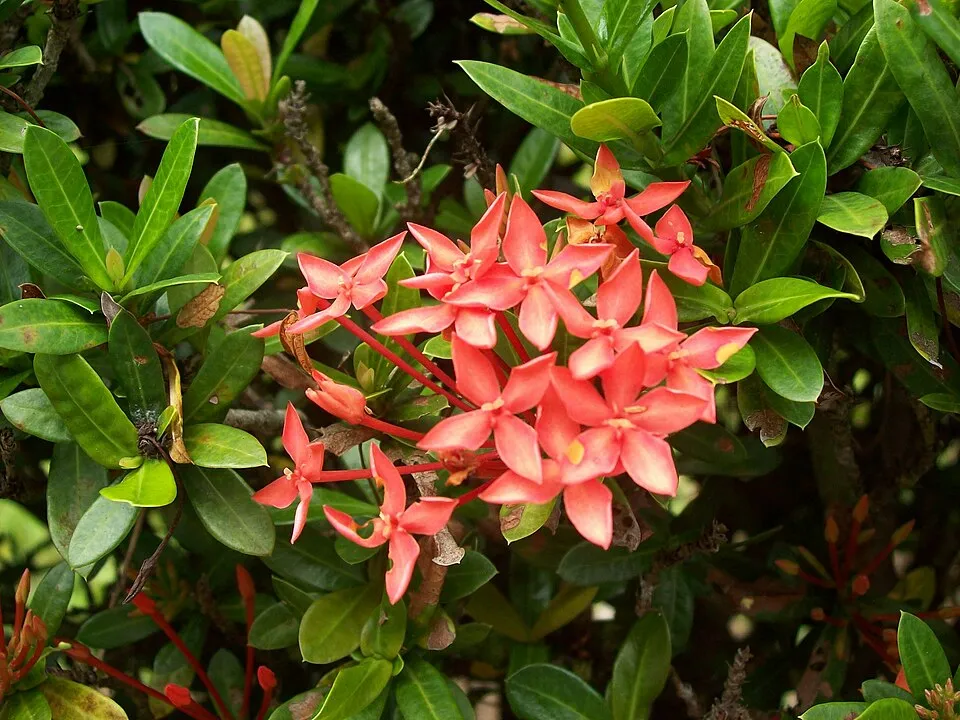
Ixora javanica, commonly known as the Jungle Flame or Javanese Ixora, is a captivating tropical evergreen shrub belonging to the Rubiaceae family, a diverse group renowned for species like coffee and gardenia. This species typically reaches a height of 1 to 3 meters in its native habitat but remains more compact, often 2 to 4 feet tall, when cultivated indoors. Its robust growth is characterized by sturdy, smooth green stems that support a dense canopy of foliage.
The leaves are a striking feature, being glossy, dark green, and ovate to elliptical in shape, ranging from 3 to 6 inches in length. These leathery leaves are crucial for moisture retention, contributing to the plant's lush appearance.
The plant is celebrated for its vibrant, domed clusters of tubular flowers, which typically display a brilliant orange-red hue. These showy blooms are highly attractive to various pollinators, including butterflies and hummingbirds, making it a lively addition to any garden or conservatory. Ixora javanica naturally thrives in the tropical and subtropical regions of Southeast Asia, which is considered its center of diversity.
It also flourishes in similar climates elsewhere, such as Florida in the United States, where it is sometimes called West Indian jasmine. This species prefers bright, filtered sunlight and consistent warmth, blooming from late spring through summer, offering an extended display of its characteristic fiery blossoms. It is adaptable to USDA hardiness zones 8 to 11, indicating its preference for frost-free environments.
Trusted Scientific References
1. Authoritative external sources for Ixora javanica
1.1 Wikipedia — Ixora javanica
1.2 Kew POWO (Plants of the World Online)
1.3 PubMed — peer-reviewed research
1.4 NCBI Taxonomy Browser
1.5 GBIF — Global Biodiversity
1.6Ixora Javanica should be interpreted through verified botanical identity, practical care, and responsible safety language. This recovery note adds the missing context needed for a complete profile: match light to the plant's habit, use well-drained soil, water according to season, and avoid unsupported medicinal or edible claims. For publishing, the plant can be presented as a source-backed indoor plant with clear care guidance, common problem diagnosis, and conservative safety wording.
1.1.Ixora Javanica — Key Features
- ✓ <strong>Vibrant orange</strong> — red, tubular flowers in large domed clusters.
- ✓ <strong>Glossy, dark green, ovate to elliptical leaves (3</strong> — 6 inches long).
- ✓ <strong>Attracts pollinators like</strong> — Attracts pollinators like butterflies and hummingbirds.
- ✓ <strong>Tropical evergreen shrub, typically 1</strong> — 3 meters tall.
- ✓ <strong>Native to tropical</strong> — Native to tropical and subtropical regions of Southeast Asia.
- ✓ <strong>Traditional uses include anti</strong> — inflammatory, analgesic, and antipyretic.
- ✓ <strong>Moderate growth rate</strong> — Moderate growth rate under optimal conditions.
- ✓ <strong>Requires high humidity</strong> — Requires high humidity and warm temperatures (USDA zones 8-11).
- ✓ <strong>Sturdy, smooth green</strong> — Sturdy, smooth green stems.
- ✓ <strong>Member of the</strong> — Member of the diverse Rubiaceae family.
1.2.Ixora Javanica — Quick Summary
- ✓ Ixora javanica is a vibrant tropical evergreen shrub known for its fiery orange-red flowers.
- ✓ Traditionally used in Southeast Asian folk medicine for its anti-inflammatory and analgesic properties.
- ✓ Rich in phytochemicals such as flavonoids, triterpenes, and tannins.
- ✓ Requires warm temperatures, high humidity, and consistent moisture for optimal growth.
- ✓ Preparations include poultices for topical use and decoctions for internal ailments like fever.
- ✓ Always consult a healthcare professional before using Ixora javanica for medicinal purposes.
2.Ixora Javanica — Scientific Identity
3.Ixora Javanica — Quick Facts
4.Ixora Javanica — Appearance & Identification
5.Ixora Javanica — Native Habitat
6.Ixora Javanica — Water Requirements
- ✓ Sunlight — Provide full sun to partial shade; at least 4-6 hours of direct light daily is ideal for optimal flowering and growth.
- ✓ Soil — Plant in rich, well-draining soil with ample organic matter; a slightly acidic to neutral pH (5.5-7.0) is preferred for healthy development.
- ✓ Watering — Maintain consistent soil moisture, especially during active growth and blooming periods; do not allow the soil to dry out completely between waterings.
- ✓ Humidity — Ensure high humidity levels, ideally above 70%, by misting regularly, using a pebble tray, or placing near a humidifier, mimicking its tropical native environment.
- ✓ Temperature — Keep temperatures warm, with an optimal range of 18-30°C (65-86°F); minimum tolerance is around 10°C (50°F), as it is sensitive to cold.
- ✓ Fertilization — Feed fortnightly during the growing season (spring and summer) with a balanced liquid fertilizer formulated for acid-loving plants to encourage vigorous growth and abundant blooms.
- ✓ Pruning — Prune after flowering to maintain a desirable shape, encourage bushier growth, and remove spent flowers to promote continuous blooming and enhance plant vigor.
- ✓ Propagation — Propagate primarily via semi-hardwood cuttings taken in summer or softwood cuttings in spring; air layering is also an effective method for larger specimens.
Reviewed by the Flora Medical Global Botanical Review Panel
Multi-disciplinary editorial group · Botany · Ethnobotany · Herbal-medicine literature
Who reviewed this: This page was checked by the Flora Medical Global Botanical Review Panel — an in-house editorial group of botany graduates, ethnobotany researchers, and horticulture practitioners who collectively maintain our 7,000+ plant encyclopedia. Meet the team.
Our 4-step verification process
1. Taxonomic verification
Scientific names and synonyms cross-checked against Kew POWO, World Flora Online, and The Plant List.
2. Phytochemical & medicinal cross-reference
Active compounds, traditional uses, and reported activities are cross-referenced with PubMed, USDA Dr. Duke's database, and peer-reviewed ethnobotanical literature.
3. Conservation & distribution check
Distribution, ecology, and conservation status confirmed against GBIF occurrence records and the IUCN Red List.
4. Editorial & safety review
Every entry passes an editorial pass for clarity, originality, and safety notices (toxicity, contraindications, dosage caveats) before publication.
Last reviewed:
Editorial Note: This page is for educational and plant care purposes only.
Written by: Flora Medical Global Editorial Team
Reviewed by: Flora Medical Global Botanical Review Panel
Last Updated: June 15, 2026







Ixora Javanica — Comments & Community Reviews
Rate this plant