
Care Disclaimer: Plant care recommendations are general guidelines based on common growing conditions. Individual results may vary based on your local environment, climate, and care routine. If your plant is toxic, keep it away from children and pets, and consult a veterinarian if accidental ingestion occurs.
1.Jade Vine Plant — Overview
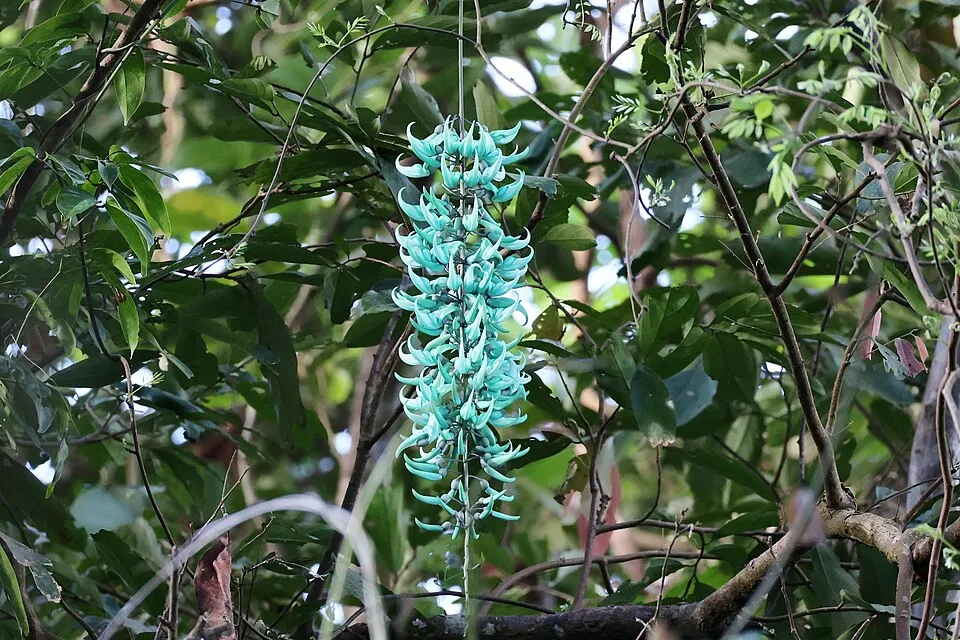
The Jade Vine Plant, scientifically known as Strongylodon macrobotrys, is an extraordinary perennial tropical liana belonging to the diverse Fabaceae family, which includes a vast array of legumes. This magnificent species is exclusively native to the humid, biodiverse rainforests of the Philippines, thriving particularly in regions like Quezon, Laguna, and Mindoro. In its natural habitat, the Jade Vine exhibits a vigorous climbing habit, capable of ascending to impressive heights of up to 16 meters (52 feet) by twining its sturdy, woody stems around the trunks and branches of host trees.
These robust stems develop a characteristic rough, mottled bark texture, displaying a spectrum of greens, browns, and grays that provide a strong support system for its extensive canopy. Its foliage is equally striking, featuring large, glossy dark green leaves, typically measuring 10-20 cm (4-8 inches) in length. Each leaf is trifoliate, composed of three elliptical leaflets, often culminating in a slightly pointed apex and featuring either entire or subtly serrated margins, contributing to the plant's dense and luxuriant appearance.
The true spectacle of Strongylodon macrobotrys is its breathtaking inflorescences. These are dramatic, pendulous racemes, often extending several feet in length, adorned with numerous claw-shaped, beak-like individual flowers. The most iconic feature is the unparalleled color of these blooms, ranging from a vibrant turquoise to a soft, luminous blue-green, a hue exceptionally rare in the botanical world.
This unique coloration is primarily attributed to specific flavonoid pigments. The flowers are exquisitely adapted for pollination by bats, particularly fruit bats, which are drawn to their subtle luminescence in low light conditions and their rich nectar. These stunning floral clusters hang gracefully from the vine, creating an unforgettable visual impact, especially when the plant is in peak bloom.
Following successful pollination, the Jade Vine produces fleshy, oblong pods containing up to 12 seeds, although seed production remains sporadic and challenging in cultivated environments, making conservation efforts crucial for this rare botanical gem.
Trusted Scientific References
1. Authoritative external sources for Strongylodon macrobotrys
1.1 Wikipedia — Strongylodon macrobotrys
1.2 Kew POWO (Plants of the World Online)
1.3 PubMed — peer-reviewed research
1.4 NCBI Taxonomy Browser
1.5 GBIF — Global Biodiversity
1.1.Jade Vine Plant — Key Features
- ✓ <strong>Iconic Turquoise Flowers</strong> — Displays rare and striking blue-green, claw-shaped inflorescences.
- ✓ <strong>Native to Philippine Rainforests</strong> — Endemic to specific humid tropical regions of the Philippines.
- ✓ <strong>Perennial Woody Liana</strong> — A robust, long-lived climbing vine with woody stems.
- ✓ <strong>Bat</strong> — Pollinated — Flowers are specially adapted to attract and be pollinated by fruit bats.
- ✓ <strong>Produces 'Edible Beans'</strong> — Bears fleshy, oblong pods containing seeds that are noted as edible, though usage is unverified.
- ✓ <strong>Member of Fabaceae Family</strong> — Belongs to the pea and bean family, sharing some characteristics with legumes.
- ✓ <strong>Large Trifoliate Leaves</strong> — Features glossy, dark green leaves composed of three distinct leaflets.
- ✓ <strong>High Ornamental Value</strong> — Highly prized in horticulture for its breathtaking floral display.
- ✓ <strong>Requires Tropical Conditions</strong> — Thrives in warm, high-humidity environments, intolerant of cold.
- ✓ <strong>Conservation Concern</strong> — Its rarity and specific habitat requirements make it a species of conservation interest.
1.2.Jade Vine Plant — Quick Summary
- ✓ Strongylodon macrobotrys is a rare, ornamental tropical vine from the Philippines.
- ✓ Renowned for its unique turquoise-blue, claw-shaped flowers, pollinated by bats.
- ✓ Belongs to the Fabaceae family and produces 'edible beans' (unverified safety/culinary use).
- ✓ Requires specific warm, humid conditions and support for its vigorous climbing habit.
- ✓ Primarily valued for its stunning aesthetic appeal and ecological importance.
- ✓ Direct medicinal uses are not widely documented, emphasizing its role as a botanical marvel.
2.Jade Vine Plant — Scientific Identity
3.Jade Vine Plant — Quick Facts
4.Jade Vine Plant — Appearance & Identification
5.Jade Vine Plant — Native Habitat
6.Jade Vine Plant — Water Requirements
- ✓ High Humidity — Requires consistently high atmospheric humidity, mimicking its native rainforest environment, often achieved with misting or humidifiers in cultivation.
- ✓ Partial Sun to Partial Shade — Thrives in bright, indirect light; direct, harsh sun can scorch its leaves, while too little light inhibits flowering.
- ✓ Warm Temperatures — Prefers temperatures between 15°C and 27°C (59-80°F), sensitive to cold and frost, suitable for USDA Hardiness Zones 10-12.
- ✓ Generous Watering — Needs regular, thorough watering, especially during warm, dry periods; soil should be kept moist but not waterlogged.
- ✓ Well-Draining, Humus-Rich Soil — Prefers fertile, loamy soil with excellent drainage, often enriched with compost, manure, or coarse sand; peat-based potting mixes work well for containers.
- ✓ Regular Fertilization — Feed bi-weekly during the active growing season with a balanced liquid fertilizer, reducing nitrogen content as flowering approaches and ceasing in winter.
- ✓ Pruning for Shape and Flowering — Prune annually to remove withered blooms and manage vigorous growth, encouraging branching; avoid excessive pruning, which can reduce flower production.
- ✓ Structural Support — As a vigorous climber, Strongylodon macrobotrys requires a sturdy trellis, arbor, or other robust support system to ascend and display its magnificent floral racemes.
Reviewed by the Flora Medical Global Botanical Review Panel
Multi-disciplinary editorial group · Botany · Ethnobotany · Herbal-medicine literature
Who reviewed this: This page was checked by the Flora Medical Global Botanical Review Panel — an in-house editorial group of botany graduates, ethnobotany researchers, and horticulture practitioners who collectively maintain our 7,000+ plant encyclopedia. Meet the team.
Our 4-step verification process
1. Taxonomic verification
Scientific names and synonyms cross-checked against Kew POWO, World Flora Online, and The Plant List.
2. Phytochemical & medicinal cross-reference
Active compounds, traditional uses, and reported activities are cross-referenced with PubMed, USDA Dr. Duke's database, and peer-reviewed ethnobotanical literature.
3. Conservation & distribution check
Distribution, ecology, and conservation status confirmed against GBIF occurrence records and the IUCN Red List.
4. Editorial & safety review
Every entry passes an editorial pass for clarity, originality, and safety notices (toxicity, contraindications, dosage caveats) before publication.
Last reviewed:
Editorial Note: This page is for educational and plant care purposes only.
Written by: Flora Medical Global Editorial Team
Reviewed by: Flora Medical Global Botanical Review Panel
Last Updated: June 15, 2026







Jade Vine Plant — Comments & Community Reviews
Rate this plant