


Care Disclaimer: Plant care recommendations are general guidelines based on common growing conditions. Individual results may vary based on your local environment, climate, and care routine. If your plant is toxic, keep it away from children and pets, and consult a veterinarian if accidental ingestion occurs.
1.Jatropha Podagrica — Overview
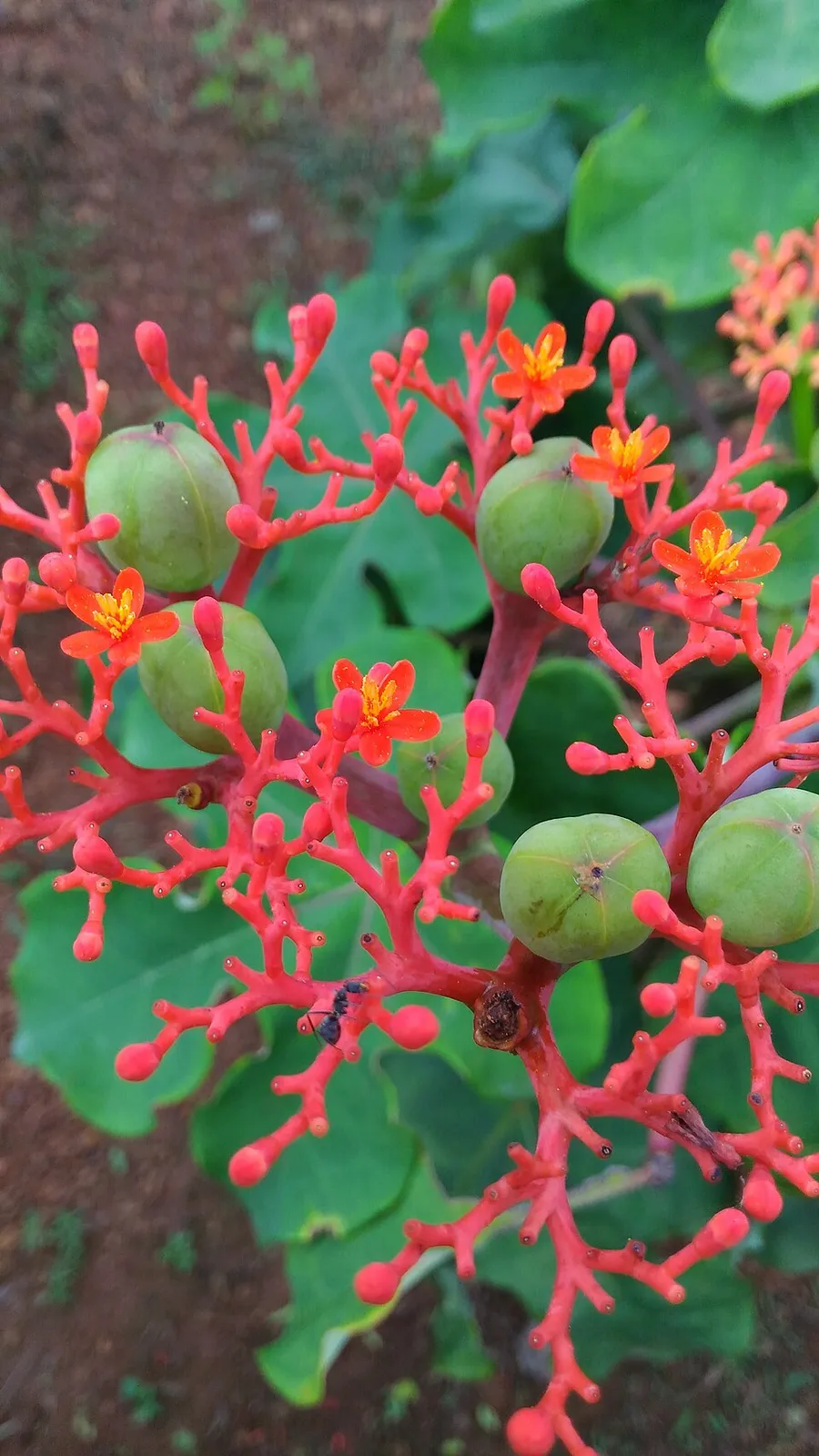
Jatropha podagrica, commonly known as the Buddha Belly Plant or Gout Plant, is a distinctive caudiciform succulent shrub belonging to the Euphorbiaceae family. Native to the tropical regions of the Americas, specifically from Mexico to Nicaragua, it thrives in warm climates. Its most striking morphological feature is its swollen, bottle-shaped, and often knobby stem, which serves as a water storage organ, giving it its common names.
This gray-skinned caudex can reach 2-3 feet in height when grown as a houseplant, but can soar up to 8 feet in its native habitat. From the upper portion of this unique stem sprout large, deeply lobed leaves, typically gray-green in color, measuring 4-8 inches wide with entire margins. These leaves are deciduous, often dropping in cooler seasons or during drought.
The plant produces vibrant clusters of orange-red flowers, borne on tall stalks above the foliage, which bloom semi-continuously throughout much of the year, even into winter. These showy cymes or panicles contain both male and female flowers. Following successful pollination, oval green seed capsules develop, maturing to brown before explosively dispersing their seeds, a characteristic method of propagation for this species.
Trusted Scientific References
1. Authoritative external sources for Jatropha podagrica
1.1 Wikipedia — Jatropha podagrica
1.2 Kew POWO (Plants of the World Online)
1.3 PubMed — peer-reviewed research
1.4 NCBI Taxonomy Browser
1.5 GBIF — Global Biodiversity
1.6Jatropha Podagrica should be interpreted through verified botanical identity, practical care, and responsible safety language. This recovery note adds the missing context needed for a complete profile: match light to the plant's habit, use well-drained soil, water according to season, and avoid unsupported medicinal or edible claims. For publishing, the plant can be presented as a source-backed indoor plant with clear care guidance, common problem diagnosis, and conservative safety wording.
1.1.Jatropha Podagrica — Key Features
- ✓ <strong>Distinctive caudiciform succulent</strong> — Distinctive caudiciform succulent with a swollen, bottle-shaped stem.
- ✓ <strong>Produces vibrant orange</strong> — red flower clusters on tall stalks.
- ✓ <strong>Features large, lobed, gray</strong> — green deciduous leaves.
- ✓ <strong>Native to tropical Americas, thrives in warm, frost</strong> — free environments.
- ✓ <strong>Contains potent toxic</strong> — Contains potent toxic compounds, including curcin and phorbol esters.
- ✓ <strong>Traditionally recognized for</strong> — Traditionally recognized for its strong purgative properties, but highly poisonous.
- ✓ <strong>Low</strong> — maintenance plant suitable for container growing.
- ✓ <strong>Capable of growing</strong> — Capable of growing up to 8 feet tall in its natural habitat.
- ✓ <strong>All parts of</strong> — All parts of the plant are considered toxic if ingested.
- ✓ <strong>Propagates easily from</strong> — Propagates easily from seeds or stem cuttings.
1.2.Jatropha Podagrica — Quick Summary
- ✓ Jatropha podagrica is an ornamental succulent known as the Buddha Belly Plant.
- ✓ Characterized by a unique swollen stem and vibrant orange-red flowers.
- ✓ Contains highly toxic compounds, including curcin and diterpenoids.
- ✓ Traditionally used as a powerful purgative, but ingestion is extremely dangerous.
- ✓ Sap causes contact dermatitis; handle with extreme caution and protective gear.
- ✓ Primarily cultivated as a striking houseplant or tropical garden specimen.
2.Jatropha Podagrica — Scientific Identity
3.Jatropha Podagrica — Quick Facts
4.Jatropha Podagrica — Appearance & Identification
5.Jatropha Podagrica — Native Habitat
6.Jatropha Podagrica — Water Requirements
- ✓ Light Requirements — Provide Jatropha podagrica with full sun to partial shade; it thrives with at least 6 hours of direct sunlight daily.
- ✓ Soil Preference — Ensure well-drained soil, ideally a sandy loam mixture, to prevent root rot, which is common in succulents.
- ✓ Watering Schedule — Allow the soil to dry out completely between waterings, reducing frequency significantly during its dormant period in winter.
- ✓ Container Growing — This plant is excellent for container cultivation, especially in regions with frost, requiring pots with ample drainage holes.
- ✓ Temperature and Humidity — Prefers warm tropical conditions; protect from frost and bring indoors when temperatures drop below 50°F (10°C).
- ✓ Propagation — Easily propagated from fresh seeds, which can be collected by bagging the capsules to prevent explosive dispersal, or from stem cuttings.
- ✓ Winter Care — During fall, leaves may drop; reduce watering and maintain a slightly cooler temperature indoors to mimic its natural dormancy.
Reviewed by the Flora Medical Global Botanical Review Panel
Multi-disciplinary editorial group · Botany · Ethnobotany · Herbal-medicine literature
Who reviewed this: This page was checked by the Flora Medical Global Botanical Review Panel — an in-house editorial group of botany graduates, ethnobotany researchers, and horticulture practitioners who collectively maintain our 7,000+ plant encyclopedia. Meet the team.
Our 4-step verification process
1. Taxonomic verification
Scientific names and synonyms cross-checked against Kew POWO, World Flora Online, and The Plant List.
2. Phytochemical & medicinal cross-reference
Active compounds, traditional uses, and reported activities are cross-referenced with PubMed, USDA Dr. Duke's database, and peer-reviewed ethnobotanical literature.
3. Conservation & distribution check
Distribution, ecology, and conservation status confirmed against GBIF occurrence records and the IUCN Red List.
4. Editorial & safety review
Every entry passes an editorial pass for clarity, originality, and safety notices (toxicity, contraindications, dosage caveats) before publication.
Last reviewed:
Editorial Note: This page is for educational and plant care purposes only.
Written by: Flora Medical Global Editorial Team
Reviewed by: Flora Medical Global Botanical Review Panel
Last Updated: June 15, 2026







Jatropha Podagrica — Comments & Community Reviews
Rate this plant