
Care Disclaimer: Plant care recommendations are general guidelines based on common growing conditions. Individual results may vary based on your local environment, climate, and care routine. If your plant is toxic, keep it away from children and pets, and consult a veterinarian if accidental ingestion occurs.
1.Kalanchoe Thyrsiflora — Overview
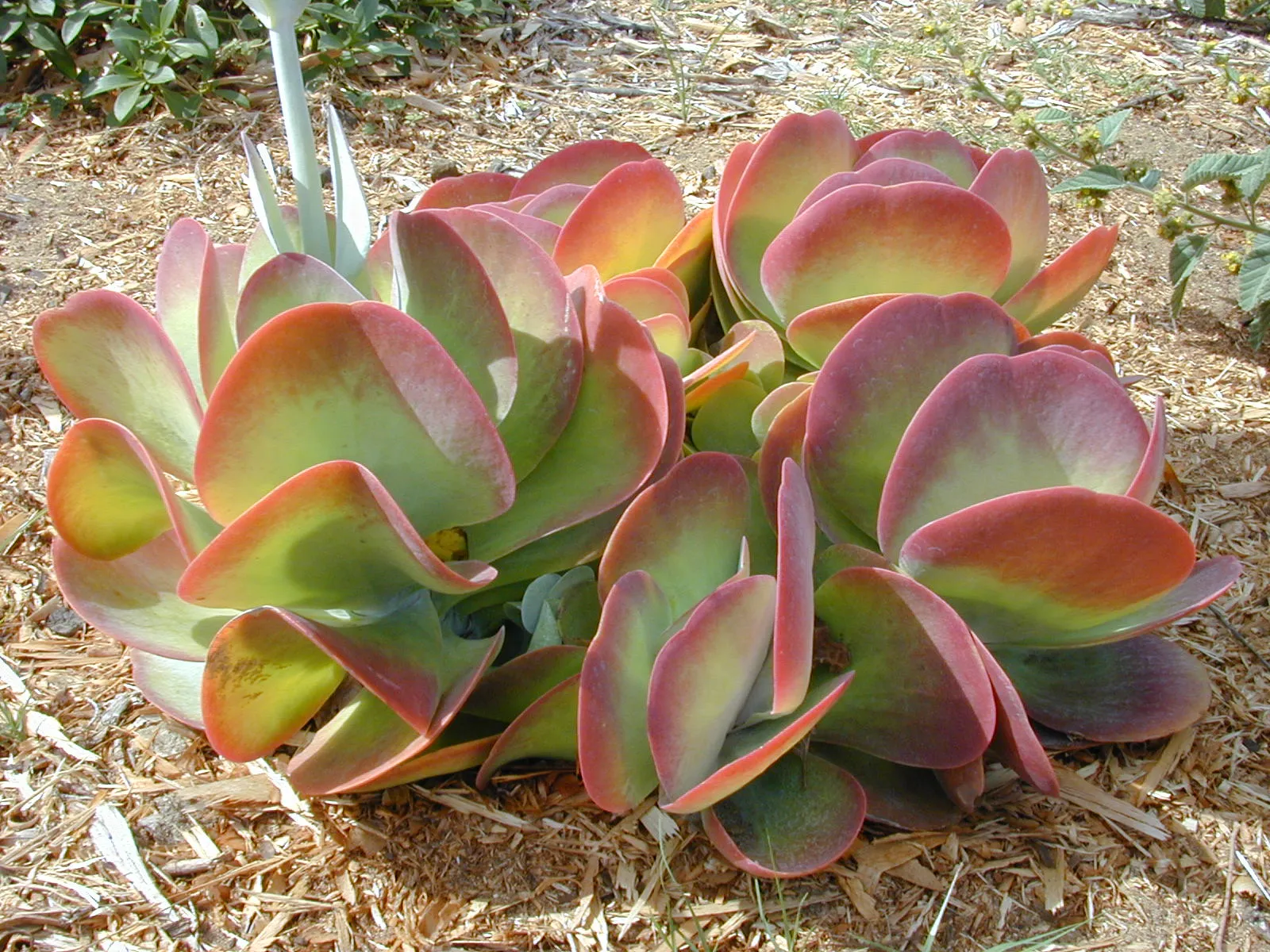
Kalanchoe thyrsiflora, widely recognized as the Flapjack Plant, Paddle Plant, Desert Cabbage, or Dog Tongue, is a distinctive succulent perennial belonging to the Crassulaceae family. This species is celebrated for its striking morphology, characterized by thick, fleshy, obovate to orbicular leaves that are arranged in a basal rosette. The leaves can grow up to 10-15 cm in length and width, often displaying a glaucous, pale green to grayish-white surface that develops prominent reddish-pink margins when exposed to ample sunlight or environmental stress.
This vibrant coloration is a key ornamental feature, intensifying during cooler months or under direct sun. The leaves are typically sessile, clasping the stem, and stacked like pancakes, giving rise to its common 'Flapjack' moniker. The plant usually grows as a monocarpic rosette, meaning the main rosette flowers once and then dies, though it often produces offsets (pups) at its base to continue the growth cycle.
From the center of the mature rosette, a tall, erect inflorescence stalk emerges, typically reaching heights of 60-150 cm. This robust stalk is often covered with a white, waxy bloom, known as farina or epicuticular wax, and bears numerous small, tubular, yellow to orange-yellow flowers. The flowers are arranged in dense, terminal thyrses or panicles, appearing from late winter to spring.
Each flower features four fused petals, characteristic of the Kalanchoe genus, and contains eight stamens. The root system of Kalanchoe thyrsiflora is generally shallow and fibrous, adapted for efficient water absorption from superficial soil layers, a common trait among succulents thriving in arid environments. The stem, when present and mature, is thick and woody at the base, becoming more herbaceous towards the apex, supporting the substantial weight of the succulent leaves and the tall flower stalk.
Native to the arid and semi-arid regions of South Africa, particularly the Free State, KwaZulu-Natal, and Mpumalanga provinces, Kalanchoe thyrsiflora thrives in well-drained, sandy soils and is highly drought-tolerant. It is sometimes confused with Kalanchoe luciae, but K.
thyrsiflora typically has a more pronounced white powdery coating (farina) and yellow, fragrant flowers.
Trusted Scientific References
1. Authoritative external sources for Kalanchoe thyrsiflora
1.1 Wikipedia — Kalanchoe thyrsiflora
1.2 Kew POWO (Plants of the World Online)
1.3 PubMed — peer-reviewed research
1.4 NCBI Taxonomy Browser
1.5 GBIF — Global Biodiversity
1.1.Kalanchoe Thyrsiflora — Key Features
- ✓ <strong>Common Names</strong> — Flapjack Plant, Paddle Plant, Desert Cabbage, Dog Tongue.
- ✓ <strong>Scientific Name</strong> — Kalanchoe thyrsiflora, belonging to the Crassulaceae family.
- ✓ <strong>Distinctive Foliage</strong> — Thick, obovate to orbicular leaves with a glaucous surface and vibrant red margins.
- ✓ <strong>Growth Habit</strong> — Forms a basal rosette, monocarpic (flowers once then dies), but produces numerous offsets.
- ✓ <strong>Inflorescence</strong> — A tall (up to 1.5m), erect spike bearing dense clusters of small, yellow, tubular flowers.
- ✓ <strong>Native Range</strong> — Indigenous to arid and semi-arid regions of South Africa.
- ✓ <strong>Toxicity</strong> — Contains cardiac glycosides (bufadienolides), rendering it toxic to humans and pets upon ingestion.
- ✓ <strong>Cultivation</strong> — Prefers full sun, well-drained soil, and is highly drought-tolerant.
- ✓ <strong>Ornamental Value</strong> — Highly prized globally for its unique form, striking coloration, and architectural interest in gardens and containers.
- ✓ <strong>Protective Farina</strong> — Leaves are covered with a powdery white wax, epicuticular wax, which aids in water conservation and sun protection.
1.2.Kalanchoe Thyrsiflora — Quick Summary
- ✓ Kalanchoe thyrsiflora is an ornamental succulent known for its striking paddle-shaped, red-edged leaves.
- ✓ Native to South Africa, it thrives in arid, sunny conditions with minimal water.
- ✓ Characterized by a monocarpic growth habit, flowering once then producing offsets.
- ✓ Contains bufadienolides, making it toxic if ingested by humans or pets.
- ✓ Requires well-drained soil, full sun, and careful handling to preserve its protective farina.
- ✓ Primarily valued for its aesthetic appeal in xeriscapes and as a low-maintenance houseplant.
2.Kalanchoe Thyrsiflora — Scientific Identity
3.Kalanchoe Thyrsiflora — Quick Facts
4.Kalanchoe Thyrsiflora — Appearance & Identification
5.Kalanchoe Thyrsiflora — Native Habitat
6.Kalanchoe Thyrsiflora — Water Requirements
- ✓ Soil Requirements — Plant in loose, sandy, well-drained soil, ideally a specialized cactus or succulent mix to prevent root rot.
- ✓ Light Exposure — Requires full sun outdoors; indoors, provide direct to bright, indirect sunlight, such as from a south or west-facing window.
- ✓ Watering Regime — Water deeply only when the soil has completely dried out; allow full drainage and significantly reduce watering during winter dormancy.
- ✓ Temperature and Humidity — Thrives in warm temperatures (above 30°F/-1°C) and low humidity; it is highly sensitive to frost and cold conditions.
- ✓ Fertilization Schedule — Feed monthly from late winter through summer with a balanced liquid houseplant fertilizer diluted to half strength, ceasing in fall and winter.
- ✓ Farina Protection — Handle with care to preserve the natural powdery, white wax (farina) on leaves, which is crucial for sun protection and water retention.
- ✓ Container Growing — Excellent for pots due to its shallow root system and preference for controlled environments, especially in regions colder than USDA Zone 10.
- ✓ Propagation — Easily propagated from stem cuttings or by carefully separating the offsets (pups) that develop around the base of the mature plant.
Reviewed by the Flora Medical Global Botanical Review Panel
Multi-disciplinary editorial group · Botany · Ethnobotany · Herbal-medicine literature
Who reviewed this: This page was checked by the Flora Medical Global Botanical Review Panel — an in-house editorial group of botany graduates, ethnobotany researchers, and horticulture practitioners who collectively maintain our 7,000+ plant encyclopedia. Meet the team.
Our 4-step verification process
1. Taxonomic verification
Scientific names and synonyms cross-checked against Kew POWO, World Flora Online, and The Plant List.
2. Phytochemical & medicinal cross-reference
Active compounds, traditional uses, and reported activities are cross-referenced with PubMed, USDA Dr. Duke's database, and peer-reviewed ethnobotanical literature.
3. Conservation & distribution check
Distribution, ecology, and conservation status confirmed against GBIF occurrence records and the IUCN Red List.
4. Editorial & safety review
Every entry passes an editorial pass for clarity, originality, and safety notices (toxicity, contraindications, dosage caveats) before publication.
Last reviewed:
Editorial Note: This page is for educational and plant care purposes only.
Written by: Flora Medical Global Editorial Team
Reviewed by: Flora Medical Global Botanical Review Panel
Last Updated: June 15, 2026







Kalanchoe Thyrsiflora — Comments & Community Reviews
Rate this plant