
Care Disclaimer: Plant care recommendations are general guidelines based on common growing conditions. Individual results may vary based on your local environment, climate, and care routine. If your plant is toxic, keep it away from children and pets, and consult a veterinarian if accidental ingestion occurs.
1.Kalanchoe Tomentosa — Overview
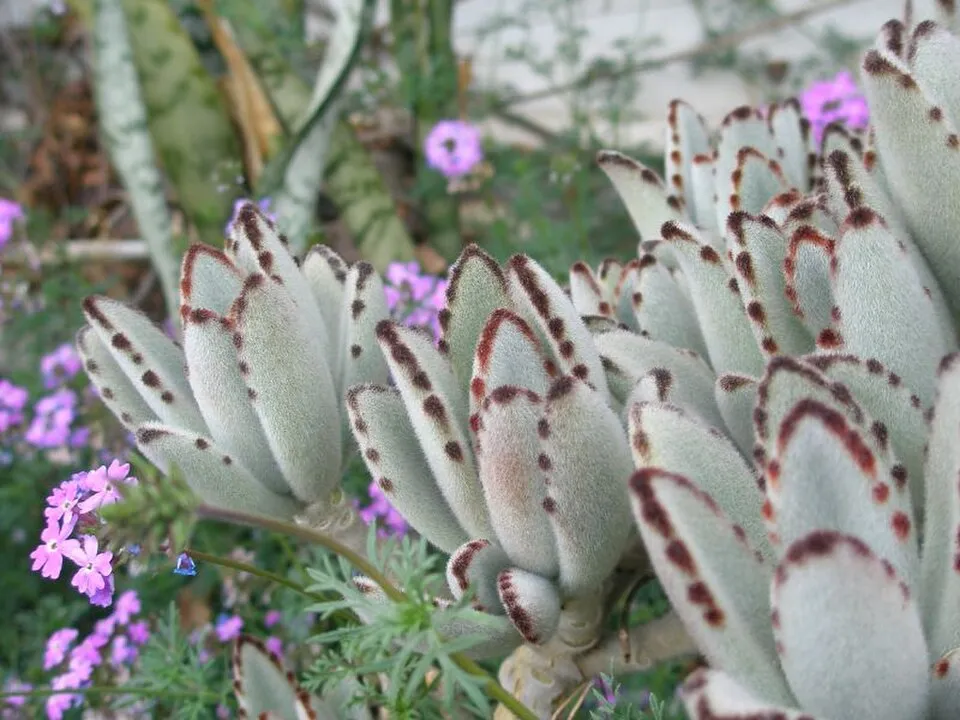
Kalanchoe tomentosa, widely recognized as the Panda Plant or Pussy Ears, is an endearing succulent species native to the high-altitude, arid, and semi-arid regions of Madagascar. This fascinating perennial, a member of the diverse Crassulaceae family, typically forms a compact, shrub-like growth reaching an average height of 30 to 60 cm (1 to 2 feet) in cultivation, though it can achieve greater dimensions in its natural habitat or optimal outdoor settings. Its most distinguishing characteristic lies in its thick, obovate to spatulate leaves, which typically measure 7 to 10 cm (3 to 4 inches) in length.
These leaves are densely covered with fine, soft, silvery-white trichomes, imparting a unique velvety, felt-like texture. The leaf margins are strikingly adorned with reddish-brown or rust-colored tips, often appearing as small, distinct teeth or spots, which provide a beautiful contrast against the pale green or gray-green lamina.
The stems of Kalanchoe tomentosa are robust and erect, gradually becoming somewhat woody with maturity, and are also covered in a fine pubescence, albeit less dense than that on the foliage. The root system is generally fibrous and shallow, a common adaptation for succulents thriving in rocky, well-draining soils, enabling efficient absorption of infrequent rainfall. While primarily cultivated for its ornamental foliage, the Panda Plant can produce inflorescences under ideal environmental conditions, typically during late winter or early spring.
These consist of terminal clusters of small, bell-shaped flowers, often presenting in shades of yellow, orange, or greenish-yellow, sometimes with subtle red or purple tinges. These delicate flowers are usually borne on sturdy stalks extending above the leaves, adding another layer to its aesthetic appeal.
Taxonomically, Kalanchoe tomentosa is part of the extensive Kalanchoe genus, which encompasses over 100 species, many of which are endemic to Madagascar and various parts of Africa. Its remarkable adaptation to harsh, dry environments is evident in its succulent leaves, which function as efficient water storage organs, allowing it to endure prolonged periods of drought.
Trusted Scientific References
1. Authoritative external sources for Kalanchoe tomentosa
1.1 Wikipedia — Kalanchoe tomentosa
1.2 Kew POWO (Plants of the World Online)
1.3 PubMed — peer-reviewed research
1.4 NCBI Taxonomy Browser
1.5 GBIF — Global Biodiversity
1.1.Kalanchoe Tomentosa — Key Features
- ✓ <strong>Velvety Foliage</strong> — Thick, obovate leaves covered in soft, silvery-white trichomes, giving a felt-like texture.
- ✓ <strong>Distinctive Leaf Margins</strong> — Reddish-brown or rust-colored tips adorn the edges of the leaves, creating a striking contrast.
- ✓ <strong>Succulent Adaptation</strong> — Stores water in its fleshy leaves, enabling drought tolerance.
- ✓ <strong>Compact Growth Habit</strong> — Typically forms a shrub-like plant reaching 30-60 cm in height.
- ✓ <strong>Crassulacean Acid Metabolism (CAM)</strong> — A specialized photosynthetic pathway for water conservation.
- ✓ <strong>Fibrous Root System</strong> — Shallow roots adapted for quick absorption of surface moisture.
- ✓ <strong>Bell</strong> — shaped Flowers — Produces terminal clusters of small, typically yellow, orange, or greenish-yellow flowers under ideal conditions.
- ✓ <strong>Native to Madagascar</strong> — Endemic to the arid and semi-arid regions of the island.
- ✓ <strong>Low Water Needs</strong> — Highly drought-tolerant due to its succulent nature.
- ✓ <strong>Easy to Propagate</strong> — Can be easily reproduced from stem or leaf cuttings.
1.2.Kalanchoe Tomentosa — Quick Summary
- ✓ Velvety Succulent — Kalanchoe tomentosa is known for its distinctive fuzzy, gray-green leaves with brown tips.
- ✓ Native to Madagascar — Originates from arid regions of Madagascar, adapting well to dry conditions.
- ✓ Low Maintenance — Requires minimal watering and bright light, making it popular for succulent enthusiasts.
- ✓ Ornamental Value — Primarily cultivated for its unique aesthetic appeal rather than widespread medicinal use.
- ✓ Potential Toxicity — Like many Kalanchoe species, it contains compounds that can be toxic if ingested.
- ✓ Easy Propagation — Readily propagated from stem or leaf cuttings.
2.Kalanchoe Tomentosa — Scientific Identity
3.Kalanchoe Tomentosa — Quick Facts
4.Kalanchoe Tomentosa — Appearance & Identification
5.Kalanchoe Tomentosa — Native Habitat
6.Kalanchoe Tomentosa — Water Requirements
- ✓ Light — Provide at least 6 hours of bright, indirect sunlight daily; can tolerate partial shade but thrives in full sun for robust growth.
- ✓ Temperature — Ideal growth occurs between 15°C and 23°C (60°F-75°F); protect from frost as it is not cold-hardy.
- ✓ Watering — Water only when the soil is completely dry, typically every 2-4 weeks; avoid overwatering to prevent root rot.
- ✓ Soil — Requires a well-draining cactus or succulent potting mix, optionally enhanced with perlite, pumice, or gritty rocks to ensure aeration.
- ✓ Fertilization — Feed mature plants with a diluted succulent-specific fertilizer during spring and autumn, its active growing seasons.
- ✓ Potting — Use pots with drainage holes to prevent water accumulation; repot annually with fresh soil if not fertilizing.
- ✓ Pruning — Prune leggy growth or dead leaves to maintain shape and encourage bushier development; leggy plants indicate insufficient light.
- ✓ Pest Control — Monitor for common succulent pests like mealybugs or spider mites; treat with insecticidal soap or diluted neem oil if infestations occur.
Reviewed by the Flora Medical Global Botanical Review Panel
Multi-disciplinary editorial group · Botany · Ethnobotany · Herbal-medicine literature
Who reviewed this: This page was checked by the Flora Medical Global Botanical Review Panel — an in-house editorial group of botany graduates, ethnobotany researchers, and horticulture practitioners who collectively maintain our 7,000+ plant encyclopedia. Meet the team.
Our 4-step verification process
1. Taxonomic verification
Scientific names and synonyms cross-checked against Kew POWO, World Flora Online, and The Plant List.
2. Phytochemical & medicinal cross-reference
Active compounds, traditional uses, and reported activities are cross-referenced with PubMed, USDA Dr. Duke's database, and peer-reviewed ethnobotanical literature.
3. Conservation & distribution check
Distribution, ecology, and conservation status confirmed against GBIF occurrence records and the IUCN Red List.
4. Editorial & safety review
Every entry passes an editorial pass for clarity, originality, and safety notices (toxicity, contraindications, dosage caveats) before publication.
Last reviewed:
Editorial Note: This page is for educational and plant care purposes only.
Written by: Flora Medical Global Editorial Team
Reviewed by: Flora Medical Global Botanical Review Panel
Last Updated: June 15, 2026







Kalanchoe Tomentosa — Comments & Community Reviews
Rate this plant