

Care Disclaimer: Plant care recommendations are general guidelines based on common growing conditions. Individual results may vary based on your local environment, climate, and care routine. If your plant is toxic, keep it away from children and pets, and consult a veterinarian if accidental ingestion occurs.
1.Lapidaria Margaretae — Overview
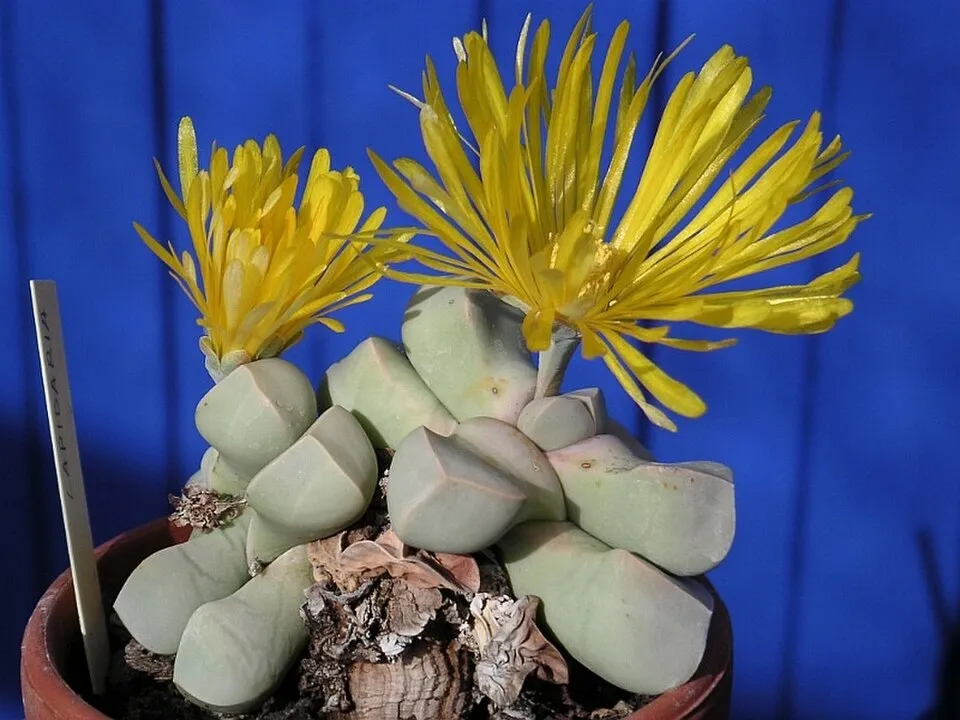
Lapidaria margaretae, affectionately known as the 'Living Jewel', 'Pebble Plant', or 'Karoo Rose', is a singular species within its genus, belonging to the diverse Aizoaceae family. This compact succulent is celebrated for its remarkable mimicry, with keeled leaf bodies that strongly resemble the quartz and gneiss rocks of its natural habitat. Native exclusively to a small, arid region spanning the Warmbad area of southern Namibia and extending into South Africa's Northern Cape Province, it thrives in mineral-rich, rocky landscapes.
The plant typically grows to a modest height of up to 15 cm, featuring thick, fleshy leaves that are variable in shape, often rounded or slightly oval, measuring between 2-5 cm in length. These leaves present a vibrant green hue, which can intensify to shades of red or purple at the tips when exposed to ample sunlight. Its stem develops a distinctive cork-like texture, reminiscent of tree bark, contributing to its unique aesthetic.
In late summer or autumn, when conditions are optimal, Lapidaria margaretae produces small, delicate, star-shaped flowers, typically displaying pale yellow to white petals. As a quintessential drought-resistant plant, it efficiently stores water within its robust leaves, making it an ideal candidate for xeriscaping or as a captivating indoor ornamental, particularly in drier climates. Its taxonomic position was once debated, having been included in the genus Dinteranthus, but it is now recognized as the sole member of its own genus, Lapidaria, highlighting its distinct botanical characteristics.
Trusted Scientific References
1. Authoritative external sources for Lapidaria margaretae
1.1 Wikipedia — Lapidaria margaretae
1.2 Kew POWO (Plants of the World Online)
1.3 PubMed — peer-reviewed research
1.4 NCBI Taxonomy Browser
1.5 GBIF — Global Biodiversity
1.6Lapidaria Margaretae should be interpreted through verified botanical identity, practical care, and responsible safety language. This recovery note adds the missing context needed for a complete profile: match light to the plant's habit, use well-drained soil, water according to season, and avoid unsupported medicinal or edible claims. For publishing, the plant can be presented as a source-backed indoor plant with clear care guidance, common problem diagnosis, and conservative safety wording.
1.1.Lapidaria Margaretae — Key Features
- ✓ <strong>Species Mimicry</strong> — Leaves strongly resemble quartz and gneiss rocks.
- ✓ <strong>Monotypic Genus</strong> — Sole species in the genus Lapidaria.
- ✓ <strong>Drought</strong> — Tolerant — Excellent water storage in fleshy leaves.
- ✓ <strong>Compact Growth</strong> — Small, slow-growing, ideal for small spaces.
- ✓ <strong>Unique Stem Texture</strong> — Cork-like bark on mature stems.
- ✓ <strong>Star</strong> — Shaped Flowers — Delicate pale yellow to white blooms.
- ✓ <strong>Native to Arid Regions</strong> — Thrives in the Karoo region of Southern Africa.
- ✓ <strong>Low Maintenance</strong> — Relatively easy to care for compared to other mesembs.
- ✓ <strong>Aizoaceae Family</strong> — Member of the 'ice plant' family, known for succulents.
- ✓ <strong>Ornamental Appeal</strong> — Highly valued for its distinctive aesthetic in cultivation.
1.2.Lapidaria Margaretae — Quick Summary
- ✓ Unique 'Living Jewel' succulent, native to South Africa/Namibia.
- ✓ Mimics quartz rocks in its arid natural habitat.
- ✓ Primarily an ornamental plant; known for drought resistance.
- ✓ Medicinal properties are largely undocumented and speculative.
- ✓ Requires very bright light and minimal watering.
- ✓ Belongs to the Aizoaceae family, with potential for phytochemical research.
2.Lapidaria Margaretae — Scientific Identity
3.Lapidaria Margaretae — Quick Facts
4.Lapidaria Margaretae — Appearance & Identification
5.Lapidaria Margaretae — Native Habitat
6.Lapidaria Margaretae — Water Requirements
- ✓ Soil & Potting — Use a fast-draining, gritty succulent/cactus mix, ideally 1:1 with pumice, low in organic material. A shallow pot is preferred due to its small root system.
- ✓ Watering — Water sparingly. During active growth (autumn, sometimes spring), water when soil is completely dry. Withhold water during summer heat and winter dormancy.
- ✓ Light — Requires very bright light; a south-facing window indoors or partial shade outdoors, protecting from the hottest afternoon sun, is ideal for blooming and growth.
- ✓ Temperature — Prefers warmer winters but can tolerate freezing temperatures if kept completely dry. Goes dormant in very hot summer conditions.
- ✓ Fertilizing — Generally unnecessary. If desired, use a very dilute cactus fertilizer once or twice a year during the main growing season, especially if using distilled water.
- ✓ Propagation — Primarily propagated by seed, as leaf or stem cuttings are typically unsuccessful for this species.
- ✓ Dormancy Care — Reduce or cease watering during summer and winter dormancy periods, resuming sparingly when growth indicates.
- ✓ Avoiding Splits — Be cautious not to overwater, as sudden absorption can cause leaves to split, which is unsightly and creates potential entry points for pests.
Reviewed by the Flora Medical Global Botanical Review Panel
Multi-disciplinary editorial group · Botany · Ethnobotany · Herbal-medicine literature
Who reviewed this: This page was checked by the Flora Medical Global Botanical Review Panel — an in-house editorial group of botany graduates, ethnobotany researchers, and horticulture practitioners who collectively maintain our 7,000+ plant encyclopedia. Meet the team.
Our 4-step verification process
1. Taxonomic verification
Scientific names and synonyms cross-checked against Kew POWO, World Flora Online, and The Plant List.
2. Phytochemical & medicinal cross-reference
Active compounds, traditional uses, and reported activities are cross-referenced with PubMed, USDA Dr. Duke's database, and peer-reviewed ethnobotanical literature.
3. Conservation & distribution check
Distribution, ecology, and conservation status confirmed against GBIF occurrence records and the IUCN Red List.
4. Editorial & safety review
Every entry passes an editorial pass for clarity, originality, and safety notices (toxicity, contraindications, dosage caveats) before publication.
Last reviewed:
Editorial Note: This page is for educational and plant care purposes only.
Written by: Flora Medical Global Editorial Team
Reviewed by: Flora Medical Global Botanical Review Panel
Last Updated: June 15, 2026







Lapidaria Margaretae — Comments & Community Reviews
Rate this plant