
Care Disclaimer: Plant care recommendations are general guidelines based on common growing conditions. Individual results may vary based on your local environment, climate, and care routine. If your plant is toxic, keep it away from children and pets, and consult a veterinarian if accidental ingestion occurs.
1.Living Stones — Overview
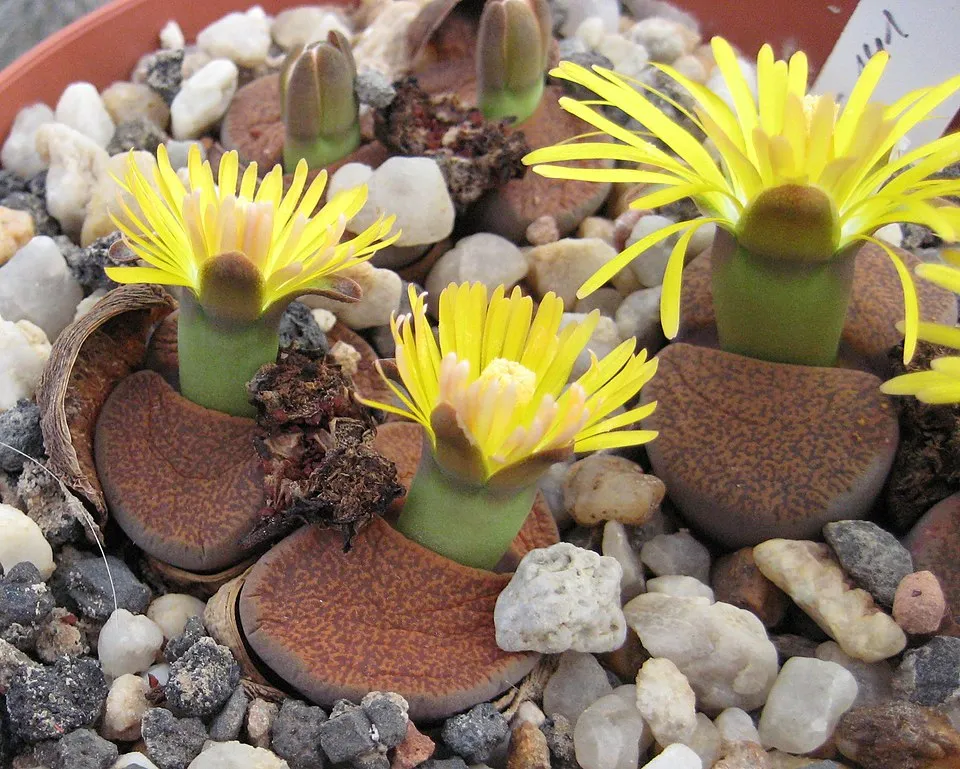
Lithops lesliei, widely recognized as Living Stones, is an exquisitely adapted succulent species native to the arid and semi-arid regions of southern Africa, specifically found across parts of South Africa, Namibia, and Botswana. This diminutive plant is a master of camouflage, evolving a morphology that allows it to blend seamlessly with the surrounding stones and pebbles in its natural habitat, primarily consisting of rocky, sandy, or gravelly soils with exceptional drainage. Its unique growth habit involves two remarkably fleshy, fused leaves that form a distinctive obconical or inverted cone shape, resembling a cleft stone. These leaves, typically ranging from 4 to 8 centimeters in diameter and 2 to 7 centimeters in height, are the plant's primary water storage organs.
The coloration of Lithops lesliei is incredibly variable, spanning shades of pale green, gray, yellowish, or even reddish-brown, often adorned with intricate patterns of windows, lines, and dots on their apical surfaces. These 'windows' are translucent areas that allow sunlight to penetrate deeper into the leaf tissue, facilitating photosynthesis while the bulk of the plant remains buried and protected from intense sun and herbivores. The root system of Lithops lesliei consists of a robust taproot that anchors the plant firmly in the substrate and allows it to access deeper moisture during rare rainfall events. A short, almost imperceptible stem connects the leaf pair to the root.
During late summer to early autumn, this fascinating succulent produces solitary, daisy-like flowers that emerge from the fissure between the two leaves. These charming blooms are typically white or pale yellow, sometimes with a slight fragrance, and are pollinated by insects. Taxonomically, Lithops lesliei belongs to the Aizoaceae family, a diverse group of succulent plants known for their adaptations to extreme environments, including specialized water-storing leaves and CAM photosynthesis.
Trusted Scientific References
1. Authoritative external sources for Lithops lesliei
1.1 Wikipedia — Lithops lesliei
1.2 Kew POWO (Plants of the World Online)
1.3 PubMed — peer-reviewed research
1.4 NCBI Taxonomy Browser
1.5 GBIF — Global Biodiversity
1.1.Living Stones — Key Features
- ✓ <strong>Master of camouflage,</strong> — Master of camouflage, blending with surrounding stones.
- ✓ <strong>Fleshy, fused leaves</strong> — Fleshy, fused leaves with distinctive 'windows' for photosynthesis.
- ✓ <strong>Robust taproot system</strong> — Robust taproot system for anchoring and deep moisture access.
- ✓ <strong>Solitary, daisy</strong> — like white or pale yellow flowers.
- ✓ <strong>Extremely drought</strong> — tolerant, adapted to arid environments.
- ✓ <strong>Native to the</strong> — Native to the arid regions of Southern Africa.
- ✓ <strong>Requires minimal water,</strong> — Requires minimal water, especially during specific growth phases.
- ✓ <strong>Prefers full sun</strong> — Prefers full sun exposure for optimal growth and form.
- ✓ <strong>Slow</strong> — growing perennial, long-lived with proper care.
- ✓ <strong>Belongs to the</strong> — Belongs to the highly specialized Aizoaceae family.
1.2.Living Stones — Quick Summary
- ✓ Unique succulent mimicking stones, native to Southern Africa.
- ✓ Requires abundant sunlight and extremely well-draining soil.
- ✓ Critical watering regime: minimal, especially during rest and new leaf emergence.
- ✓ Primarily an ornamental plant; no established medicinal uses.
- ✓ Non-toxic and safe for homes with children and pets.
- ✓ Thrives in deep pots due to its robust taproot.
2.Living Stones — Scientific Identity
3.Living Stones — Quick Facts
4.Living Stones — Appearance & Identification
5.Living Stones — Native Habitat
6.Living Stones — Water Requirements
- Cultivating Lithops lesliei requires attention to its specialized desert adaptations to ensure its unique form and health.
- ✓ Light — Requires plentiful sunlight year-round, ideally a minimum of six hours of direct sun per day; artificial lights may be necessary indoors.
- ✓ Water — The watering regime is critical: water sparingly in spring/summer to keep barely moist, deeply but infrequently when a bud appears, and cease watering entirely after flowering and during new leaf emergence.
- ✓ Soil — Essential to use a loose, fast-draining soil mix; typically equal parts potting soil and sand, or a commercial cactus mix without added nutrients.
- ✓ Potting — Use a deep pot to accommodate its long taproot; repotting is only needed every four years or when crowded.
- ✓ Temperature — Thrives in normal room temperatures, but must be kept above 50°F (10°C) to prevent cold damage.
- ✓ Nutrition — Feeding is generally unnecessary as Lithops lesliei obtains sufficient limited nutrition from its specialized soil mixture.
- ✓ Air Circulation — Good air circulation is a must; keep separate from other plants that require high humidity or misting.
- ✓ Rest Period — Observe a distinct rest period after flowering and during the emergence of new leaves, withholding water to prevent disruption of the natural cycle.
Reviewed by the Flora Medical Global Botanical Review Panel
Multi-disciplinary editorial group · Botany · Ethnobotany · Herbal-medicine literature
Who reviewed this: This page was checked by the Flora Medical Global Botanical Review Panel — an in-house editorial group of botany graduates, ethnobotany researchers, and horticulture practitioners who collectively maintain our 7,000+ plant encyclopedia. Meet the team.
Our 4-step verification process
1. Taxonomic verification
Scientific names and synonyms cross-checked against Kew POWO, World Flora Online, and The Plant List.
2. Phytochemical & medicinal cross-reference
Active compounds, traditional uses, and reported activities are cross-referenced with PubMed, USDA Dr. Duke's database, and peer-reviewed ethnobotanical literature.
3. Conservation & distribution check
Distribution, ecology, and conservation status confirmed against GBIF occurrence records and the IUCN Red List.
4. Editorial & safety review
Every entry passes an editorial pass for clarity, originality, and safety notices (toxicity, contraindications, dosage caveats) before publication.
Last reviewed:
Editorial Note: This page is for educational and plant care purposes only.
Written by: Flora Medical Global Editorial Team
Reviewed by: Flora Medical Global Botanical Review Panel
Last Updated: June 15, 2026







Living Stones — Comments & Community Reviews
Rate this plant