
Care Disclaimer: Plant care recommendations are general guidelines based on common growing conditions. Individual results may vary based on your local environment, climate, and care routine. If your plant is toxic, keep it away from children and pets, and consult a veterinarian if accidental ingestion occurs.
1.Livistona Rotundifolia — Overview
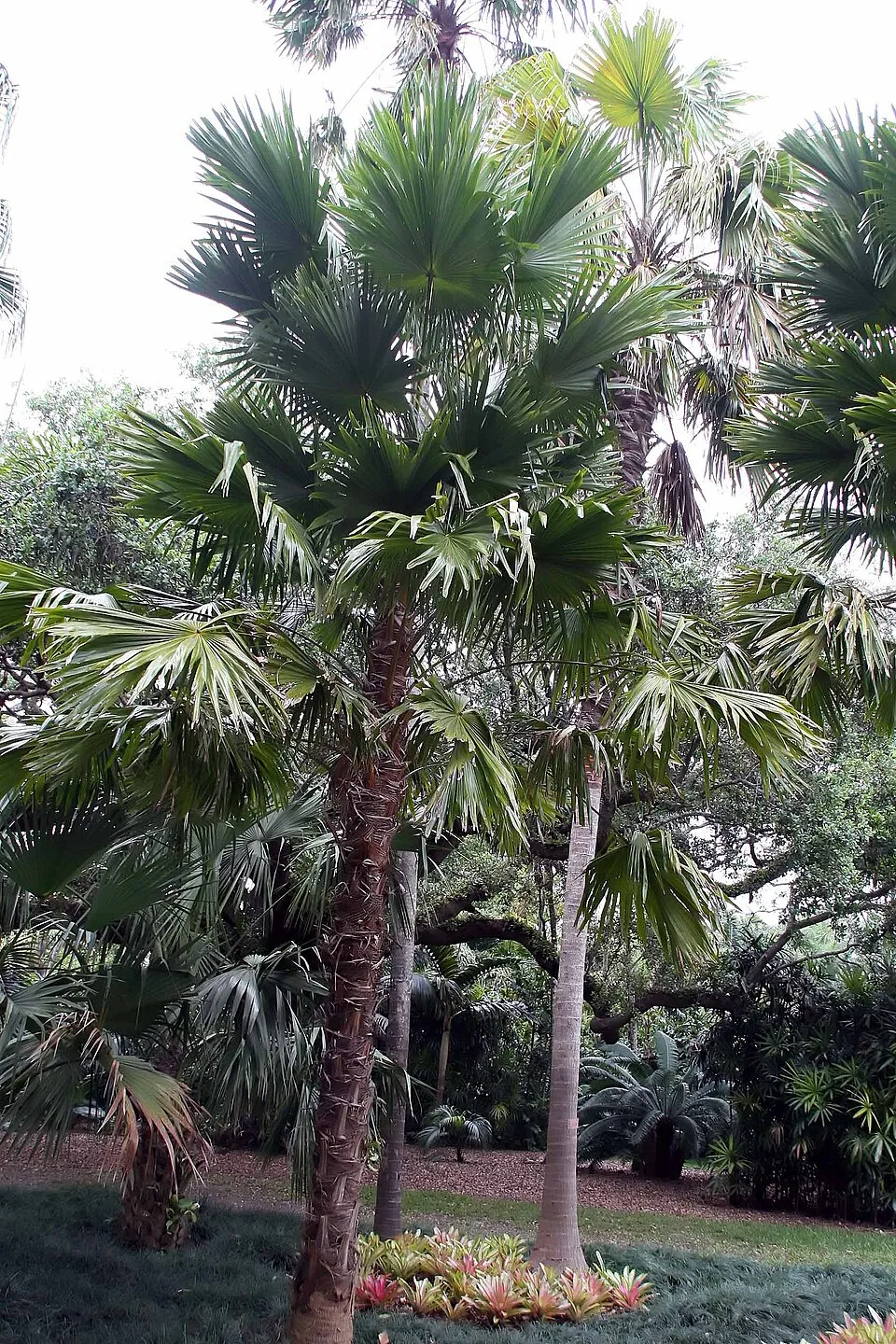
Livistona rotundifolia, commonly known as the Round-leaved Fan Palm or Footstool Palm, is a captivating member of the Arecaceae family, renowned for its striking ornamental presence. This solitary, erect palm can reach impressive heights of 15-20 meters (50-65 feet) in its native tropical environments, though it typically remains smaller when cultivated indoors. Its robust, columnar trunk, measuring 15-20 cm (6-8 inches) in diameter, exhibits a smooth, pale gray to light brown surface that may initially retain textured remnants of old leaf bases, smoothing out with maturity.
The most defining characteristic of Livistona rotundifolia is its large, circular, deeply segmented palmate leaves, which can span 1-1.5 meters (3-5 feet) across. Each frond is a vibrant, glossy dark green, radiating outwards like an open fan or umbrella, supported by stout, unarmed petioles (leaf stalks) that extend 1-2 meters (3-6 feet). Young petioles may have small, sharp teeth along their margins, which diminish with age.
The plant's fibrous, adventitious root system is typical of monocots, providing strong anchorage and efficient nutrient uptake. In its mature state, Livistona rotundifolia produces inconspicuous, yellowish-white flowers arranged in large, branching inflorescences up to 1-2 meters long, emerging from the leaf axils. These inflorescences bear small, spherical fruits, 1.5-2 cm in diameter, which ripen from green to a dark blue or black, each containing a single seed.
This species is indigenous to the humid tropical regions of Southeast Asia, specifically endemic to areas including Indonesia (Java, Sulawesi, Maluku), Malaysia (Peninsular Malaysia, Borneo), and the Philippines. It thrives in various habitats, from the understory of lowland rainforests to open coastal areas, demonstrating adaptability to different light and soil conditions within its warm, moist natural range.
Trusted Scientific References
1. Authoritative external sources for Livistona rotundifolia
1.1 Wikipedia — Livistona rotundifolia
1.2 Kew POWO (Plants of the World Online)
1.3 PubMed — peer-reviewed research
1.4 NCBI Taxonomy Browser
1.5 GBIF — Global Biodiversity
1.1.Livistona Rotundifolia — Key Features
- ✓ <strong>Large, circular, deeply</strong> — Large, circular, deeply segmented palmate leaves up to 1.5 meters across.
- ✓ <strong>Distinctive glossy dark</strong> — Distinctive glossy dark green fronds resembling an open fan.
- ✓ <strong>Solitary, erect trunk reaching up to 15</strong> — 20 meters in natural habitats.
- ✓ <strong>Native to humid</strong> — Native to humid tropical regions of Indonesia, Malaysia, and the Philippines.
- ✓ <strong>Classified as an air</strong> — purifying plant, removing indoor toxins.
- ✓ <strong>Generally considered non</strong> — toxic to humans and common household pets.
- ✓ <strong>Produces inconspicuous yellowish</strong> — white flowers and small, dark blue/black fruits.
- ✓ <strong>Requires consistent moisture,</strong> — Requires consistent moisture, high humidity, and indirect sunlight.
- ✓ <strong>Exhibits low susceptibility</strong> — Exhibits low susceptibility to common plant diseases and pests.
- ✓ <strong>A popular choice</strong> — A popular choice for both indoor and outdoor tropical landscaping.
1.2.Livistona Rotundifolia — Quick Summary
- ✓ Livistona rotundifolia is an ornamental Round-leaved Fan Palm from Southeast Asia.
- ✓ Known for its large, glossy, fan-shaped leaves and air-purifying qualities.
- ✓ Thrives in bright, indirect light and requires consistent moisture and high humidity.
- ✓ Generally considered non-toxic to humans and pets.
- ✓ While primarily ornamental, it may possess general plant phytochemical benefits like antioxidants.
- ✓ Cultivation is straightforward, making it a popular indoor and outdoor tropical plant.
2.Livistona Rotundifolia — Scientific Identity
3.Livistona Rotundifolia — Quick Facts
4.Livistona Rotundifolia — Appearance & Identification
5.Livistona Rotundifolia — Native Habitat
6.Livistona Rotundifolia — Water Requirements
- ✓ Light Requirements — Prefers bright, indirect sunlight for optimal growth; too much direct sun can scorch its fan-shaped leaves.
- ✓ Watering Schedule — Keep the soil consistently moist during warmer months (every 5-7 days), reducing frequency in cooler seasons (every 10-14 days), but avoid waterlogging.
- ✓ Soil & Potting — Thrives in well-draining, peat-based potting mix. Repot every 2-3 years into a pot at least 20% larger to accommodate root growth and replenish nutrients.
- ✓ Temperature & Humidity — Ideal temperatures range from 18-29°C (65-85°F). It prefers high humidity, so regular misting or a pebble tray is beneficial, especially indoors.
- ✓ Fertilization — Feed with a balanced liquid fertilizer every two weeks during the growing season (spring to late summer); reduce or cease in autumn and winter.
- ✓ Pruning — Only prune to remove dead, yellowed, or damaged fronds. Use clean, sharp tools to make cuts close to the trunk without damaging the main stem.
- ✓ Pest & Disease Management — Generally resistant to pests, but monitor for common houseplant issues like spider mites or mealybugs. Overwatering can lead to root rot.
Reviewed by the Flora Medical Global Botanical Review Panel
Multi-disciplinary editorial group · Botany · Ethnobotany · Herbal-medicine literature
Who reviewed this: This page was checked by the Flora Medical Global Botanical Review Panel — an in-house editorial group of botany graduates, ethnobotany researchers, and horticulture practitioners who collectively maintain our 7,000+ plant encyclopedia. Meet the team.
Our 4-step verification process
1. Taxonomic verification
Scientific names and synonyms cross-checked against Kew POWO, World Flora Online, and The Plant List.
2. Phytochemical & medicinal cross-reference
Active compounds, traditional uses, and reported activities are cross-referenced with PubMed, USDA Dr. Duke's database, and peer-reviewed ethnobotanical literature.
3. Conservation & distribution check
Distribution, ecology, and conservation status confirmed against GBIF occurrence records and the IUCN Red List.
4. Editorial & safety review
Every entry passes an editorial pass for clarity, originality, and safety notices (toxicity, contraindications, dosage caveats) before publication.
Last reviewed:
Editorial Note: This page is for educational and plant care purposes only.
Written by: Flora Medical Global Editorial Team
Reviewed by: Flora Medical Global Botanical Review Panel
Last Updated: June 15, 2026







Livistona Rotundifolia — Comments & Community Reviews
Rate this plant