

Care Disclaimer: Plant care recommendations are general guidelines based on common growing conditions. Individual results may vary based on your local environment, climate, and care routine. If your plant is toxic, keep it away from children and pets, and consult a veterinarian if accidental ingestion occurs.
1.Lycopodium Squarrosum — Overview
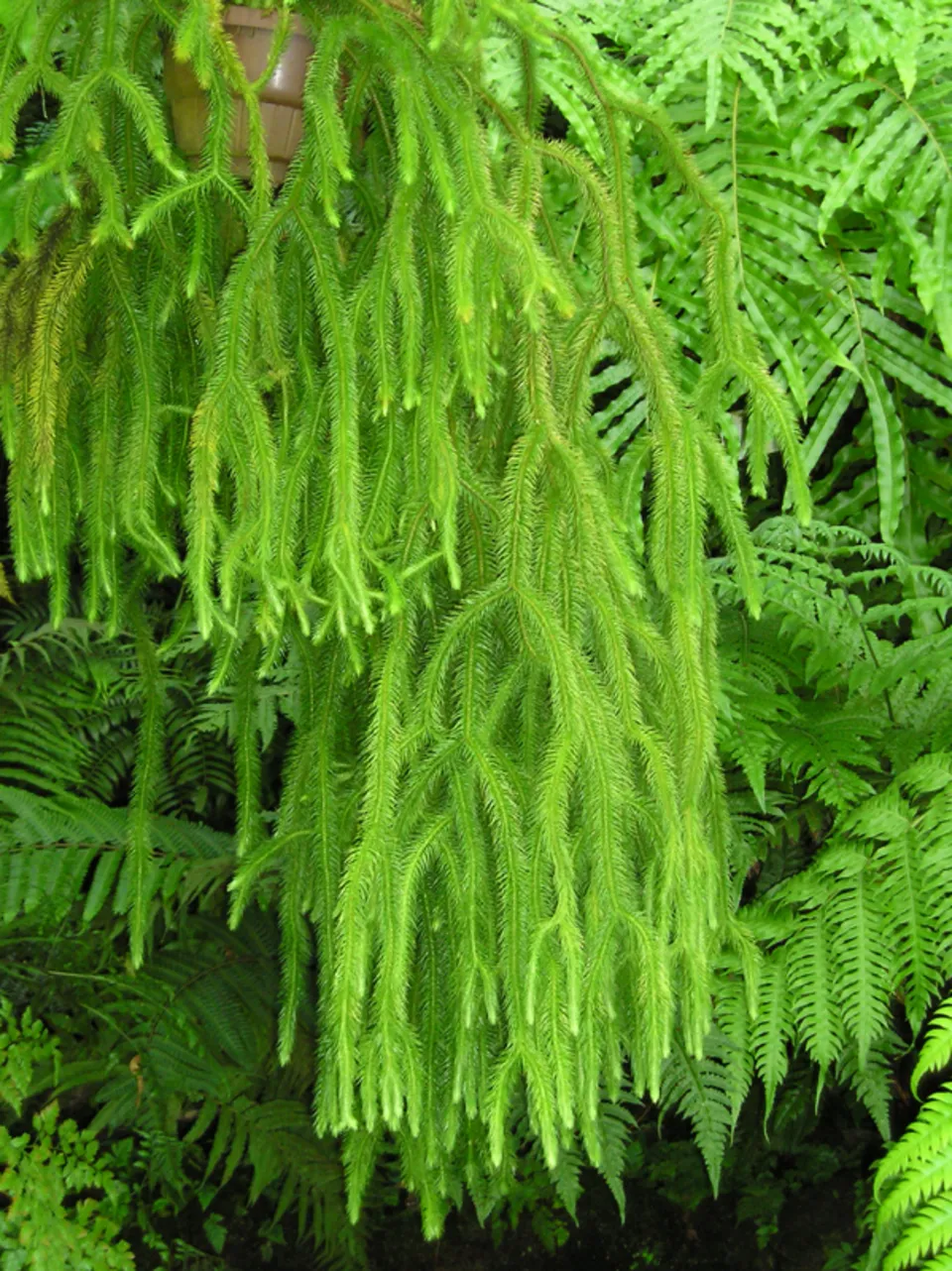
Phlegmariurus squarrosus, an ancient and captivating pteridophyte, is commonly known as Tassel Fern or Hanging Clubmoss, despite not being a true fern. It thrives as an epiphyte, anchoring itself to tree branches, or as a lithophyte, clinging to rock crevices in the humid, shaded understories of tropical and subtropical montane forests. This perennial clubmoss exhibits a striking pendulous or cascading growth habit, with robust yet flexible stems typically extending 30 to 90 cm.
Its densely packed foliage consists of small, spirally arranged, scale-like or needle-like leaves, each about 1 to 2 cm long, presenting a lush, muted green hue. Unlike flowering plants, Phlegmariurus squarrosus reproduces via spores, which are produced in specialized sporangia. These sporangia are aggregated into distinct, cylindrical strobili (cone-like structures) found terminally on branches, maturing to a pale yellow or light brown before releasing their fine, powdery spores for dispersal.
Its adventitious, fibrous root system provides firm anchorage. Geographically, Lycopodium squarrosum is widespread across Southeast Asia, including Thailand, Malaysia, Indonesia, and the Philippines, extending into parts of Australia and various Pacific islands. Taxonomically, it was historically classified under Lycopodium but has been reclassified into the genus Phlegmariurus following phylogenetic studies, underscoring its unique evolutionary lineage within the ancient Lycopodiaceae family.
Trusted Scientific References
1. Authoritative external sources for Phlegmariurus squarrosus
1.1 Wikipedia — Phlegmariurus squarrosus
1.2 Kew POWO (Plants of the World Online)
1.3 PubMed — peer-reviewed research
1.4 NCBI Taxonomy Browser
1.5 GBIF — Global Biodiversity
1.6Lycopodium Squarrosum should be interpreted through verified botanical identity, practical care, and responsible safety language. This recovery note adds the missing context needed for a complete profile: match light to the plant's habit, use well-drained soil, water according to season, and avoid unsupported medicinal or edible claims. For publishing, the plant can be presented as a source-backed indoor plant with clear care guidance, common problem diagnosis, and conservative safety wording.
1.1.Lycopodium Squarrosum — Key Features
- ✓ <strong>Ancient Vascular Plant</strong> — Belongs to the Lycopodiaceae family, one of the oldest lineages of vascular plants on Earth.
- ✓ <strong>Epiphytic/Lithophytic Growth</strong> — Naturally grows on trees or rocks, not in soil, adapting to its substrate with adventitious roots.
- ✓ <strong>Cascading/Pendulous Habit</strong> — Displays a unique weeping or hanging form, making it popular for hanging baskets.
- ✓ <strong>Spore</strong> — Bearing — Reproduces via spores produced in terminal strobili, lacking flowers or seeds.
- ✓ <strong>Dense, Scale</strong> — like Foliage — Characterized by numerous small, spirally arranged leaves, giving it a lush, moss-like appearance.
- ✓ <strong>Humid Environment Lover</strong> — Requires consistently high humidity, typical of its tropical and subtropical forest origins.
- ✓ <strong>Slow Growing</strong> — Exhibits a relatively slow growth rate compared to many other houseplants.
- ✓ <strong>Distinctive Strobili</strong> — Produces prominent, cylindrical spore-producing cones at the tips of its branches.
- ✓ <strong>Taxonomic Reclassification</strong> — Formerly Lycopodium squarrosum, now Phlegmariurus squarrosus, reflecting modern phylogenetic understanding.
- ✓ <strong>Reported Toxicity</strong> — Contains compounds that are toxic if ingested by humans or animals.
1.2.Lycopodium Squarrosum — Quick Summary
- ✓ Phlegmariurus squarrosus is an ancient, epiphytic clubmoss, often called Tassel Fern.
- ✓ Known for its distinctive cascading growth and dense, scale-like leaves.
- ✓ Primarily an ornamental plant, thriving in high humidity and bright, indirect light.
- ✓ Reported to be toxic if ingested; not suitable for internal medicinal use.
- ✓ Reproduces via spores, a characteristic of its ancient vascular plant lineage.
- ✓ Contains various phytochemicals, including alkaloids and flavonoids, common to the Lycopodiaceae family.
2.Lycopodium Squarrosum — Scientific Identity
3.Lycopodium Squarrosum — Quick Facts
4.Lycopodium Squarrosum — Appearance & Identification
5.Lycopodium Squarrosum — Native Habitat
6.Lycopodium Squarrosum — Water Requirements
- ✓ Light — Provide bright, indirect light; soft morning sun or dappled light is beneficial, but harsh, direct sun should be avoided to prevent leaf scorch.
- ✓ Water — Requires frequent watering, often several times per week, especially in warm or brightly lit conditions; the chunky growing medium necessitates regular, thorough soaks.
- ✓ Humidity — Thrives in high humidity (above 60-80%); regular misting or placement in a humid environment like a bathroom is crucial for its delicate foliage.
- ✓ Soil/Substrate — Plant in a well-draining, chunky medium such as coco coir pieces, orchid bark, or a blend that mimics its epiphytic/lithophytic natural habitat.
- ✓ Temperature — Maintain warm temperatures, ideally above 15°C (60°F); it prefers stable tropical or subtropical conditions and is sensitive to cold drafts.
- ✓ Air Circulation — Good air movement is important to prevent fungal issues in high humidity; ensure adequate ventilation without strong, drying drafts.
- ✓ Fertilization — Fertilize sparingly during the growing season (spring/summer) with a diluted nitrogen-rich liquid fertilizer once a month to support its slow growth.
- ✓ Propagation — Propagation is challenging and slow, often taking over a year from cuttings; it is generally not recommended for casual growers due to low success rates.
Reviewed by the Flora Medical Global Botanical Review Panel
Multi-disciplinary editorial group · Botany · Ethnobotany · Herbal-medicine literature
Who reviewed this: This page was checked by the Flora Medical Global Botanical Review Panel — an in-house editorial group of botany graduates, ethnobotany researchers, and horticulture practitioners who collectively maintain our 7,000+ plant encyclopedia. Meet the team.
Our 4-step verification process
1. Taxonomic verification
Scientific names and synonyms cross-checked against Kew POWO, World Flora Online, and The Plant List.
2. Phytochemical & medicinal cross-reference
Active compounds, traditional uses, and reported activities are cross-referenced with PubMed, USDA Dr. Duke's database, and peer-reviewed ethnobotanical literature.
3. Conservation & distribution check
Distribution, ecology, and conservation status confirmed against GBIF occurrence records and the IUCN Red List.
4. Editorial & safety review
Every entry passes an editorial pass for clarity, originality, and safety notices (toxicity, contraindications, dosage caveats) before publication.
Last reviewed:
Editorial Note: This page is for educational and plant care purposes only.
Written by: Flora Medical Global Editorial Team
Reviewed by: Flora Medical Global Botanical Review Panel
Last Updated: June 15, 2026







Lycopodium Squarrosum — Comments & Community Reviews
Rate this plant