
Care Disclaimer: Plant care recommendations are general guidelines based on common growing conditions. Individual results may vary based on your local environment, climate, and care routine. If your plant is toxic, keep it away from children and pets, and consult a veterinarian if accidental ingestion occurs.
1.Macodes Petola — Overview
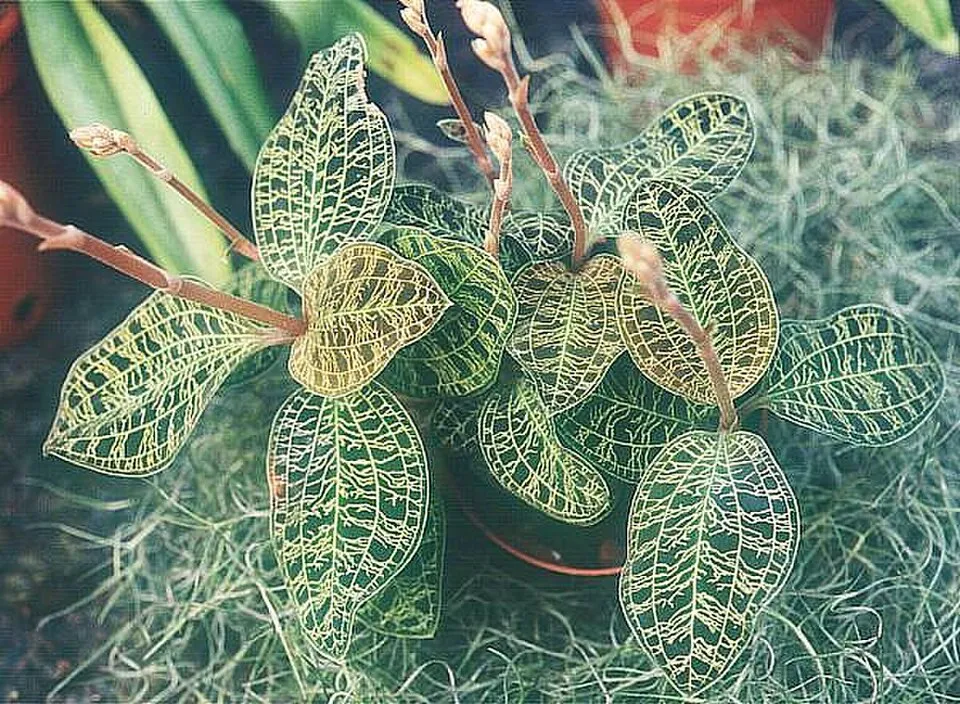
Macodes petola, widely recognized as the Jewel Orchid, is an enchanting terrestrial orchid species within the diverse Orchidaceae family, celebrated primarily for its strikingly intricate, vein-patterned foliage rather than its relatively modest flowers. This captivating plant is indigenous to the humid, shaded understories of Southeast Asian rainforests, thriving in regions spanning Malaysia, Indonesia (including Sumatra, Java, Borneo, and Sulawesi), the Philippines, and New Guinea. Its natural habitat is characterized by consistently high humidity, stable moisture levels, and filtered light, conditions crucial for its survival.
The genus name 'Macodes' originates from the Greek 'makos,' meaning length, possibly alluding to the elongated appearance of certain floral structures, while 'petola' likely refers to its distinctive, gem-like leaves that exhibit a mesmerizing iridescent sheen. Discovered and formally described in the early 19th century, Macodes petola rapidly gained acclaim among botanists and horticulturists, becoming a highly coveted specimen for plant collectors, particularly during the Victorian era's 'orchid craze.' Ecologically, beyond its ornamental appeal, its role is primarily as a component of the forest understory, contributing to local biodiversity. Its unique optical property, known as 'structural color,' results from specialized epidermal cells that reflect light in a metallic fashion, enhancing its allure as a decorative indoor plant for terrariums and shaded displays.
Trusted Scientific References
1. Authoritative external sources for Macodes petola
1.1 Wikipedia — Macodes petola
1.2 Kew POWO (Plants of the World Online)
1.3 PubMed — peer-reviewed research
1.4 NCBI Taxonomy Browser
1.5 GBIF — Global Biodiversity
1.6Macodes Petola should be interpreted through verified botanical identity, practical care, and responsible safety language. This recovery note adds the missing context needed for a complete profile: match light to the plant's habit, use well-drained soil, water according to season, and avoid unsupported medicinal or edible claims. For publishing, the plant can be presented as a source-backed indoor plant with clear care guidance, common problem diagnosis, and conservative safety wording.
1.1.Macodes Petola — Key Features
- ✓ <strong>Iridescent, metallic</strong> — veined foliage is its most prominent characteristic.
- ✓ <strong>Terrestrial orchid species,</strong> — Terrestrial orchid species, growing in soil rather than on trees.
- ✓ <strong>Indigenous to tropical</strong> — Indigenous to tropical rainforests of Southeast Asia.
- ✓ <strong>Thrives in high</strong> — Thrives in high humidity and consistent moisture.
- ✓ <strong>Prefers low to</strong> — Prefers low to moderate, indirect light conditions.
- ✓ <strong>Exhibits slow to</strong> — Exhibits slow to moderate growth rate.
- ✓ <strong>Non</strong> — toxic to humans and common household animals.
- ✓ <strong>Prized ornamental plant</strong> — Prized ornamental plant for terrariums and indoor displays.
- ✓ <strong>Unique structural coloration</strong> — Unique structural coloration due to specialized epidermal cells.
- ✓ <strong>Limited scientifically documented</strong> — Limited scientifically documented medicinal applications.
1.2.Macodes Petola — Quick Summary
- ✓ Jewel Orchid with striking, iridescent, vein-patterned foliage.
- ✓ Native to the humid, shaded understories of Southeast Asian rainforests.
- ✓ Primarily valued as a highly sought-after ornamental houseplant.
- ✓ Considered non-toxic to humans and common household pets.
- ✓ Requires specific care: high humidity, bright indirect light, and consistent moisture.
- ✓ Traditional medicinal uses are scarce, largely anecdotal, and not scientifically substantiated.
2.Macodes Petola — Scientific Identity
3.Macodes Petola — Quick Facts
4.Macodes Petola — Appearance & Identification
5.Macodes Petola — Native Habitat
6.Macodes Petola — Water Requirements
- ✓ Light — Provide bright, indirect sunlight; direct sun exposure can lead to leaf scorching, mimicking its natural shaded forest understory.
- ✓ Watering — Keep the substrate consistently moist but never waterlogged; water when the top 1-2 inches of soil feel dry, using low-chlorine, lukewarm water.
- ✓ Humidity — Requires high humidity, ideally above 80%; utilize humidifiers, terrariums, or pebble trays to maintain optimal environmental conditions.
- ✓ Temperature — Thrives in warm, stable temperatures between 65-85°F (18-29°C), avoiding sudden fluctuations or cold drafts.
- ✓ Soil — Plant in a well-draining, nutrient-rich, and porous substrate, such as a mix of 50% perlite and 50% coco coir or peat moss.
- ✓ Fertilization — Apply a highly diluted organic or orchid-specific fertilizer weekly (1/5 to 1/10 of the recommended strength) to support robust growth.
- ✓ Potting — Use appropriately sized pots; avoid over-potting which can retain too much moisture and lead to root issues.
- ✓ Propagation — Can be propagated through stem cuttings, ensuring each cutting includes at least one node and is planted in moist, well-draining medium.
Reviewed by the Flora Medical Global Botanical Review Panel
Multi-disciplinary editorial group · Botany · Ethnobotany · Herbal-medicine literature
Who reviewed this: This page was checked by the Flora Medical Global Botanical Review Panel — an in-house editorial group of botany graduates, ethnobotany researchers, and horticulture practitioners who collectively maintain our 7,000+ plant encyclopedia. Meet the team.
Our 4-step verification process
1. Taxonomic verification
Scientific names and synonyms cross-checked against Kew POWO, World Flora Online, and The Plant List.
2. Phytochemical & medicinal cross-reference
Active compounds, traditional uses, and reported activities are cross-referenced with PubMed, USDA Dr. Duke's database, and peer-reviewed ethnobotanical literature.
3. Conservation & distribution check
Distribution, ecology, and conservation status confirmed against GBIF occurrence records and the IUCN Red List.
4. Editorial & safety review
Every entry passes an editorial pass for clarity, originality, and safety notices (toxicity, contraindications, dosage caveats) before publication.
Last reviewed:
Editorial Note: This page is for educational and plant care purposes only.
Written by: Flora Medical Global Editorial Team
Reviewed by: Flora Medical Global Botanical Review Panel
Last Updated: June 15, 2026







Macodes Petola — Comments & Community Reviews
Rate this plant