


Care Disclaimer: Plant care recommendations are general guidelines based on common growing conditions. Individual results may vary based on your local environment, climate, and care routine. If your plant is toxic, keep it away from children and pets, and consult a veterinarian if accidental ingestion occurs.
1.Majesty Palm — Overview
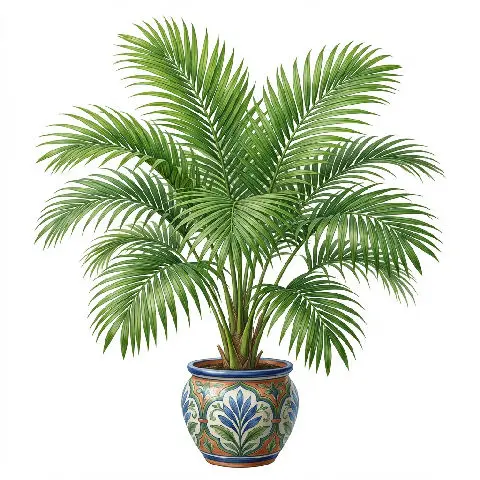
The Majesty Palm, scientifically known as Ravenea rivularis, is a magnificent tropical palm endemic to the island of Madagascar. In its native habitat, it thrives along riverbanks and in moist, lowland rainforests, often growing in seasonally flooded areas, which significantly influences its care requirements in cultivation. This elegant member of the Arecaceae family exhibits a robust, single trunk that can reach up to 6 inches in diameter, featuring a smooth, grayish bark that may display faint vertical striations.
Its most striking feature is its lush crown of pinnate fronds, which are long, arching, and feathery, extending up to 4 feet in length and showcasing a vibrant, glossy deep green hue. When cultivated indoors, the Majesty Palm typically achieves a graceful stature of 5 to 10 feet, though it can grow much taller in optimal outdoor conditions. While it can produce small, creamy white flowers in dense clusters, followed by small red fruits, these are rarely observed in indoor environments.
Taxonomically, Ravenea rivularis belongs to the Ceroxyleae tribe within the Ceroxyloideae subfamily, closely related to other Madagascan palms like Dypsis, highlighting its unique evolutionary lineage within the diverse palm family.
Trusted Scientific References
1. Authoritative external sources for Ravenea rivularis
1.1 Wikipedia — Ravenea rivularis
1.2 Kew POWO (Plants of the World Online)
1.3 PubMed — peer-reviewed research
1.4 NCBI Taxonomy Browser
1.5 GBIF — Global Biodiversity
1.6Majesty Palm should be interpreted through verified botanical identity, practical care, and responsible safety language. This recovery note adds the missing context needed for a complete profile: match light to the plant's habit, use well-drained soil, water according to season, and avoid unsupported medicinal or edible claims. For publishing, the plant can be presented as a source-backed indoor plant with clear care guidance, common problem diagnosis, and conservative safety wording.
1.1.Majesty Palm — Key Features
- ✓ <strong>Tall, graceful stature, reaching 5</strong> — 10 feet indoors.
- ✓ <strong>Distinctive pinnate, feathery,</strong> — Distinctive pinnate, feathery, deep green, glossy fronds.
- ✓ <strong>Smooth, grayish trunk</strong> — Smooth, grayish trunk with faint vertical lines.
- ✓ <strong>Native to the</strong> — Native to the riverbanks and rainforests of Madagascar.
- ✓ <strong>Primarily cultivated as</strong> — Primarily cultivated as an ornamental houseplant.
- ✓ <strong>Known for its</strong> — Known for its potential to purify indoor air by absorbing toxins.
- ✓ <strong>Requires high humidity</strong> — Requires high humidity and consistent soil moisture.
- ✓ <strong>Thrives in bright,</strong> — Thrives in bright, indirect light conditions.
- ✓ <strong>Generally considered non</strong> — toxic to humans and pets.
- ✓ <strong>Creates a lush,</strong> — Creates a lush, tropical ambiance in indoor spaces.
1.2.Majesty Palm — Quick Summary
- ✓ The Majesty Palm (Ravenea rivularis) is a majestic, non-toxic tropical houseplant from Madagascar.
- ✓ Valued for its lush, pinnate fronds and elegant form, enhancing indoor aesthetics.
- ✓ Requires bright, indirect light, consistently moist soil, and high humidity to thrive.
- ✓ Contributes to improved indoor air quality and psychological well-being.
- ✓ Generally safe for homes with children and pets, with minimal known adverse effects.
2.Majesty Palm — Scientific Identity
3.Majesty Palm — Quick Facts
4.Majesty Palm — Appearance & Identification
5.Majesty Palm — Native Habitat
6.Majesty Palm — Water Requirements
- ✓ Bright, Indirect Light — Provide 6-8 hours of bright, indirect sunlight daily; direct afternoon sun can scorch fronds, while insufficient light leads to sparse, pale growth.
- ✓ Consistent Moisture — Keep the soil consistently moist but never waterlogged, allowing the top inch to dry slightly between waterings; avoid complete drying out as they are riparian natives.
- ✓ High Humidity — Majesty Palms thrive in high humidity (above 50%); mist fronds regularly, use a pebble tray, or place a humidifier nearby, especially in dry indoor environments.
- ✓ Well-Draining Soil — Plant in a rich, peat-based potting mix that offers good drainage while retaining adequate moisture, mimicking its native habitat.
- ✓ Regular Fertilization — Feed with a balanced liquid houseplant fertilizer every 2-3 months during the spring and summer growing seasons, abstaining in fall and winter.
- ✓ Repotting — Repot every 1-2 years, or when roots emerge from drainage holes, increasing pot size by no more than 2 inches to prevent root bound conditions and encourage growth.
- ✓ Pruning — Prune only yellowed, brown, or dead fronds by cutting them close to the trunk with clean, sharp shears to maintain plant health and appearance.
- ✓ Pest Monitoring — Regularly inspect fronds for common pests like spider mites, especially in dry conditions; increase humidity and wipe leaves to deter infestations.
Reviewed by the Flora Medical Global Botanical Review Panel
Multi-disciplinary editorial group · Botany · Ethnobotany · Herbal-medicine literature
Who reviewed this: This page was checked by the Flora Medical Global Botanical Review Panel — an in-house editorial group of botany graduates, ethnobotany researchers, and horticulture practitioners who collectively maintain our 7,000+ plant encyclopedia. Meet the team.
Our 4-step verification process
1. Taxonomic verification
Scientific names and synonyms cross-checked against Kew POWO, World Flora Online, and The Plant List.
2. Phytochemical & medicinal cross-reference
Active compounds, traditional uses, and reported activities are cross-referenced with PubMed, USDA Dr. Duke's database, and peer-reviewed ethnobotanical literature.
3. Conservation & distribution check
Distribution, ecology, and conservation status confirmed against GBIF occurrence records and the IUCN Red List.
4. Editorial & safety review
Every entry passes an editorial pass for clarity, originality, and safety notices (toxicity, contraindications, dosage caveats) before publication.
Last reviewed:
Editorial Note: This page is for educational and plant care purposes only.
Written by: Flora Medical Global Editorial Team
Reviewed by: Flora Medical Global Botanical Review Panel
Last Updated: June 15, 2026







Majesty Palm — Comments & Community Reviews
Rate this plant