
Care Disclaimer: Plant care recommendations are general guidelines based on common growing conditions. Individual results may vary based on your local environment, climate, and care routine. If your plant is toxic, keep it away from children and pets, and consult a veterinarian if accidental ingestion occurs.
1.Mammillaria Hahniana — Overview
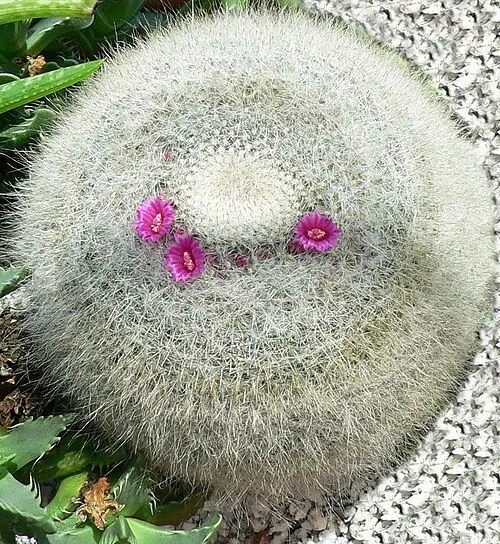
Mammillaria hahniana, commonly known as the Old Lady Cactus, is a captivating member of the Cactaceae family, celebrated for its unique ornamental characteristics. This species typically exhibits a globular to somewhat cylindrical stem morphology, usually reaching a modest height and diameter of 10 to 15 centimeters, though mature specimens can grow up to 20 cm, forming a charmingly compact and often clumping silhouette. Its most distinguishing feature is the dense covering of soft, white, hair-like radial spines that emanate from its tubercles, creating a remarkably fluffy, silvery-white coat. This delicate spination often obscures the green stem beneath, evoking the appearance of an elderly woman's hair, hence its endearing common name.
Like most cacti, Mammillaria hahniana lacks conventional leaves, instead utilizing its succulent stem and specialized tubercles for efficient photosynthesis and water storage. These small, conical protuberances are arranged in spirals along the stem, each bearing an areole from which the characteristic spines emerge, including 1-4 shorter, stouter central spines, sometimes with red tips when young. During the spring and early summer, this cactus produces a striking crown of vibrant pink to purplish-red, sometimes white, funnel-shaped flowers, each measuring approximately 2 to 3 centimeters in diameter. These beautiful blooms form a circlet around the plant's apex, emerging from the axils of older tubercles, creating a stark contrast against the silvery-white spination.
Following successful pollination, small, club-shaped, reddish fruits develop, containing minute, viable seeds. Mammillaria hahniana is indigenous to central Mexico, thriving in the semi-arid, rocky landscapes of states like Querétaro, Guanajuato, and Tamaulipas. It typically inhabits elevations ranging from 1,800 to 2,200 meters, where it has adapted to withstand significant diurnal temperature fluctuations and prolonged periods of drought, making it a resilient desert dweller.
Trusted Scientific References
1. Authoritative external sources for Mammillaria hahniana
1.1 Wikipedia — Mammillaria hahniana
1.2 Kew POWO (Plants of the World Online)
1.3 PubMed — peer-reviewed research
1.4 NCBI Taxonomy Browser
1.5 GBIF — Global Biodiversity
1.1.Mammillaria Hahniana — Key Features
- ✓ <strong>Distinctive Appearance</strong> — Dense, soft, white hair-like radial spines give it a unique 'old lady' or 'fuzzy' look.
- ✓ <strong>Globular to Cylindrical Shape</strong> — Compact growth habit, typically 10-20 cm in height and diameter.
- ✓ <strong>Vibrant Crown of Flowers</strong> — Produces a circlet of pink to purplish-red flowers around its apex in spring/early summer.
- ✓ <strong>Drought</strong> — Tolerant — Highly adapted to arid conditions, requiring infrequent watering.
- ✓ <strong>Low Maintenance</strong> — Easy to care for, making it suitable for beginners and busy individuals.
- ✓ <strong>Native to Mexico</strong> — Indigenous to semi-arid, rocky regions of central Mexico.
- ✓ <strong>CAM Photosynthesis</strong> — Efficient water use due to Crassulacean Acid Metabolism.
- ✓ <strong>Ornamental Value</strong> — Highly prized as a decorative houseplant or xeriscape garden specimen.
- ✓ <strong>Succulent Nature</strong> — Stores water in its fleshy stem, enabling survival in dry environments.
- ✓ <strong>Non</strong> — Traditional Medicinal Use — Primarily ornamental, with no established traditional medicinal applications for this specific species.
1.2.Mammillaria Hahniana — Quick Summary
- ✓ Mammillaria hahniana, the Old Lady Cactus, is an ornamental Mexican succulent.
- ✓ Distinctive for its dense, soft, white hair-like spines and vibrant pink flowers.
- ✓ Thrives in full sun, well-draining soil, and requires minimal watering.
- ✓ Primarily valued for aesthetic appeal; not traditionally used medicinally.
- ✓ Requires careful handling due to spination; not for consumption.
- ✓ An excellent, low-maintenance choice for succulent enthusiasts.
2.Mammillaria Hahniana — Scientific Identity
3.Mammillaria Hahniana — Quick Facts
4.Mammillaria Hahniana — Appearance & Identification
5.Mammillaria Hahniana — Native Habitat
6.Mammillaria Hahniana — Water Requirements
- ✓ Sunlight — Mammillaria hahniana thrives in bright lighting conditions; it requires full sun for optimal growth and prolific flowering, ideally placed near a south-facing window or in a sunny outdoor spot.
- ✓ Watering — As a drought-tolerant cactus, it prefers infrequent but thorough watering. Water every 1-2 weeks in summer, allowing the soil to dry completely between waterings, and reduce to once a month or less in winter during its dormancy.
- ✓ Soil — Use a well-draining cactus or succulent potting mix. A homemade blend of turf, leaf soil, sand, and brick chips in a 2:2:3:1 ratio provides excellent drainage and aeration.
- ✓ Temperature — This thermophilic plant prefers optimal summer temperatures between 20-24°C (68-75°F). During winter, a cooler period of 10-15°C (50-59°F) is beneficial for encouraging flowering.
- ✓ Fertilization — Feed monthly from early spring to mid-fall using a balanced fertilizer formulated for cacti and succulents, diluted to half strength. Cease all feeding during the winter months.
- ✓ Repotting — Repot Mammillaria hahniana every 2-3 years, or when it outgrows its container, into a pot only slightly larger than its current size. Ensure the new container has adequate drainage holes.
- ✓ Propagation — This cactus can be propagated from seeds, which should be soaked in a mild potassium permanganate solution before sowing, or more easily from young offsets (pups) that form around the base of the mother plant.
Reviewed by the Flora Medical Global Botanical Review Panel
Multi-disciplinary editorial group · Botany · Ethnobotany · Herbal-medicine literature
Who reviewed this: This page was checked by the Flora Medical Global Botanical Review Panel — an in-house editorial group of botany graduates, ethnobotany researchers, and horticulture practitioners who collectively maintain our 7,000+ plant encyclopedia. Meet the team.
Our 4-step verification process
1. Taxonomic verification
Scientific names and synonyms cross-checked against Kew POWO, World Flora Online, and The Plant List.
2. Phytochemical & medicinal cross-reference
Active compounds, traditional uses, and reported activities are cross-referenced with PubMed, USDA Dr. Duke's database, and peer-reviewed ethnobotanical literature.
3. Conservation & distribution check
Distribution, ecology, and conservation status confirmed against GBIF occurrence records and the IUCN Red List.
4. Editorial & safety review
Every entry passes an editorial pass for clarity, originality, and safety notices (toxicity, contraindications, dosage caveats) before publication.
Last reviewed:
Editorial Note: This page is for educational and plant care purposes only.
Written by: Flora Medical Global Editorial Team
Reviewed by: Flora Medical Global Botanical Review Panel
Last Updated: June 15, 2026







Mammillaria Hahniana — Comments & Community Reviews
Rate this plant