
Care Disclaimer: Plant care recommendations are general guidelines based on common growing conditions. Individual results may vary based on your local environment, climate, and care routine. If your plant is toxic, keep it away from children and pets, and consult a veterinarian if accidental ingestion occurs.
1.Manettia — Overview
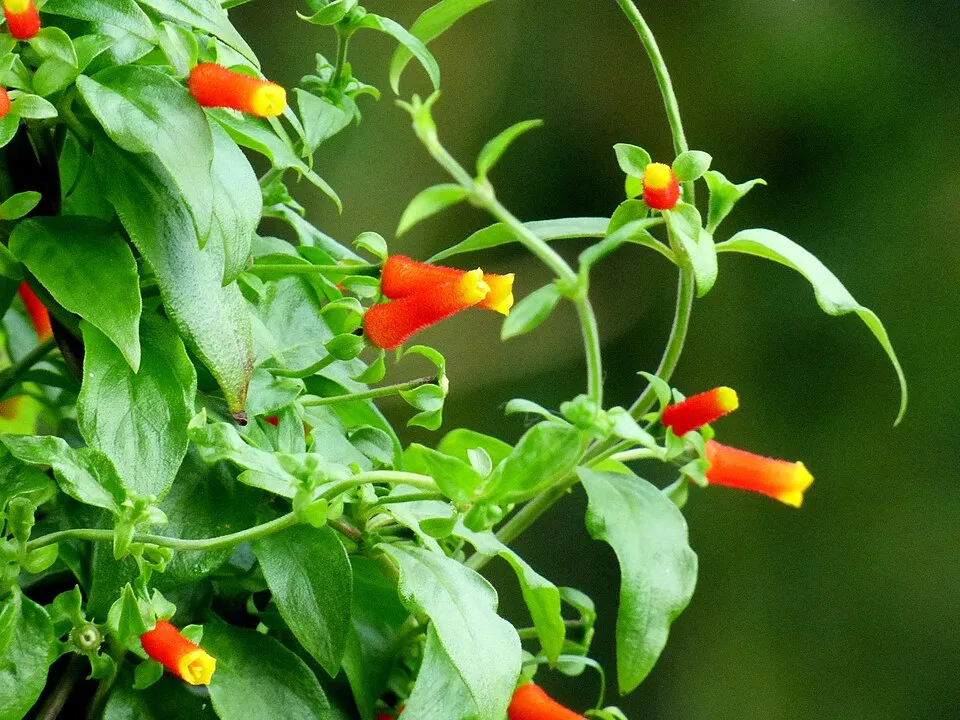
Manettia luteorubra, widely recognized by its common names Firecracker Vine, Brazilian Firecracker, and sometimes Candy Corn Plant (especially under its updated botanical name Manettia inflata), is a captivating perennial vine belonging to the diverse Rubiaceae family. This scrambling or twining plant is indigenous to the tropical regions of South America, predominantly Brazil, thriving in humid forest understories and disturbed areas where it can act as ground cover or ascend low vegetation. The vine features slender, wiry stems that can extend over 6 feet (1.8 meters) when given support, though it often cascades gracefully in hanging baskets, typically reaching 1-3 feet.
Its foliage consists of opposite, ovate to lanceolate, dark green leaves with a subtle gloss, usually measuring between 2-4 inches in length. The most striking feature of Manettia luteorubra is its profusion of tubular, zygomorphic flowers, which display a vibrant gradient of red and yellow, truly resembling miniature firecrackers—a characteristic reflected in its scientific epithet 'luteorubra' (luteo- for yellow, rubra for red). These eye-catching blooms appear in clusters from the leaf axils and along the stems, offering a sporadic but often abundant display throughout warmer months, and are a magnet for hummingbirds and various insects, playing a vital role in its native ecosystem's pollination.
While it maintains its evergreen status in frost-free climates, it is frequently cultivated as an annual or a houseplant in cooler zones, requiring a warm, humid environment to flourish. Its primary value is ornamental, making it a popular choice for conservatories, greenhouses, and indoor spaces.
Trusted Scientific References
1. Authoritative external sources for Manettia luteorubra
1.1 Wikipedia — Manettia luteorubra
1.2 Kew POWO (Plants of the World Online)
1.3 PubMed — peer-reviewed research
1.4 NCBI Taxonomy Browser
1.5 GBIF — Global Biodiversity
1.6Manettia should be interpreted through verified botanical identity, practical care, and responsible safety language. This recovery note adds the missing context needed for a complete profile: match light to the plant's habit, use well-drained soil, water according to season, and avoid unsupported medicinal or edible claims. For publishing, the plant can be presented as a source-backed indoor plant with clear care guidance, common problem diagnosis, and conservative safety wording.
1.1.Manettia — Key Features
- ✓ <strong>Striking Red and Yellow Tubular Flowers</strong> — Resembling miniature firecrackers.
- ✓ <strong>Scrambling or Twining Growth Habit</strong> — Ideal for trellises, supports, or hanging baskets.
- ✓ <strong>Native to Tropical South America</strong> — Thrives in warm, humid climates.
- ✓ <strong>Attractive to Hummingbirds</strong> — A valuable addition to pollinator gardens.
- ✓ <strong>Evergreen in Frost</strong> — Free Climates — Provides year-round foliage and sporadic blooms.
- ✓ <strong>Prefers Bright Light and High Humidity</strong> — Essential for vigorous growth and flowering.
- ✓ <strong>Relatively Easy to Grow Indoors</strong> — Popular choice for conservatories and houseplant enthusiasts.
- ✓ <strong>Formerly Known as Manettia luteorubra</strong> — Now often referred to as Manettia inflata.
- ✓ <strong>Member of the Rubiaceae Family</strong> — Sharing lineage with coffee and gardenias.
- ✓ <strong>Adaptable to Containers</strong> — Can be managed as a compact plant with regular pruning.
1.2.Manettia — Quick Summary
- ✓ Manettia luteorubra, or Firecracker Vine, is a vibrant, tropical ornamental vine.
- ✓ Features striking red and yellow tubular flowers, attracting hummingbirds.
- ✓ Belongs to the Rubiaceae family, known for diverse secondary metabolites.
- ✓ Primarily grown as a houseplant or seasonal outdoor plant in warm, humid conditions.
- ✓ Has no documented traditional or modern medicinal uses or specific toxicities.
- ✓ Also known as Candy Corn Plant (Manettia inflata) due to flower resemblance.
2.Manettia — Scientific Identity
3.Manettia — Quick Facts
4.Manettia — Appearance & Identification
5.Manettia — Native Habitat
6.Manettia — Water Requirements
- ✓ Light — Provide bright, indirect light to full sun exposure, ideally from a south or west-facing window; insufficient light reduces blooming.
- ✓ Water — Keep the soil consistently moist from spring through fall, allowing the top inch to dry slightly between waterings; reduce watering in winter.
- ✓ Humidity — Maintain high relative humidity, ideally above 45%, using a cool-mist humidifier or pebble tray, as dry air can cause brown leaf tips.
- ✓ Temperature — Thrives in average room temperatures between 65-75°F (18-24°C); it is frost-tender and will not tolerate temperatures below 55°F (13°C).
- ✓ Soil — Use a well-aerated, fast-draining potting mixture, such as equal parts all-purpose potting mix, perlite, and peat moss, to prevent root rot.
- ✓ Fertilizer — Feed every two weeks from spring to fall with a high-phosphorus liquid fertilizer, diluted to half strength, to encourage abundant flowering.
- ✓ Pruning — Prune stems back by up to half in early spring to promote bushier growth and maintain shape, being careful to avoid removing developing flower buds.
- ✓ Repotting — Repot in spring only when roots become crowded, moving to a pot just one size larger, as this vine blooms best when slightly pot-bound.
Reviewed by the Flora Medical Global Botanical Review Panel
Multi-disciplinary editorial group · Botany · Ethnobotany · Herbal-medicine literature
Who reviewed this: This page was checked by the Flora Medical Global Botanical Review Panel — an in-house editorial group of botany graduates, ethnobotany researchers, and horticulture practitioners who collectively maintain our 7,000+ plant encyclopedia. Meet the team.
Our 4-step verification process
1. Taxonomic verification
Scientific names and synonyms cross-checked against Kew POWO, World Flora Online, and The Plant List.
2. Phytochemical & medicinal cross-reference
Active compounds, traditional uses, and reported activities are cross-referenced with PubMed, USDA Dr. Duke's database, and peer-reviewed ethnobotanical literature.
3. Conservation & distribution check
Distribution, ecology, and conservation status confirmed against GBIF occurrence records and the IUCN Red List.
4. Editorial & safety review
Every entry passes an editorial pass for clarity, originality, and safety notices (toxicity, contraindications, dosage caveats) before publication.
Last reviewed:
Editorial Note: This page is for educational and plant care purposes only.
Written by: Flora Medical Global Editorial Team
Reviewed by: Flora Medical Global Botanical Review Panel
Last Updated: June 15, 2026







Manettia — Comments & Community Reviews
Rate this plant