

Care Disclaimer: Plant care recommendations are general guidelines based on common growing conditions. Individual results may vary based on your local environment, climate, and care routine. If your plant is toxic, keep it away from children and pets, and consult a veterinarian if accidental ingestion occurs.
1.Marcgravia Umbellata — Overview
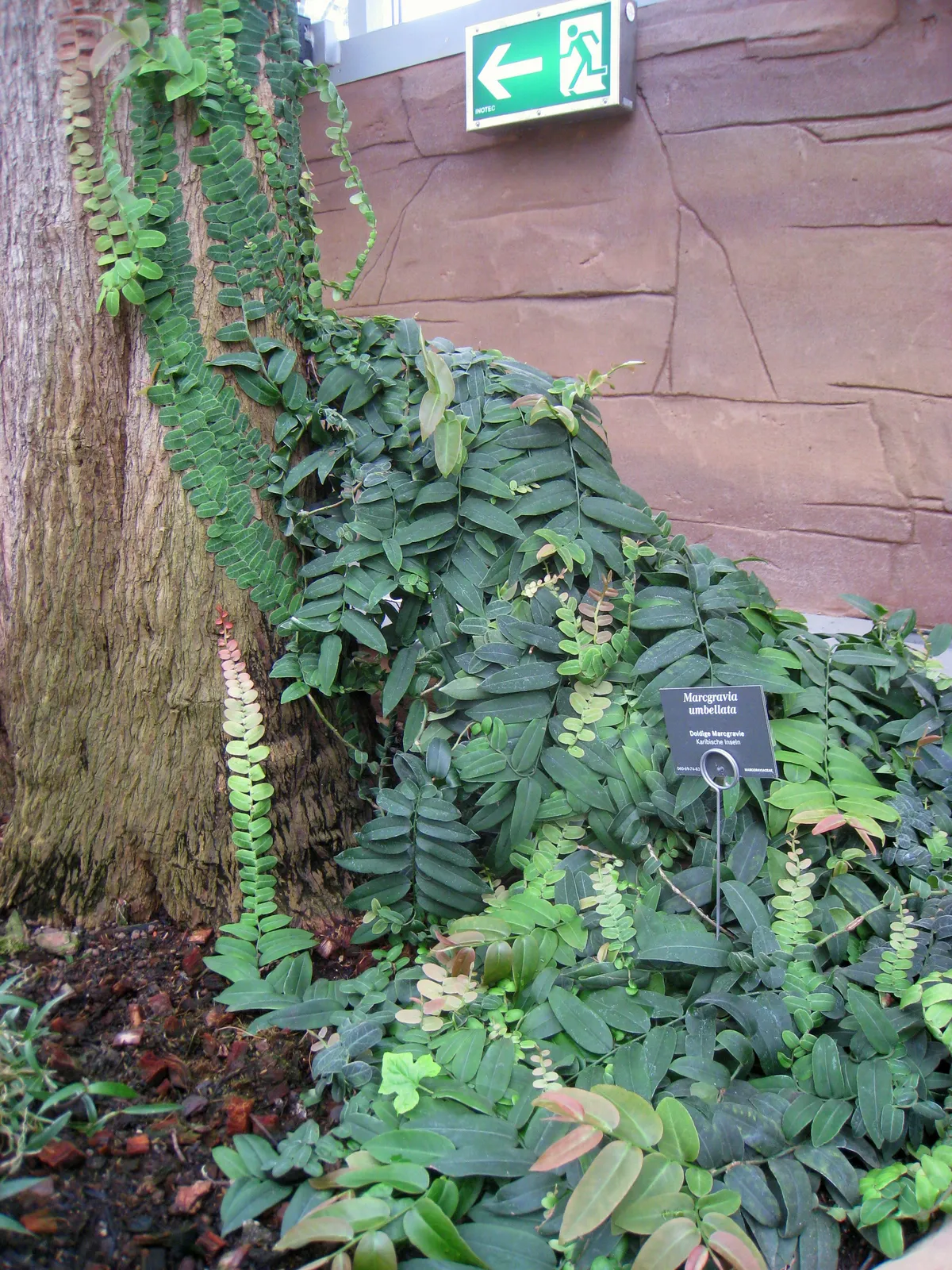
Marcgravia umbellata, commonly known as the shingling plant or monkey paws, is a captivating hemiepiphytic species belonging to the Marcgraviaceae family. This unique vine is native to the lush, humid tropical rainforests of Central and South America, where it thrives by clinging to tree trunks and rocks. Its most distinctive feature is its juvenile growth phase, characterized by flat, elongated leaves that tightly adhere, or 'shingle,' along surfaces.
These glossy, deep green leaves typically range from 5 to 25 cm in length and 3 to 6 cm in width, featuring a tapered tip and a subtle wave along their edges. As the plant matures, under ideal natural conditions, its foliage can transition to a larger, non-shingling form, which is rarely observed in typical indoor or terrarium cultivation. While not frequently seen in cultivation, Marcgravia umbellata produces small, tubular, pale yellow flowers when mature and in optimal environmental settings.
The plant's slender stems develop a textured, brownish bark, adding to its aesthetic appeal. Taxonomically, it falls within the order Ericales and showcases remarkable adaptations, including its ability to germinate in both arboreal canopies and terrestrial soil, eventually becoming fully epiphytic by losing root contact with the ground. This adaptability makes it a fascinating subject for botanical study and a prized specimen for plant enthusiasts recreating rainforest habitats.
Trusted Scientific References
1. Authoritative external sources for Marcgravia umbellata
1.1 Wikipedia — Marcgravia umbellata
1.2 Kew POWO (Plants of the World Online)
1.3 PubMed — peer-reviewed research
1.4 NCBI Taxonomy Browser
1.5 GBIF — Global Biodiversity
1.6Marcgravia Umbellata should be interpreted through verified botanical identity, practical care, and responsible safety language. This recovery note adds the missing context needed for a complete profile: match light to the plant's habit, use well-drained soil, water according to season, and avoid unsupported medicinal or edible claims. For publishing, the plant can be presented as a source-backed indoor plant with clear care guidance, common problem diagnosis, and conservative safety wording.
1.1.Marcgravia Umbellata — Key Features
- ✓ <strong>Botanical Name</strong> — Marcgravia umbellata.
- ✓ <strong>Common Names</strong> — Shingling Plant, Monkey Paws, Shampoo Ginger (regional, potentially misidentified).
- ✓ <strong>Family</strong> — Marcgraviaceae.
- ✓ <strong>Growth Habit</strong> — Hemiepiphytic, climbing vine with aerial roots.
- ✓ <strong>Distinctive Foliage</strong> — Juvenile leaves 'shingle' tightly to surfaces; mature leaves are larger and non-shingling.
- ✓ <strong>Habitat</strong> — Tropical rainforests of Central and South America, requiring high humidity.
- ✓ <strong>Traditional Medicinal Use</strong> — Noted for anti-inflammatory, antimicrobial, and wound-healing properties.
- ✓ <strong>Horticultural Value</strong> — Highly valued as an ornamental plant for terrariums and vivariums.
- ✓ <strong>Flowers</strong> — Small, pale yellow, tubular, rarely produced in indoor cultivation.
- ✓ <strong>Adaptations</strong> — Unique ability to grow on other plants without parasitism, often losing ground contact.
1.2.Marcgravia Umbellata — Quick Summary
- ✓ Marcgravia umbellata is a unique epiphytic shingling vine native to tropical Central and South America.
- ✓ It is highly prized in horticulture for its distinctive juvenile foliage, making it popular for terrariums.
- ✓ Traditionally, the plant is recognized for its anti-inflammatory, antimicrobial, and wound-healing properties.
- ✓ Cultivation requires high humidity, bright indirect light, and consistently moist, well-draining substrate.
- ✓ Traditional applications include topical use for skin issues and internal remedies for inflammatory conditions.
- ✓ Due to limited scientific research, caution and professional guidance are advised for any medicinal use.
2.Marcgravia Umbellata — Scientific Identity
3.Marcgravia Umbellata — Quick Facts
4.Marcgravia Umbellata — Appearance & Identification
5.Marcgravia Umbellata — Native Habitat
6.Marcgravia Umbellata — Water Requirements
- ✓ Humidity — Marcgravia umbellata thrives in high humidity, making it an excellent choice for terrariums, vivariums, or enclosed display cases.
- ✓ Light — Provide bright, indirect light; direct sunlight can scorch its delicate leaves. An east-facing window or filtered south/west light is ideal.
- ✓ Substrate — Plant in a well-draining, airy substrate such as sphagnum moss, a chunky orchid mix, or an aroid blend to mimic its epiphytic nature.
- ✓ Watering — Keep the substrate consistently moist but never waterlogged. Water thoroughly when the top inch of the medium feels dry to the touch.
- ✓ Support — Offer a vertical climbing surface like a cork bark slab, moss pole, or even glass for its aerial roots to cling to and encourage shingling.
- ✓ Temperature — Maintain warm temperatures, ideally between 20-30°C (68-86°F), and avoid sudden drops or cold drafts.
- ✓ Pruning — Regular pruning helps manage its growth, especially in confined spaces, and encourages a denser, bushier appearance.
- ✓ Fertilization — Fertilize sparingly with a highly diluted balanced liquid fertilizer during the active growing season, typically once a month.
Reviewed by the Flora Medical Global Botanical Review Panel
Multi-disciplinary editorial group · Botany · Ethnobotany · Herbal-medicine literature
Who reviewed this: This page was checked by the Flora Medical Global Botanical Review Panel — an in-house editorial group of botany graduates, ethnobotany researchers, and horticulture practitioners who collectively maintain our 7,000+ plant encyclopedia. Meet the team.
Our 4-step verification process
1. Taxonomic verification
Scientific names and synonyms cross-checked against Kew POWO, World Flora Online, and The Plant List.
2. Phytochemical & medicinal cross-reference
Active compounds, traditional uses, and reported activities are cross-referenced with PubMed, USDA Dr. Duke's database, and peer-reviewed ethnobotanical literature.
3. Conservation & distribution check
Distribution, ecology, and conservation status confirmed against GBIF occurrence records and the IUCN Red List.
4. Editorial & safety review
Every entry passes an editorial pass for clarity, originality, and safety notices (toxicity, contraindications, dosage caveats) before publication.
Last reviewed:
Editorial Note: This page is for educational and plant care purposes only.
Written by: Flora Medical Global Editorial Team
Reviewed by: Flora Medical Global Botanical Review Panel
Last Updated: June 15, 2026







Marcgravia Umbellata — Comments & Community Reviews
Rate this plant