
Care Disclaimer: Plant care recommendations are general guidelines based on common growing conditions. Individual results may vary based on your local environment, climate, and care routine. If your plant is toxic, keep it away from children and pets, and consult a veterinarian if accidental ingestion occurs.
1.Microsorum Crocodile — Overview
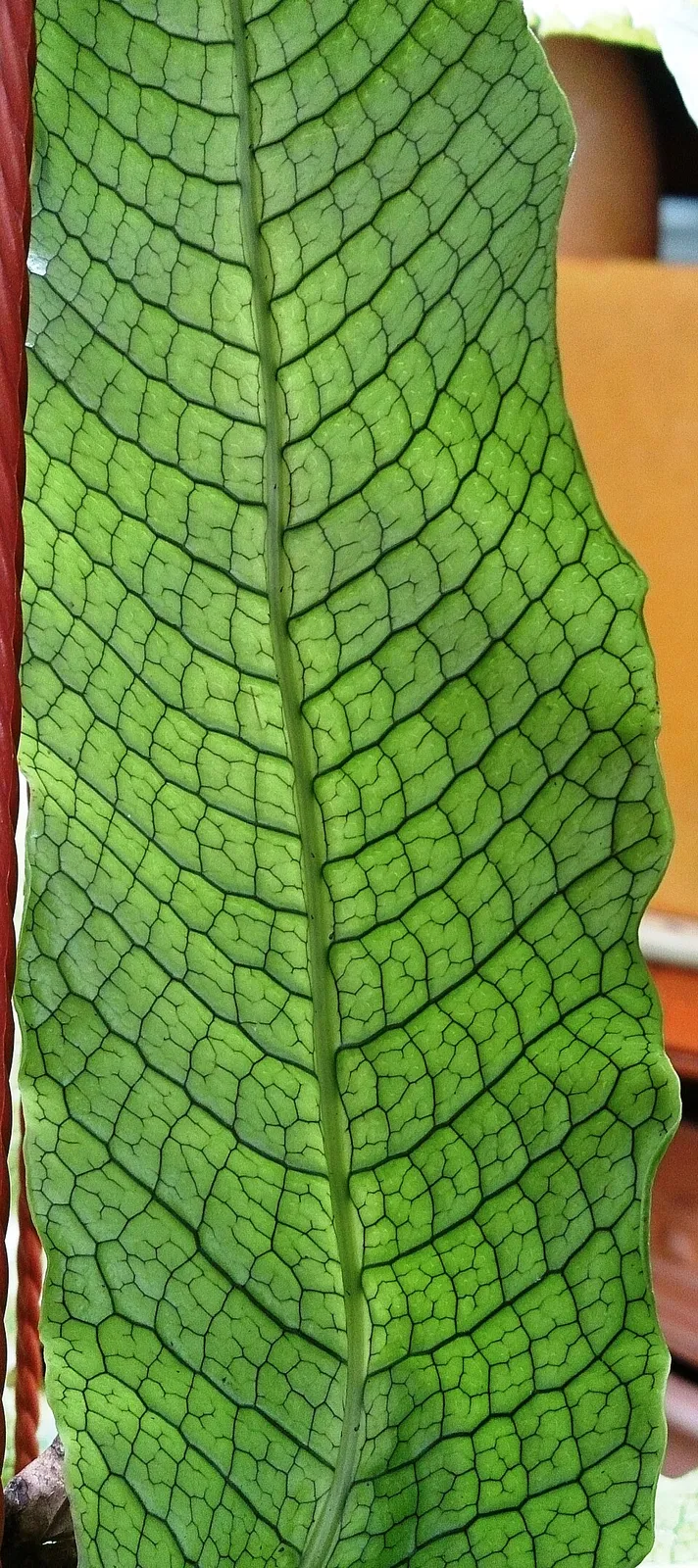
Microsorum musifolium 'Crocodyllus', commonly known as the Crocodile Fern, is a distinctive epiphytic or terrestrial fern highly valued for its uniquely textured foliage. This cultivar, belonging to the Polypodiaceae family, is characterized by its long, lanceolate to ovate fronds, which can extend up to 60 cm (2 feet) in length and 15 cm (6 inches) in width. The most striking feature is the frond's surface, which exhibits an intricate, raised pattern of dark green to blackish blotches against a lighter green background, remarkably mimicking the scaly skin of a crocodile—hence its common name.
The rhizomes are creeping, dark brown, and covered with fine, hair-like scales, enabling the plant to spread effectively or anchor itself to various substrates. In its native tropical rainforests, primarily in Malaysia, it thrives as an epiphyte on tree trunks and branches, or as a lithophyte on moss-covered rocks, always preferring environments with ample shade and high humidity. Fertile fronds bear characteristic round sori, or spore clusters, arranged in neat rows on their undersides.
Beyond its botanical intrigue, the Crocodile Fern's robust, architectural form and tolerance for lower light conditions make it a highly sought-after indoor ornamental plant, further enhanced by its general air-purifying qualities common to many houseplants.
Trusted Scientific References
1. Authoritative external sources for Microsorum musifolium Crocodyllus
1.1 Wikipedia — Microsorum musifolium Crocodyllus
1.2 Kew POWO (Plants of the World Online)
1.3 PubMed — peer-reviewed research
1.4 NCBI Taxonomy Browser
1.5 GBIF — Global Biodiversity
1.6Microsorum Crocodile should be interpreted through verified botanical identity, practical care, and responsible safety language. This recovery note adds the missing context needed for a complete profile: match light to the plant's habit, use well-drained soil, water according to season, and avoid unsupported medicinal or edible claims. For publishing, the plant can be presented as a source-backed indoor plant with clear care guidance, common problem diagnosis, and conservative safety wording.
1.1.Microsorum Crocodile — Key Features
- ✓ <strong>Distinctive Foliage</strong> — Features unique, scaly, crocodile-like frond texture.
- ✓ <strong>Epiphytic/Terrestrial Nature</strong> — Adaptable to growing on trees, rocks, or in soil.
- ✓ <strong>Low Light Tolerance</strong> — Thrives in bright, indirect light, making it ideal for indoor settings.
- ✓ <strong>High Humidity Lover</strong> — Prefers moist air, mimicking its tropical native habitat.
- ✓ <strong>Air</strong> — Purifying Qualities — Contributes to cleaner indoor air by absorbing toxins.
- ✓ <strong>Robust & Architectural Form</strong> — Offers a strong visual statement in any decor.
- ✓ <strong>Easy to Care For</strong> — Considered a low-maintenance plant once ideal conditions are met.
- ✓ <strong>Native to Malaysia</strong> — Originates from tropical rainforests.
- ✓ <strong>Family Polypodiaceae</strong> — A member of the true fern family.
- ✓ <strong>Non</strong> — Toxic Ornamental — Generally safe for homes with pets and children.
1.2.Microsorum Crocodile — Quick Summary
- ✓ Unique 'crocodile skin' textured fronds, highly prized ornamental fern.
- ✓ Native to Malaysian jungles, thrives in warm, humid, indirect light.
- ✓ Easy-care houseplant, suitable for beginners and experienced growers.
- ✓ Contributes to indoor air purification and aesthetic well-being.
- ✓ Propagated by rhizome division; requires consistent moisture and humidity.
- ✓ Generally non-toxic to humans and pets, making it a safe indoor choice.
2.Microsorum Crocodile — Scientific Identity
3.Microsorum Crocodile — Quick Facts
4.Microsorum Crocodile — Appearance & Identification
5.Microsorum Crocodile — Native Habitat
6.Microsorum Crocodile — Water Requirements
- ✓ Light — Provide bright, indirect light; avoid direct sunlight which can scorch fronds. East or north-facing windows are ideal.
- ✓ Soil — Use a loose, well-draining potting mix. A blend of peat moss or coco coir, perlite, and orchid bark (2:1:1 ratio) works well.
- ✓ Water — Keep soil consistently moist but never waterlogged during spring and summer; reduce watering in fall and winter.
- ✓ Temperature — Maintain warm temperatures between 18-24°C (65-75°F); avoid dropping below 10°C (50°F).
- ✓ Humidity — Requires high humidity (at least 50%). Group with other plants, use a pebble tray, or a small humidifier.
- ✓ Fertilizer — Feed monthly during growing season (spring/summer) with a balanced liquid houseplant fertilizer diluted to half strength.
- ✓ Propagation — Easily propagated by rhizome division during repotting in spring or summer, ensuring each division has healthy roots and fronds.
- ✓ Repotting — Repot only when root-bound, typically every 1-2 years, into a slightly larger pot.
Reviewed by the Flora Medical Global Botanical Review Panel
Multi-disciplinary editorial group · Botany · Ethnobotany · Herbal-medicine literature
Who reviewed this: This page was checked by the Flora Medical Global Botanical Review Panel — an in-house editorial group of botany graduates, ethnobotany researchers, and horticulture practitioners who collectively maintain our 7,000+ plant encyclopedia. Meet the team.
Our 4-step verification process
1. Taxonomic verification
Scientific names and synonyms cross-checked against Kew POWO, World Flora Online, and The Plant List.
2. Phytochemical & medicinal cross-reference
Active compounds, traditional uses, and reported activities are cross-referenced with PubMed, USDA Dr. Duke's database, and peer-reviewed ethnobotanical literature.
3. Conservation & distribution check
Distribution, ecology, and conservation status confirmed against GBIF occurrence records and the IUCN Red List.
4. Editorial & safety review
Every entry passes an editorial pass for clarity, originality, and safety notices (toxicity, contraindications, dosage caveats) before publication.
Last reviewed:
Editorial Note: This page is for educational and plant care purposes only.
Written by: Flora Medical Global Editorial Team
Reviewed by: Flora Medical Global Botanical Review Panel
Last Updated: June 15, 2026







Microsorum Crocodile — Comments & Community Reviews
Rate this plant