
Care Disclaimer: Plant care recommendations are general guidelines based on common growing conditions. Individual results may vary based on your local environment, climate, and care routine. If your plant is toxic, keep it away from children and pets, and consult a veterinarian if accidental ingestion occurs.
1.Miltoniopsis Orchid — Overview
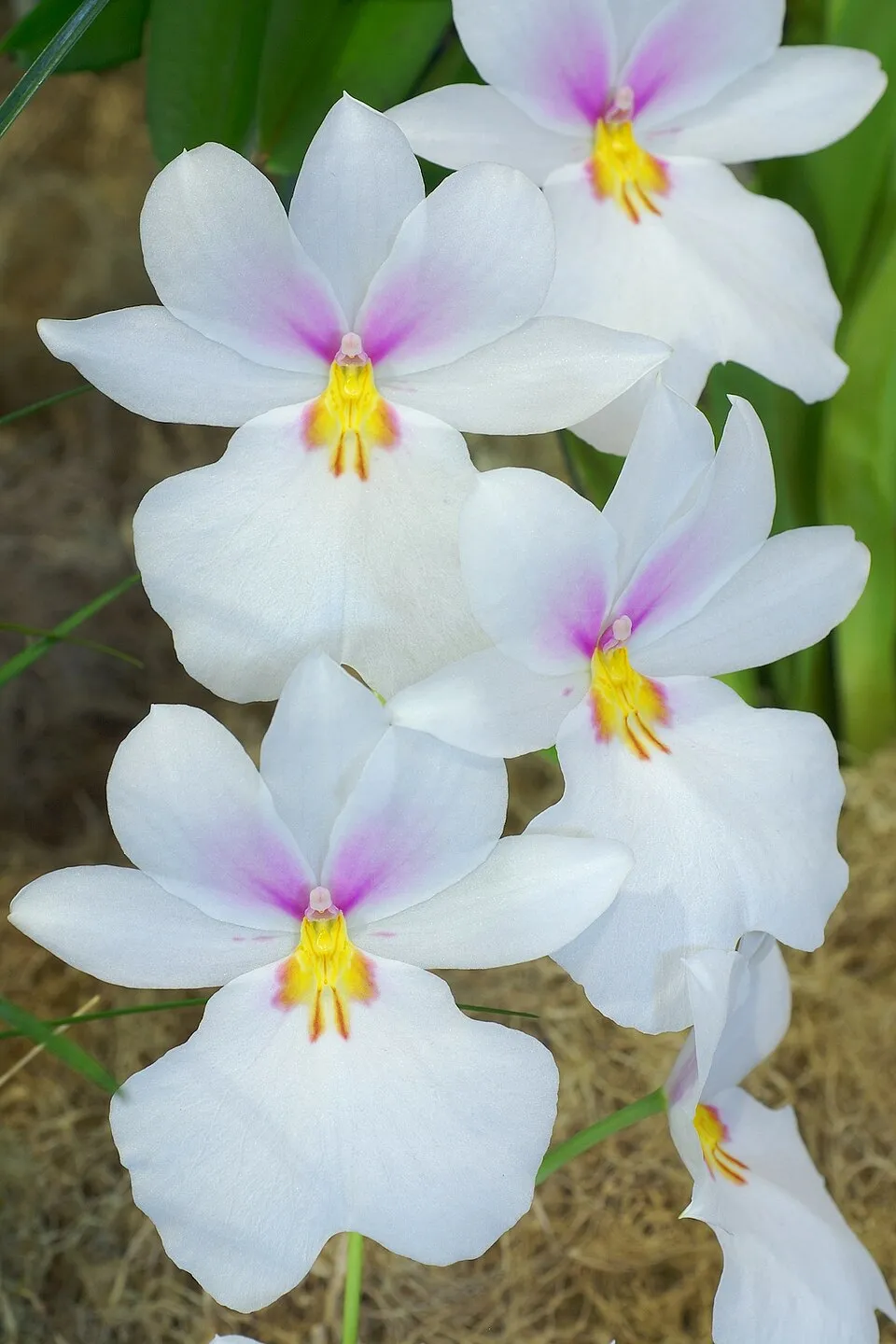
Miltoniopsis vexillaria, commonly known as the Pansy Orchid, is a captivating epiphytic orchid species native to the cool, humid cloud forests of Colombia and Ecuador. This genus, belonging to the Orchidaceae family, is distinguished by its flattened, oval-shaped pseudobulbs, which typically support one to three lanceolate to oblong, leathery leaves that can reach lengths of 30-40 cm.
The foliage of Miltoniopsis vexillaria specifically exhibits a soft, grayish-green hue, adding to its delicate appearance.
From the base of mature pseudobulbs, elegant, arching inflorescences emerge, bearing several exquisite flowers, often blooming sequentially from spring to fall. The individual blossoms, typically 5-10 cm across, are renowned for their striking resemblance to pansies, characterized by a prominent, often vibrantly colored labellum (lip) with intricate crests and patterns.
Sepals and petals are usually similar in form, though narrower than the lip, displaying a spectrum of colors from white, pink, and yellow to reddish-brown and lavender. Miltoniopsis vexillaria flowers are particularly noted for their shades of pink to red with a darker, distinct lip, and each upright stem can bear up to a dozen 4-inch flowers.
Thriving at elevations between 1000 and 2000 meters, these orchids naturally perch on mossy tree branches or rock crevices, benefiting from filtered sunlight, consistent air movement, and high atmospheric humidity. Their fine root systems are expertly adapted to absorb moisture and nutrients from the air and decaying organic matter, reflecting their specialized epiphytic lifestyle.
The genus Miltoniopsis is differentiated from its close relative, Miltonia, primarily by its characteristic flattened pseudobulbs and arching flower spikes, making Miltoniopsis vexillaria a unique and cherished botanical specimen.
Trusted Scientific References
1. Authoritative external sources for Miltoniopsis vexillaria
1.1 Wikipedia — Miltoniopsis vexillaria
1.2 Kew POWO (Plants of the World Online)
1.3 PubMed — peer-reviewed research
1.4 NCBI Taxonomy Browser
1.5 GBIF — Global Biodiversity
1.1.Miltoniopsis Orchid — Key Features
- ✓ <strong>Pansy</strong> — like Flowers — Distinctive blossoms with a prominent, often colorful labellum.
- ✓ <strong>Epiphytic Growth Habit</strong> — Naturally grows on trees and rocks in its native habitat.
- ✓ <strong>Cool</strong> — Growing Orchid — Thrives in cooler temperatures, especially at night.
- ✓ <strong>High Humidity Requirement</strong> — Essential for mimicking its cloud forest environment.
- ✓ <strong>Pseudobulbs</strong> — Flattened, oval-shaped structures for water and nutrient storage.
- ✓ <strong>Native to Andes</strong> — Indigenous to the tropical cloud forests of Colombia and Ecuador.
- ✓ <strong>Ornamental Value</strong> — Highly prized for its aesthetic appeal in horticulture.
- ✓ <strong>Unique Foliage</strong> — Soft, grayish-green leaves add to its delicate charm.
- ✓ <strong>Sequential Blooming</strong> — Flowers often open over an extended period, providing continuous display.
- ✓ <strong>Distinct from Miltonia</strong> — Differentiated by specific floral and pseudobulb characteristics.
1.2.Miltoniopsis Orchid — Quick Summary
- ✓ Exquisite Pansy Orchid, Miltoniopsis vexillaria, native to Andean cloud forests.
- ✓ Renowned for its stunning, pansy-like flowers in shades of pink to red.
- ✓ Requires cool temperatures, high humidity, and filtered light for optimal growth.
- ✓ Primarily an ornamental plant, contributing to aesthetic well-being.
- ✓ Contains potential antioxidant and anti-inflammatory phytochemicals.
- ✓ Generally considered non-toxic, but direct ingestion is not advised.
2.Miltoniopsis Orchid — Scientific Identity
3.Miltoniopsis Orchid — Quick Facts
4.Miltoniopsis Orchid — Appearance & Identification
5.Miltoniopsis Orchid — Native Habitat
6.Miltoniopsis Orchid — Water Requirements
- ✓ Provide partial shade with only 1-2 hours of bright, filtered sunlight daily, ideally near a north-facing window, to prevent leaf scorching.
- ✓ Plant in a well-draining epiphytic medium composed of small fir bark, sphagnum moss, and pebbles, ensuring excellent air circulation for roots.
- ✓ Maintain a consistently moist but not waterlogged growing medium for Miltoniopsis vexillaria; water in the morning to allow drying before nightfall.
- ✓ Ensure cool nighttime temperatures of 55-60°F (13-16°C) for optimal blooming, with daytime temperatures around 70°F (21°C).
- ✓ Keep humidity levels high, ideally between 60-70%, to replicate its native cloud forest environment, using humidifiers or pebble trays if necessary.
- ✓ Fertilize monthly during active growth and flowering periods with a balanced orchid fertilizer, flushing the medium periodically with plain water due to salt sensitivity.
- ✓ Repot only when the medium breaks down (typically every 2+ years), using a slightly larger clay pot with superior drainage to accommodate its preference for being potbound.
Reviewed by the Flora Medical Global Botanical Review Panel
Multi-disciplinary editorial group · Botany · Ethnobotany · Herbal-medicine literature
Who reviewed this: This page was checked by the Flora Medical Global Botanical Review Panel — an in-house editorial group of botany graduates, ethnobotany researchers, and horticulture practitioners who collectively maintain our 7,000+ plant encyclopedia. Meet the team.
Our 4-step verification process
1. Taxonomic verification
Scientific names and synonyms cross-checked against Kew POWO, World Flora Online, and The Plant List.
2. Phytochemical & medicinal cross-reference
Active compounds, traditional uses, and reported activities are cross-referenced with PubMed, USDA Dr. Duke's database, and peer-reviewed ethnobotanical literature.
3. Conservation & distribution check
Distribution, ecology, and conservation status confirmed against GBIF occurrence records and the IUCN Red List.
4. Editorial & safety review
Every entry passes an editorial pass for clarity, originality, and safety notices (toxicity, contraindications, dosage caveats) before publication.
Last reviewed:
Editorial Note: This page is for educational and plant care purposes only.
Written by: Flora Medical Global Editorial Team
Reviewed by: Flora Medical Global Botanical Review Panel
Last Updated: June 15, 2026







Miltoniopsis Orchid — Comments & Community Reviews
Rate this plant