
Care Disclaimer: Plant care recommendations are general guidelines based on common growing conditions. Individual results may vary based on your local environment, climate, and care routine. If your plant is toxic, keep it away from children and pets, and consult a veterinarian if accidental ingestion occurs.
1.Monstera — Overview
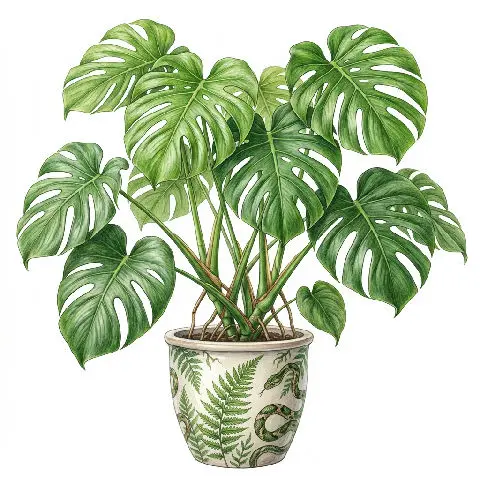
Monstera deliciosa, widely recognized as the Swiss Cheese Plant or Fruit Salad Plant, is an evergreen perennial vine native to the humid tropical rainforests of Southern Mexico and Panama, extending throughout Central America. This striking member of the Araceae family is characterized by its large, heart-shaped leaves that develop distinctive natural splits and holes, known as fenestrations, as they mature. In its natural epiphytic habitat, it can ascend trees to heights exceeding 70 feet, anchoring itself with robust aerial roots.
When cultivated indoors, it typically reaches a more manageable size of 3-7 feet, though it can still grow quite large. The stems are thick and smooth, often producing numerous aerial roots that seek moisture and support. While mature plants can produce an inflorescence consisting of a creamy-white spathe enclosing a spadix, followed by an edible, pineapple-like fruit, indoor flowering and fruiting are rare.
Its preference for bright, indirect light and high humidity mimics its jungle origins, where it thrives in the understory. The name 'Monstera deliciosa' translates to 'delicious monstrosity,' aptly describing its impressive size and the delectable flavor of its fully ripe fruit.
Trusted Scientific References
1. Authoritative external sources for Monstera deliciosa
1.1 Wikipedia — Monstera deliciosa
1.2 Kew POWO (Plants of the World Online)
1.3 PubMed — peer-reviewed research
1.4 NCBI Taxonomy Browser
1.5 GBIF — Global Biodiversity
1.6Monstera should be interpreted through verified botanical identity, practical care, and responsible safety language. This recovery note adds the missing context needed for a complete profile: match light to the plant's habit, use well-drained soil, water according to season, and avoid unsupported medicinal or edible claims. For publishing, the plant can be presented as a source-backed indoor plant with clear care guidance, common problem diagnosis, and conservative safety wording.
1.1.Monstera — Key Features
- ✓ <strong>Distinctive Fenestrated Leaves</strong> — Large, glossy, heart-shaped leaves with natural splits and holes.
- ✓ <strong>Epiphytic Growth Habit</strong> — Climbs using aerial roots in its native tropical environment.
- ✓ <strong>Edible Ripe Fruit</strong> — Produces a sweet, tropical-flavored fruit when fully mature, resembling banana and pineapple.
- ✓ <strong>Prominent Aerial Roots</strong> — Sturdy roots that emerge from stems, providing support and absorbing moisture.
- ✓ <strong>High Ornamental Value</strong> — A popular houseplant cherished for its lush, exotic appearance.
- ✓ <strong>Contains Calcium Oxalate Raphides</strong> — Responsible for severe irritation and toxicity in raw plant parts.
- ✓ <strong>Tropical Origin</strong> — Native to the rainforests of Southern Mexico and Central America.
- ✓ <strong>Requires Support for Optimal Growth</strong> — Benefits from moss poles or trellises to climb.
- ✓ <strong>Guttation Phenomenon</strong> — Exhibits water droplets on leaf edges, indicating healthy water transport.
- ✓ <strong>Low Maintenance (as a houseplant)</strong> — Relatively easy to care for once its basic needs are met.
1.2.Monstera — Quick Summary
- ✓ Iconic ornamental plant known for its unique fenestrated leaves.
- ✓ All vegetative parts are highly toxic due to calcium oxalate crystals (raphides).
- ✓ The fully ripe fruit is edible and has a tropical flavor.
- ✓ Traditionally used externally for conditions like arthritis and snakebites, with limited scientific evidence and high risk.
- ✓ Requires bright indirect light, high humidity, and well-draining soil as a houseplant.
- ✓ Essential to keep away from children and pets due to severe toxicity upon ingestion.
2.Monstera — Scientific Identity
3.Monstera — Quick Facts
4.Monstera — Appearance & Identification
5.Monstera — Native Habitat
6.Monstera — Water Requirements
- ✓ Bright Indirect Light — Monstera deliciosa thrives in bright, indirect light; direct sunlight can scorch its leaves, while too little light may inhibit fenestration development.
- ✓ Consistent Watering — Allow the top 2-3 inches of soil to dry out between waterings; overwatering can lead to root rot, especially in cooler months.
- ✓ High Humidity — Native to tropical rainforests, this plant prefers high humidity; consider using a humidifier or pebble tray, as misting alone is often insufficient.
- ✓ Well-Draining Soil — Plant in a rich, well-draining potting mix, ideally one formulated for aroids, to prevent waterlogging and promote healthy root growth.
- ✓ Provide Support — As a vining plant, Monstera benefits from a moss pole, trellises, or bamboo stakes to climb, encouraging larger leaf development and upright growth.
- ✓ Regular Fertilization — Feed with a balanced liquid fertilizer at half strength every 2-4 weeks during the growing season (spring and summer), reducing frequency in winter.
- ✓ Repot as Needed — Repot every 1-2 years or when roots emerge from drainage holes, increasing pot size by no more than 2 inches to avoid excess moisture retention.
- ✓ Leaf Cleaning — Periodically wipe leaves with a damp cloth to remove dust, ensuring optimal photosynthesis and maintaining the plant's aesthetic appeal.
Reviewed by the Flora Medical Global Botanical Review Panel
Multi-disciplinary editorial group · Botany · Ethnobotany · Herbal-medicine literature
Who reviewed this: This page was checked by the Flora Medical Global Botanical Review Panel — an in-house editorial group of botany graduates, ethnobotany researchers, and horticulture practitioners who collectively maintain our 7,000+ plant encyclopedia. Meet the team.
Our 4-step verification process
1. Taxonomic verification
Scientific names and synonyms cross-checked against Kew POWO, World Flora Online, and The Plant List.
2. Phytochemical & medicinal cross-reference
Active compounds, traditional uses, and reported activities are cross-referenced with PubMed, USDA Dr. Duke's database, and peer-reviewed ethnobotanical literature.
3. Conservation & distribution check
Distribution, ecology, and conservation status confirmed against GBIF occurrence records and the IUCN Red List.
4. Editorial & safety review
Every entry passes an editorial pass for clarity, originality, and safety notices (toxicity, contraindications, dosage caveats) before publication.
Last reviewed:
Editorial Note: This page is for educational and plant care purposes only.
Written by: Flora Medical Global Editorial Team
Reviewed by: Flora Medical Global Botanical Review Panel
Last Updated: June 15, 2026







Monstera — Comments & Community Reviews
Rate this plant