

Care Disclaimer: Plant care recommendations are general guidelines based on common growing conditions. Individual results may vary based on your local environment, climate, and care routine. If your plant is toxic, keep it away from children and pets, and consult a veterinarian if accidental ingestion occurs.
1.Monstera Adansonii Variegata — Overview
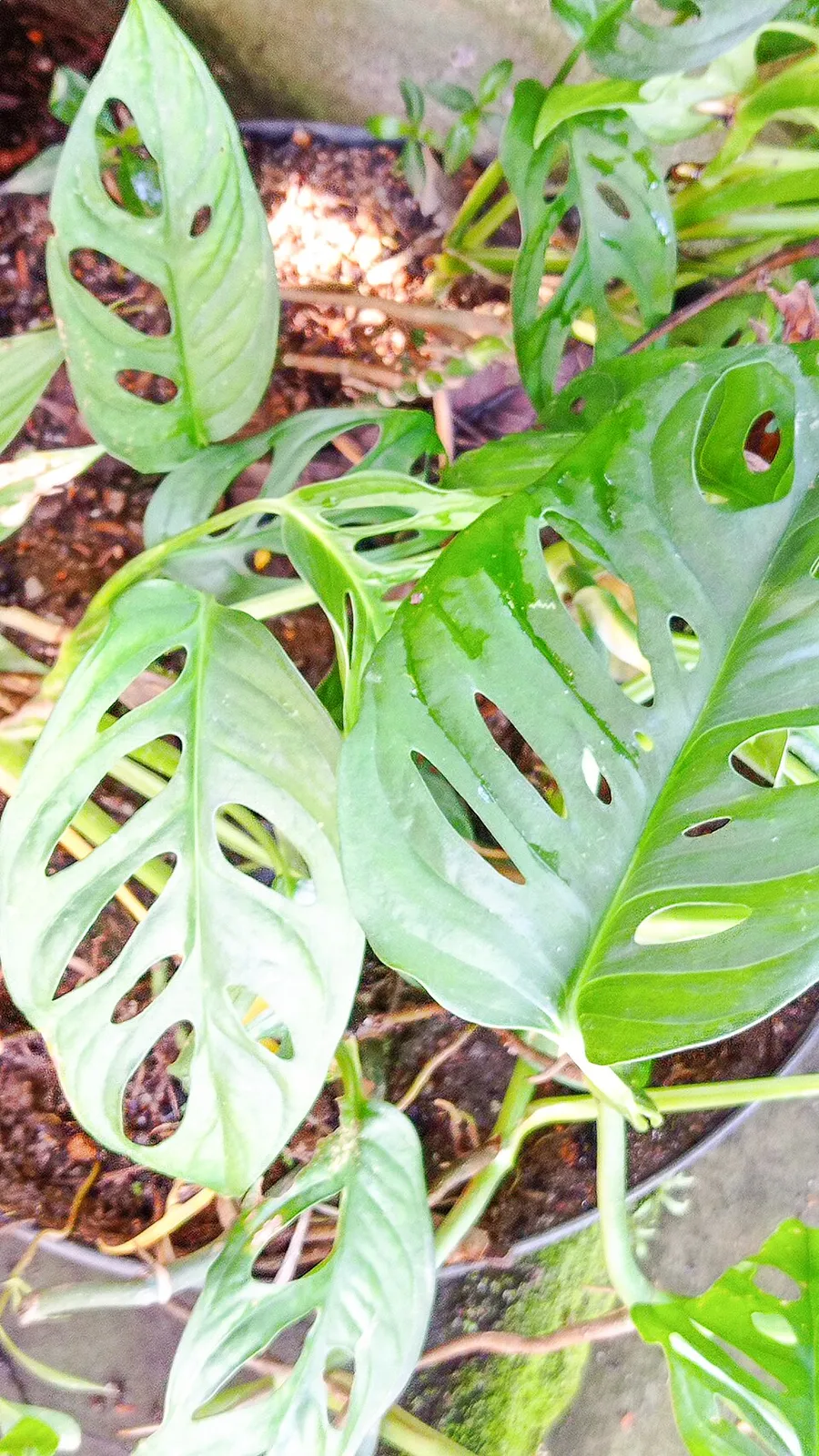
Monstera adansonii variegata is a highly coveted and visually striking cultivar derived from the classic evergreen perennial, Monstera adansonii, itself a prominent member of the expansive Araceae family. This captivating aroid is primarily distinguished by its exquisite foliage, which showcases an intricate and unpredictable pattern of creamy white or pale yellow variegation beautifully contrasted against vibrant green leaf tissue. The leaves typically present an ovate to cordate shape, usually spanning 15 to 30 centimeters in length, and are famously recognized for their natural fenestrations—distinctive, irregular perforations that develop as the leaf matures, earning the plant its endearing moniker, 'Swiss cheese plant'. These characteristic holes become more pronounced and numerous under optimal growing conditions and with the plant's age. The unique variegation pattern is highly variable; each individual leaf frequently displays a one-of-a-kind mosaic of color, rendering every plant a truly distinct and cherished specimen.
Its stems are robust and versatile, exhibiting a climbing or trailing habit, often smooth with a light green hue that may acquire subtle speckles over time. These stems are adept at producing aerial roots, which serve to anchor the plant to surfaces or to absorb ambient moisture from the atmosphere. In its indigenous tropical rainforest environments, predominantly across Central America from southern Mexico down to Panama, the non-variegated Monstera adansonii naturally ascends towering trees, reaching considerable heights. However, when cultivated indoors, the variegated Monstera adansonii typically maintains a more manageable stature, often growing to approximately 1 to 2 meters, especially when provided with adequate climbing support such as a moss pole. While infrequent in standard indoor cultivation, mature plants are capable of producing an inflorescence comprising a spathe and spadix, characteristic of the Araceae family.
These inflorescences are generally small, creamy-white to pale yellow, and, though less conspicuous, bear a resemblance to those of its larger relative, Monstera deliciosa. This cultivar thrives in warm, consistently humid conditions, mirroring its native understory habitat, and prefers a well-draining yet consistently moist soil substrate. Its botanical placement within the Araceae family aligns it with other significant genera like Philodendron and Anthurium, known for their ornamental and sometimes medic ...[CURRENT TEXT EXISTS: 2771 chars]
1.1.Monstera Adansonii Variegata — Key Features
- ✓ <strong>Striking Variegation</strong> — Features unpredictable patterns of creamy white or pale yellow on deep green leaves.
- ✓ <strong>Characteristic Fenestrations</strong> — Unique, natural holes develop in mature leaves, earning it the 'Swiss cheese plant' moniker.
- ✓ <strong>Climbing/Trailing Habit</strong> — Versatile growth allows it to be displayed in various settings with support.
- ✓ <strong>Aerial Roots</strong> — Develops roots from stems to anchor or absorb atmospheric moisture.
- ✓ <strong>High Humidity Lover</strong> — Thrives in warm, humid environments, mimicking its native tropical habitat.
- ✓ <strong>Ornamental Value</strong> — Primarily cultivated for its exceptional beauty and decorative appeal.
- ✓ <strong>Moderate Growth Rate</strong> — Can grow approximately one foot per year under optimal conditions.
- ✓ <strong>Collector's Plant</strong> — Highly desirable and often expensive due to its rarity and unique aesthetics.
- ✓ <strong>Araceae Family Member</strong> — Belongs to a large family known for many popular houseplants.
- ✓ <strong>Non</strong> — Flowering Indoors — Rarely produces its characteristic spathe and spadix inflorescence in typical home environments.
1.2.Monstera Adansonii Variegata — Quick Summary
- ✓ Highly sought-after variegated ornamental plant with unique fenestrated leaves.
- ✓ Distinctive creamy white or pale yellow patterns against vibrant green foliage.
- ✓ Primarily grown indoors for aesthetic appeal and indirect air quality benefits.
- ✓ Requires bright, indirect light, high humidity, and well-draining soil.
- ✓ Contains calcium oxalate crystals, making all parts toxic if ingested.
- ✓ No documented traditional or modern medicinal uses specific to this cultivar.
2.Monstera Adansonii Variegata — Scientific Identity
3.Monstera Adansonii Variegata — Quick Facts
4.Monstera Adansonii Variegata — Appearance & Identification
5.Monstera Adansonii Variegata — Native Habitat
6.Monstera Adansonii Variegata — Water Requirements
- Cultivating Monstera adansonii variegata requires mimicking its tropical understory habitat to encourage vibrant growth and variegation.
- ✓ Indirect Sunlight — Provide bright, indirect light; direct sun can scorch the variegated leaves and reduce vibrancy.
- ✓ Well-Draining Soil — Use an airy, peat-based potting mix with amendments like perlite, orchid bark, or coco coir to ensure excellent drainage and aeration.
- ✓ Consistent Moisture — Water thoroughly when the top inch of soil feels dry, but avoid overwatering to prevent root rot.
- ✓ High Humidity — Maintain high humidity levels (60-80%) using a humidifier, pebble tray, or by grouping plants; a bathroom is often ideal.
- ✓ Warm Temperatures — Keep temperatures between 18-29°C (65-85°F); avoid cold drafts and sudden temperature drops.
- ✓ Regular Fertilization — Feed monthly from spring to early autumn with a balanced liquid NPK fertilizer (e.g., 5-2-3), diluted to half strength.
- ✓ Pruning for Variegation — Regularly prune solid green leaves or stems to redirect energy to variegated growth, encouraging more pronounced patterns.
- ✓ Repotting — Repot every 1-2 years, or when roots become pot-bound, moving to a pot only one inch larger in diameter.
Reviewed by the Flora Medical Global Botanical Review Panel
Multi-disciplinary editorial group · Botany · Ethnobotany · Herbal-medicine literature
Who reviewed this: This page was checked by the Flora Medical Global Botanical Review Panel — an in-house editorial group of botany graduates, ethnobotany researchers, and horticulture practitioners who collectively maintain our 7,000+ plant encyclopedia. Meet the team.
Our 4-step verification process
1. Taxonomic verification
Scientific names and synonyms cross-checked against Kew POWO, World Flora Online, and The Plant List.
2. Phytochemical & medicinal cross-reference
Active compounds, traditional uses, and reported activities are cross-referenced with PubMed, USDA Dr. Duke's database, and peer-reviewed ethnobotanical literature.
3. Conservation & distribution check
Distribution, ecology, and conservation status confirmed against GBIF occurrence records and the IUCN Red List.
4. Editorial & safety review
Every entry passes an editorial pass for clarity, originality, and safety notices (toxicity, contraindications, dosage caveats) before publication.
Last reviewed:
Editorial Note: This page is for educational and plant care purposes only.
Written by: Flora Medical Global Editorial Team
Reviewed by: Flora Medical Global Botanical Review Panel
Last Updated: June 15, 2026







Monstera Adansonii Variegata — Comments & Community Reviews
Rate this plant