
Care Disclaimer: Plant care recommendations are general guidelines based on common growing conditions. Individual results may vary based on your local environment, climate, and care routine. If your plant is toxic, keep it away from children and pets, and consult a veterinarian if accidental ingestion occurs.
1.Monstera Aurea — Overview
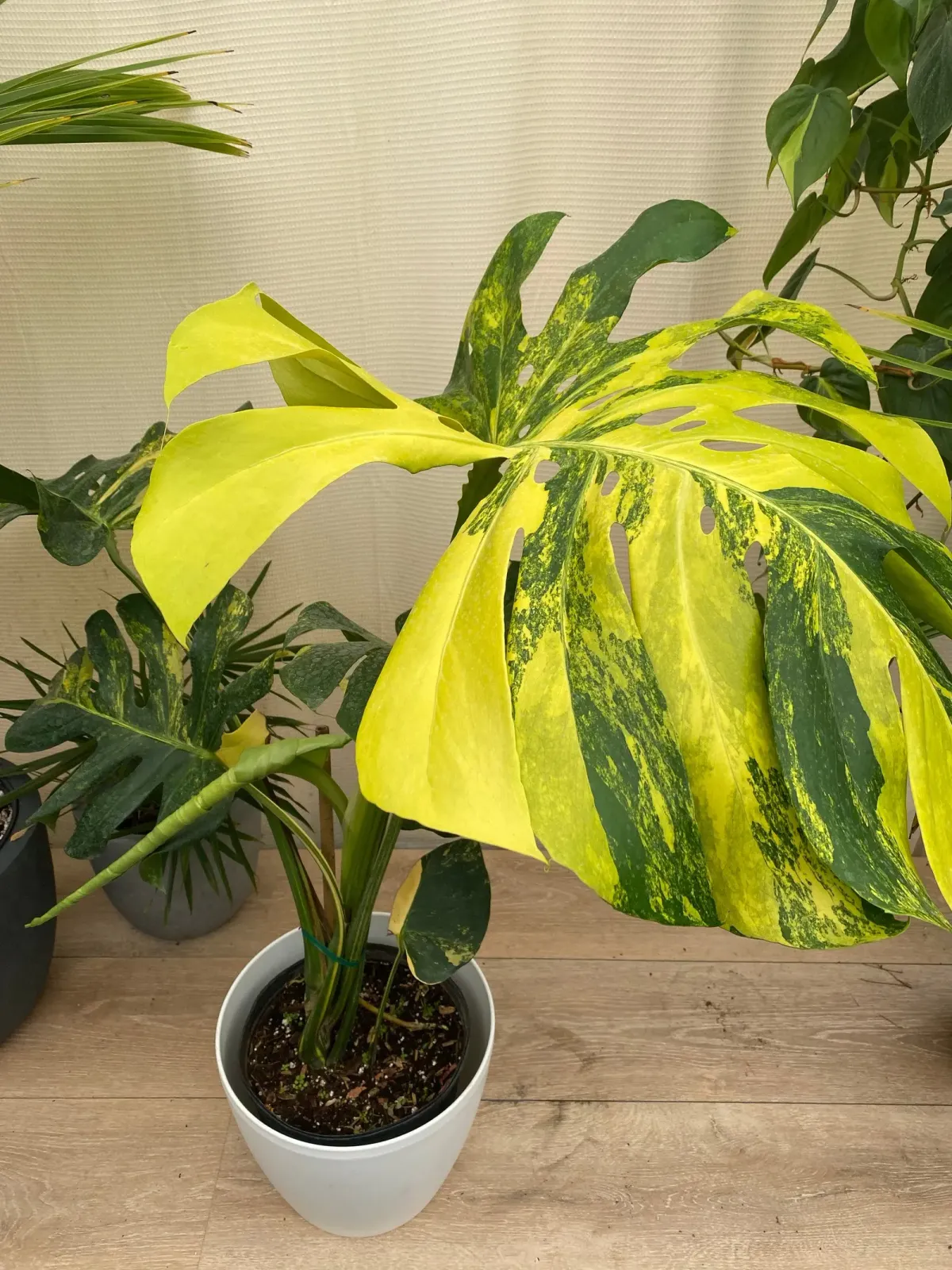
Monstera Aurea, scientifically known as Monstera deliciosa aurea, is a highly prized cultivar belonging to the Araceae family, native to the tropical rainforests of Central America, specifically regions spanning Mexico to Panama. This striking climbing epiphyte can achieve impressive heights, often reaching up to 3 meters when provided with adequate support in its natural or cultivated environment.
Its defining characteristic is the large, heart-shaped to ovate leaves, typically measuring between 30 to 60 cm in length, which develop intricate golden or yellow variegation. This unique marbling pattern makes each leaf distinct, contrasting beautifully with the plant's deep green base.
Young leaves emerge as solid green, gradually undergoing the fascinating process of fenestration, where the leaf blades develop characteristic splits and holes as they mature. This 'Swiss cheese' effect is particularly pronounced and aesthetically pleasing in the Aurea variety. The plant's robust, thick stem is designed to support its substantial foliage and climbing habit, often producing aerial roots that anchor it to host trees or support structures.
While flowering is uncommon in indoor settings, mature plants can produce the typical Araceae inflorescence—a creamy-white spadix enveloped by a boat-shaped spathe—under optimal outdoor conditions. In its native habitat, Monstera Aurea thrives under the dense canopy of larger trees, receiving filtered sunlight, which is crucial for maintaining its vibrant variegation and overall health. Its classification within the Araceae family places it alongside other well-known houseplants like Philodendrons and other Monstera species.
Trusted Scientific References
1. Authoritative external sources for Monstera deliciosa aurea
1.1 Wikipedia — Monstera deliciosa aurea
1.2 Kew POWO (Plants of the World Online)
1.3 PubMed — peer-reviewed research
1.4 NCBI Taxonomy Browser
1.5 GBIF — Global Biodiversity
1.6Monstera Aurea should be interpreted through verified botanical identity, practical care, and responsible safety language. This recovery note adds the missing context needed for a complete profile: match light to the plant's habit, use well-drained soil, water according to season, and avoid unsupported medicinal or edible claims. For publishing, the plant can be presented as a source-backed indoor plant with clear care guidance, common problem diagnosis, and conservative safety wording.
1.1.Monstera Aurea — Key Features
- ✓ <strong>Striking Golden Variegation</strong> — Distinctive yellow to gold marbling on deep green leaves.
- ✓ <strong>Iconic Fenestrations</strong> — Develops characteristic splits and holes as leaves mature, enhancing its 'Swiss cheese' appearance.
- ✓ <strong>Large, Heart</strong> — Shaped Leaves — Leaves can grow significantly, making a bold statement.
- ✓ <strong>Epiphytic Climbing Habit</strong> — Naturally climbs using aerial roots, requiring support in cultivation.
- ✓ <strong>Tropical Rainforest Native</strong> — Thrives in warm, humid environments with filtered light.
- ✓ <strong>Contains Calcium Oxalate</strong> — All plant parts are toxic if ingested, causing irritation.
- ✓ <strong>Highly Prized Ornamental</strong> — A popular and often rare collector's plant in horticulture.
- ✓ <strong>Air</strong> — Purifying Qualities (General) — Contributes to indoor air quality, like many houseplants.
- ✓ <strong>Psychological Well</strong> — being Contributor — Enhances mood and reduces stress through biophilic presence.
- ✓ <strong>Moderate to High Maintenance</strong> — Requires specific care for light, water, and humidity to thrive.
1.2.Monstera Aurea — Quick Summary
- ✓ Monstera Aurea is a highly sought-after variegated cultivar of Monstera deliciosa, known for its striking golden leaf patterns.
- ✓ Native to Central American rainforests, it's a climbing epiphyte prized for its aesthetic appeal and unique fenestrated foliage.
- ✓ Requires bright, indirect light, high humidity, and well-draining soil for optimal growth and variegation.
- ✓ All parts of the plant contain calcium oxalate crystals, making it toxic if ingested by humans or pets.
- ✓ Primarily valued for its decorative qualities and indirect psychological benefits, it has no traditional medicinal uses.
- ✓ Proper care and safety precautions are essential due to its irritant properties.
2.Monstera Aurea — Scientific Identity
3.Monstera Aurea — Quick Facts
4.Monstera Aurea — Appearance & Identification
5.Monstera Aurea — Native Habitat
6.Monstera Aurea — Water Requirements
- ✓ Light — Requires bright, indirect light to maintain vibrant variegation and prevent leaf burn; direct sun can scorch the delicate golden patches.
- ✓ Water — Water thoroughly when the top inch of soil feels dry; ensure excellent drainage to prevent root rot, as overwatering is a common issue.
- ✓ Soil — Thrives in a rich, well-draining, airy potting mix, typically a blend of orchid bark, perlite, and a high-quality compost or Monstera-specific mix.
- ✓ Humidity — Prefers high humidity, ideally around 70%; supplement with a humidifier, pebble tray, or by grouping with other plants in drier environments.
- ✓ Repotting — Repot every 1-2 years or when the plant becomes root-bound, moving to a pot only 1-2 inches larger to avoid excessive soil moisture.
- ✓ Propagation — Easily propagated via node cuttings, which can be rooted in water, sphagnum moss, or a moist perlite mix, ensuring at least one node is present.
- ✓ Pruning — Prune to control size, shape, and to encourage balanced variegation; remove fully green or fully variegated leaves to maintain plant health and aesthetic.
- ✓ Temperature — Maintain consistent indoor temperatures between 18-30°C (65-85°F), avoiding sudden drops or cold drafts.
Reviewed by the Flora Medical Global Botanical Review Panel
Multi-disciplinary editorial group · Botany · Ethnobotany · Herbal-medicine literature
Who reviewed this: This page was checked by the Flora Medical Global Botanical Review Panel — an in-house editorial group of botany graduates, ethnobotany researchers, and horticulture practitioners who collectively maintain our 7,000+ plant encyclopedia. Meet the team.
Our 4-step verification process
1. Taxonomic verification
Scientific names and synonyms cross-checked against Kew POWO, World Flora Online, and The Plant List.
2. Phytochemical & medicinal cross-reference
Active compounds, traditional uses, and reported activities are cross-referenced with PubMed, USDA Dr. Duke's database, and peer-reviewed ethnobotanical literature.
3. Conservation & distribution check
Distribution, ecology, and conservation status confirmed against GBIF occurrence records and the IUCN Red List.
4. Editorial & safety review
Every entry passes an editorial pass for clarity, originality, and safety notices (toxicity, contraindications, dosage caveats) before publication.
Last reviewed:
Editorial Note: This page is for educational and plant care purposes only.
Written by: Flora Medical Global Editorial Team
Reviewed by: Flora Medical Global Botanical Review Panel
Last Updated: June 15, 2026







Monstera Aurea — Comments & Community Reviews
Rate this plant