
Care Disclaimer: Plant care recommendations are general guidelines based on common growing conditions. Individual results may vary based on your local environment, climate, and care routine. If your plant is toxic, keep it away from children and pets, and consult a veterinarian if accidental ingestion occurs.
1.Nautilocalyx — Overview
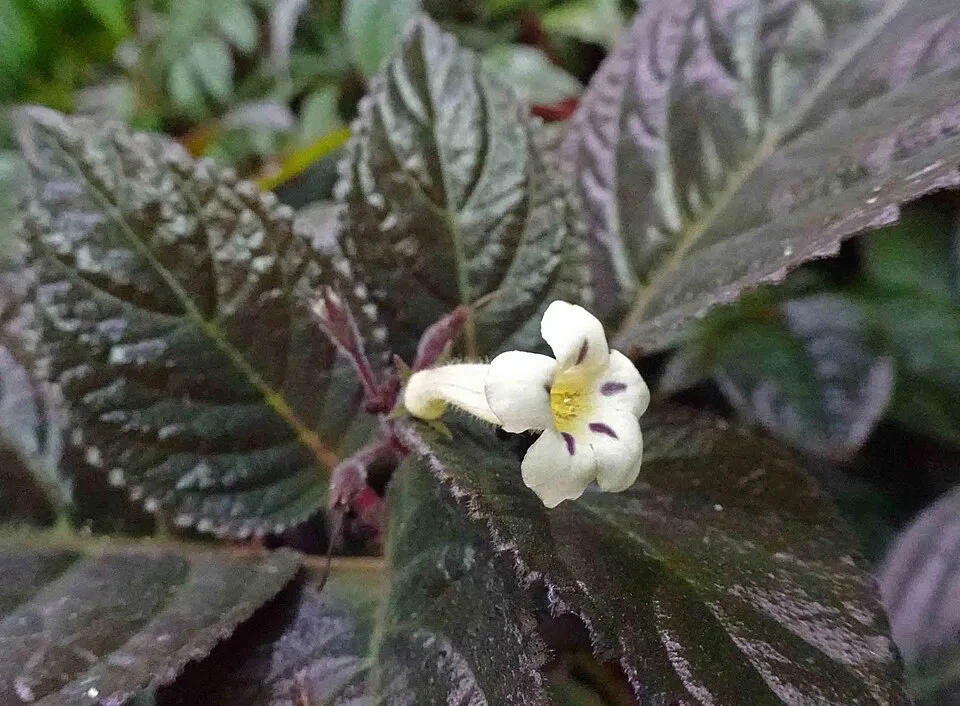
Nautilocalyx lynchii, affectionately known as the ‘Black Scallop’ or ‘Red-Back Gesneriad’, stands as a captivating member of the Gesneriaceae family, primarily celebrated for its dramatic foliage rather than its inconspicuous flowers. This species is indigenous to the humid, shaded understories of tropical rainforests in northern South America, with its native range extending across regions of Colombia, Venezuela, and Ecuador, where it typically thrives as a terrestrial or occasionally epiphytic plant.
Its classification in the late 19th and early 20th centuries highlighted its unique botanical characteristics, although detailed historical records regarding its traditional indigenous uses are notably limited compared to more widely recognized medicinal flora.
Botanically, Nautilocalyx lynchii is distinguished by its striking, elliptical to ovate leaves, which can measure between 10 to 20 cm in length. The adaxial, or upper, surface of these leaves exhibits a rich, velvety texture in shades of dark green to almost black, dramatically contrasted by a vibrant reddish-purple hue on the abaxial, or lower, surface. This spectacular coloration, combined with deeply impressed veins that create a puckered or scalloped appearance, renders it a highly prized ornamental plant.
Its moderate growth habit and specific requirements for consistently warm temperatures, high humidity, and moderate indirect light make it an exceptional choice for cultivation in terrariums, vivariums, or as a distinctive potted indoor specimen in temperate climates. While direct scientific research into Nautilocalyx lynchii’s medicinal applications is still nascent, the presence of various secondary metabolites, such as flavonoids and phenolic compounds, is highly probable, suggesting potential avenues for future phytochemical and pharmacological exploration within its family.
Trusted Scientific References
1. Authoritative external sources for Nautilocalyx lynchii
1.1 Wikipedia — Nautilocalyx lynchii
1.2 Kew POWO (Plants of the World Online)
1.3 PubMed — peer-reviewed research
1.4 NCBI Taxonomy Browser
1.5 GBIF — Global Biodiversity
1.1.Nautilocalyx — Key Features
- ✓ <strong>Striking Bicolor Foliage</strong> — Dark green to black above, reddish-purple below.
- ✓ <strong>Velvety Leaf Texture</strong> — Distinctive soft, tactile feel on the upper leaf surface.
- ✓ <strong>Scalloped Leaf Appearance</strong> — Deeply impressed veins create a unique puckered look.
- ✓ <strong>Tropical Rainforest Native</strong> — Indigenous to the understory of South American humid forests.
- ✓ <strong>Understory Growth Habit</strong> — Adapted to low-light conditions beneath a dense canopy.
- ✓ <strong>Terrestrial or Epiphytic</strong> — Can grow in soil or on other plants in its natural habitat.
- ✓ <strong>High Humidity Requirement</strong> — Essential for optimal growth and leaf health.
- ✓ <strong>Moderate Indirect Light Preference</strong> — Avoids direct sunlight to prevent leaf damage.
- ✓ <strong>Ideal for Terrariums/Vivariums</strong> — Thrives in enclosed, humid environments.
- ✓ <strong>Member of Gesneriaceae Family</strong> — Related to African Violets and Gloxinias.
1.2.Nautilocalyx — Quick Summary
- ✓ Distinctive Bicolor Foliage — Velvety dark green/black upper surface with a reddish-purple underside.
- ✓ Tropical Rainforest Native — Originates from humid understories of northern South America.
- ✓ Primarily Ornamental — Valued for its aesthetic appeal in terrariums and indoor environments.
- ✓ Limited Medicinal Research — Specific uses for *N. lynchii* are largely unexplored.
- ✓ Probable Phytochemicals — Contains anticipated flavonoids and phenolic compounds.
- ✓ Requires High Humidity — Thrives in warm, moist conditions with indirect light.
2.Nautilocalyx — Scientific Identity
3.Nautilocalyx — Quick Facts
4.Nautilocalyx — Appearance & Identification
5.Nautilocalyx — Native Habitat
6.Nautilocalyx — Water Requirements
- ✓ Light — Provide moderate to bright indirect light; direct sunlight can scorch the distinctive foliage.
- ✓ Humidity — Requires high humidity, ideally between 70-80%, making it suitable for terrariums or humid indoor environments.
- ✓ Temperature — Thrives in warm conditions, with an optimal range of 18-27°C (65-80°F).
- ✓ Watering — Keep the soil consistently moist but never waterlogged; allow the top inch to dry slightly between waterings.
- ✓ Soil — Use a well-draining, aerated potting mix rich in organic matter, such as a peat-based mix with perlite.
- ✓ Fertilization — Fertilize sparingly during the growing season (spring and summer) with a diluted balanced liquid fertilizer.
- ✓ Propagation — Easily propagated from stem cuttings, which root readily in high humidity conditions.
- ✓ Acclimation — Plants grown in high humidity may need gradual acclimation to average home humidity if not placed in a terrarium.
Reviewed by the Flora Medical Global Botanical Review Panel
Multi-disciplinary editorial group · Botany · Ethnobotany · Herbal-medicine literature
Who reviewed this: This page was checked by the Flora Medical Global Botanical Review Panel — an in-house editorial group of botany graduates, ethnobotany researchers, and horticulture practitioners who collectively maintain our 7,000+ plant encyclopedia. Meet the team.
Our 4-step verification process
1. Taxonomic verification
Scientific names and synonyms cross-checked against Kew POWO, World Flora Online, and The Plant List.
2. Phytochemical & medicinal cross-reference
Active compounds, traditional uses, and reported activities are cross-referenced with PubMed, USDA Dr. Duke's database, and peer-reviewed ethnobotanical literature.
3. Conservation & distribution check
Distribution, ecology, and conservation status confirmed against GBIF occurrence records and the IUCN Red List.
4. Editorial & safety review
Every entry passes an editorial pass for clarity, originality, and safety notices (toxicity, contraindications, dosage caveats) before publication.
Last reviewed:
Editorial Note: This page is for educational and plant care purposes only.
Written by: Flora Medical Global Editorial Team
Reviewed by: Flora Medical Global Botanical Review Panel
Last Updated: June 15, 2026







Nautilocalyx — Comments & Community Reviews
Rate this plant