
Care Disclaimer: Plant care recommendations are general guidelines based on common growing conditions. Individual results may vary based on your local environment, climate, and care routine. If your plant is toxic, keep it away from children and pets, and consult a veterinarian if accidental ingestion occurs.
1.Nepenthes Alata — Overview
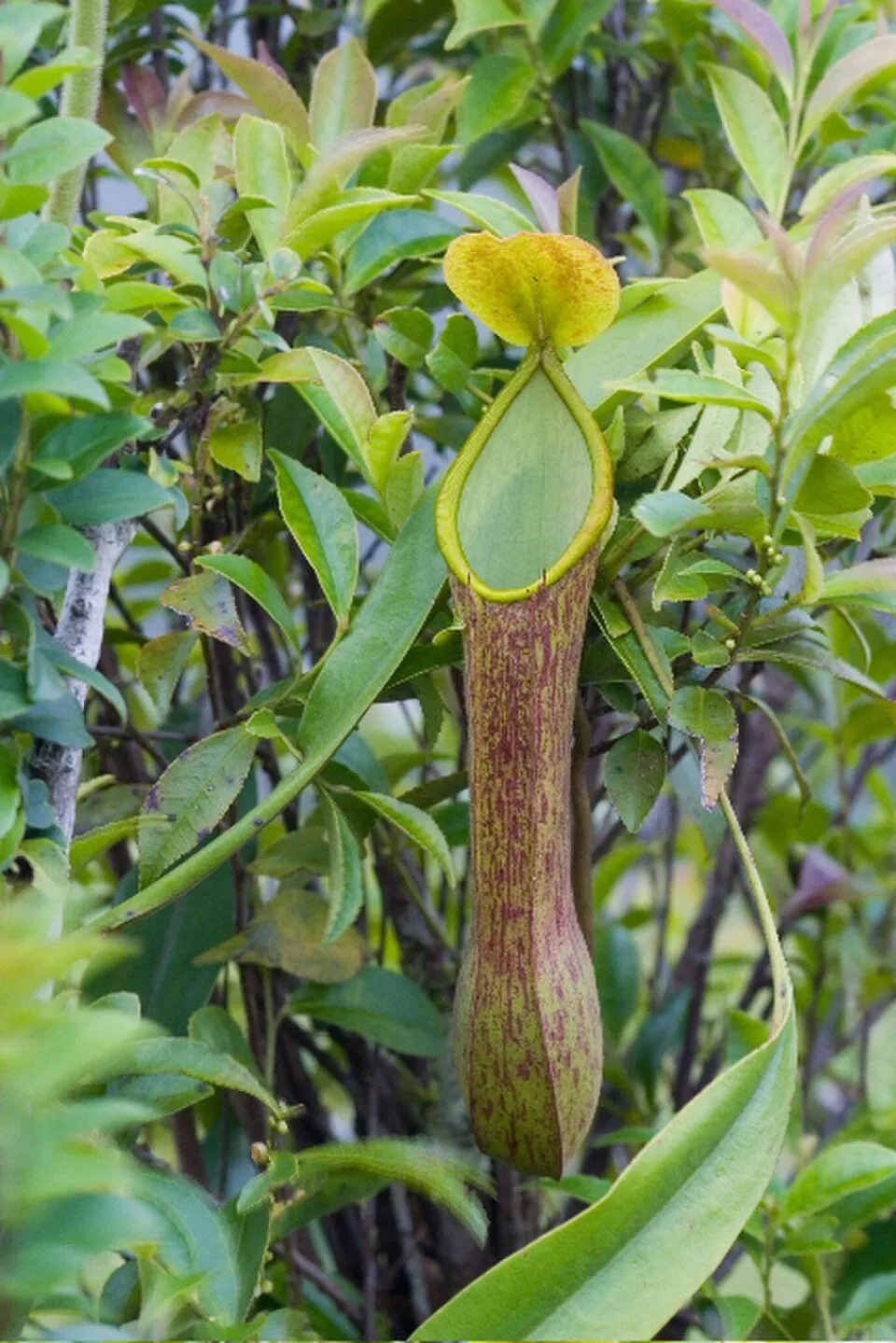
Nepenthes alata, commonly known as the winged pitcher plant, is an enchanting tropical carnivorous plant indigenous to the Philippines, primarily thriving across Luzon, Mindanao, and other associated islands. This species is characterized by its scandent or climbing stems, which can extend up to several meters in length, allowing it to ascend surrounding vegetation in its native rainforest habitats, though some forms exhibit a more compact, rosette-like growth. Its foliage consists of elongated, lanceolate leaves, typically 20-30 centimeters long, tapering to an acuminate point, often displaying subtly undulated margins. The most distinctive feature is its specialized pitcher traps, which are modified leaf structures.
These tubular vessels, reaching up to 15 centimeters in height, are typically a vibrant greenish-yellow, frequently adorned with striking red or burgundy speckles, particularly on the peristome (the ribbed rim) and the operculum (lid). The pitcher's interior is coated with a waxy layer to prevent prey escape and features glands that secrete potent digestive enzymes. The lid protects the digestive fluid from rain dilution and often bears nectar glands on its underside to attract insects. Nepenthes alata anchors itself with a fibrous root system.
Its flowers are dioecious, meaning male and female reproductive structures are on separate plants, and are generally inconspicuous, appearing on racemose inflorescences with small, greenish-brown to reddish petals, emphasizing their role in insect attraction rather than showy display. This species typically flourishes in warm, humid environments, often found in open, disturbed areas or along forest margins.
Trusted Scientific References
1. Authoritative external sources for Nepenthes alata
1.1 Wikipedia — Nepenthes alata
1.2 Kew POWO (Plants of the World Online)
1.3 PubMed — peer-reviewed research
1.4 NCBI Taxonomy Browser
1.5 GBIF — Global Biodiversity
1.6Nepenthes Alata should be interpreted through verified botanical identity, practical care, and responsible safety language. This recovery note adds the missing context needed for a complete profile: match light to the plant's habit, use well-drained soil, water according to season, and avoid unsupported medicinal or edible claims. For publishing, the plant can be presented as a source-backed indoor plant with clear care guidance, common problem diagnosis, and conservative safety wording.
1.1.Nepenthes Alata — Key Features
- ✓ <strong>Carnivorous Plant</strong> — Possesses unique modified leaves forming pitcher traps to capture and digest insects.
- ✓ <strong>Distinctive Pitcher Traps</strong> — Elongated, tubular vessels with a waxy interior, digestive glands, and an attractive lid/peristome.
- ✓ <strong>Tropical Rainforest Native</strong> — Thrives in warm, humid conditions mimicking its natural habitat in the Philippines.
- ✓ <strong>Scandent Growth Habit</strong> — Stems can climb or trail, using tendrils to anchor themselves to supports.
- ✓ <strong>Dioecious Flowers</strong> — Male and female flowers are borne on separate plants, requiring both for seed production.
- ✓ <strong>Digestive Enzyme Secretion</strong> — Produces proteases, chitinases, and phosphatases to break down prey nutrients.
- ✓ <strong>Ornamental Value</strong> — Highly prized for its exotic appearance and fascinating carnivorous nature in cultivation.
- ✓ <strong>High Humidity Requirement</strong> — Essential for the proper development and function of its pitcher traps.
- ✓ <strong>Sensitive to Water Quality</strong> — Requires distilled, rainwater, or reverse osmosis water to prevent mineral buildup.
- ✓ <strong>Nectar Glands</strong> — Specialized glands on the pitcher lid and peristome attract insect prey.
1.2.Nepenthes Alata — Quick Summary
- ✓ Nepenthes alata is a carnivorous tropical pitcher plant from the Philippines.
- ✓ It captures insects in specialized pitcher traps containing digestive enzymes.
- ✓ Primarily valued as an ornamental plant, with limited traditional medicinal uses for other Nepenthes species.
- ✓ Requires specific care: bright indirect light, high humidity, warm temperatures, and pure water.
- ✓ Contains naphthoquinones, proteolytic enzymes, and flavonoids among other compounds.
- ✓ Not recommended for internal consumption due to lack of safety data and potential toxicity.
2.Nepenthes Alata — Scientific Identity
3.Nepenthes Alata — Quick Facts
4.Nepenthes Alata — Appearance & Identification
5.Nepenthes Alata — Native Habitat
6.Nepenthes Alata — Water Requirements
- ✓ Light — Provide bright, indirect light; filtered sunlight or dappled shade is ideal, as prolonged direct sun can cause leaf burn.
- ✓ Temperature — Maintain warm tropical conditions with daytime temperatures between 24-29°C (75-85°F) and nighttime temperatures not dropping below 13°C (55°F).
- ✓ Humidity — Crucial for pitcher development, aim for high humidity levels between 50% and 60%, potentially using a humidifier or pebble tray.
- ✓ Watering — Use only distilled water, rainwater, or reverse osmosis water; keep the soil consistently moist but never waterlogged, watering when the top inch feels slightly dry.
- ✓ Soil and Potting Mix — Utilize a well-draining, acidic mix such as long-fibered sphagnum moss blended with perlite or orchid bark, avoiding conventional potting soil.
- ✓ Feeding — Supplement with small insects or a highly diluted, nutrient-poor liquid fertilizer at half-strength during the active growing season, as it obtains nutrients from captured prey.
- ✓ Pruning — Trim dead or dried leaves and pitchers to maintain plant health and aesthetic appearance, being careful not to damage growing tips.
- ✓ Support — Provide stakes or a trellis for the climbing vines to encourage a desired growth pattern and prevent sprawling.
Reviewed by the Flora Medical Global Botanical Review Panel
Multi-disciplinary editorial group · Botany · Ethnobotany · Herbal-medicine literature
Who reviewed this: This page was checked by the Flora Medical Global Botanical Review Panel — an in-house editorial group of botany graduates, ethnobotany researchers, and horticulture practitioners who collectively maintain our 7,000+ plant encyclopedia. Meet the team.
Our 4-step verification process
1. Taxonomic verification
Scientific names and synonyms cross-checked against Kew POWO, World Flora Online, and The Plant List.
2. Phytochemical & medicinal cross-reference
Active compounds, traditional uses, and reported activities are cross-referenced with PubMed, USDA Dr. Duke's database, and peer-reviewed ethnobotanical literature.
3. Conservation & distribution check
Distribution, ecology, and conservation status confirmed against GBIF occurrence records and the IUCN Red List.
4. Editorial & safety review
Every entry passes an editorial pass for clarity, originality, and safety notices (toxicity, contraindications, dosage caveats) before publication.
Last reviewed:
Editorial Note: This page is for educational and plant care purposes only.
Written by: Flora Medical Global Editorial Team
Reviewed by: Flora Medical Global Botanical Review Panel
Last Updated: June 15, 2026







Nepenthes Alata — Comments & Community Reviews
Rate this plant