

Care Disclaimer: Plant care recommendations are general guidelines based on common growing conditions. Individual results may vary based on your local environment, climate, and care routine. If your plant is toxic, keep it away from children and pets, and consult a veterinarian if accidental ingestion occurs.
1.Nepenthes Ampullaria — Overview
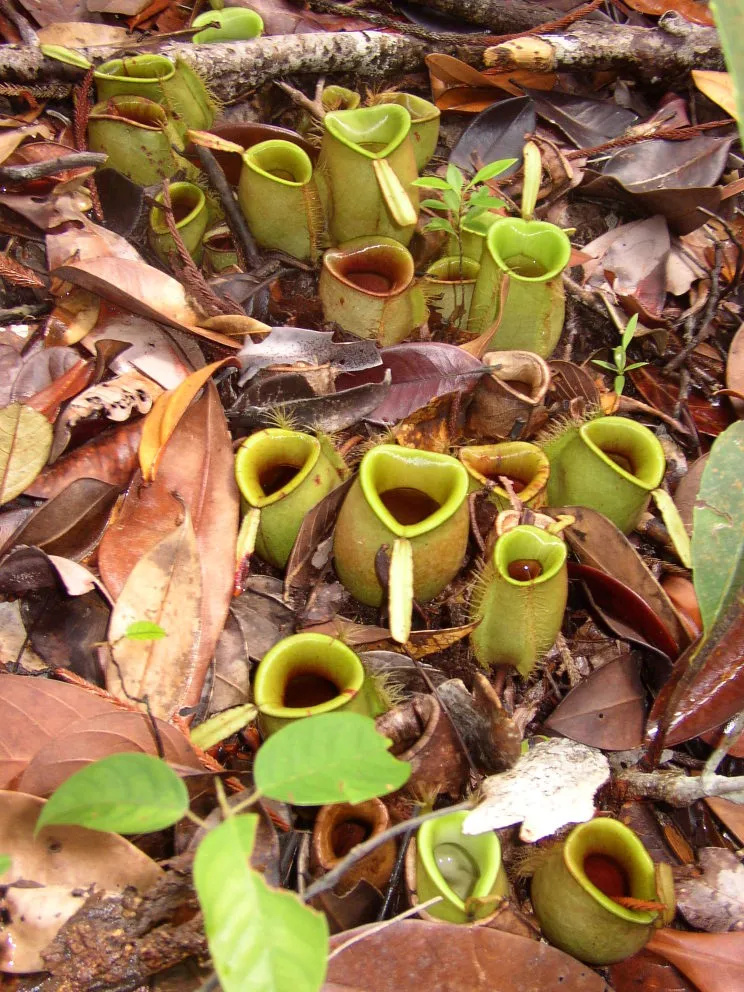
Nepenthes ampullaria, commonly known as the hollow-leafed pitcher plant, is a fascinating and highly specialized carnivorous plant belonging to the family Nepenthaceae. This species exhibits a unique growth habit, often sprawling or climbing as a liana through the undergrowth of its native tropical rainforests, though it can also form impressive rosettes in open areas. Under optimal conditions, its stems can extend significantly, supporting an array of its distinctive leaves.
The foliage of N. ampullaria is dimorphic; the lower pitchers are typically globose to ovoid, often resting on the ground, while the upper pitchers, if produced, are generally smaller, more funnel-shaped, and hang freely. The leaves are uniquely adapted, featuring a flat, ribbon-like lamina that terminates in an inverted, urn-shaped pitcher.
These pitchers, which can reach up to 20 centimeters (about 8 inches) in length, are highly variable in color, ranging from vibrant greens to deep reds, often adorned with intricate patterns or speckles that enhance their visual appeal. The pitcher's interior is smooth and waxy, designed to minimize moisture loss and facilitate the trapping and digestion of insects, a crucial adaptation for nutrient acquisition in its poor soil habitats.
Originating from the humid, lowland rainforests of Southeast Asia, Nepenthes ampullaria is particularly abundant in regions such as Borneo, Sumatra, and the Malay Peninsula, where it thrives in warm, consistently moist environments. It is often found in peat swamps, disturbed forest areas, and along riverbanks, preferring acidic, nutrient-deficient soils. Its root system is typically shallow and fibrous, primarily serving as an anchor, as the plant derives most of its essential nutrients, particularly nitrogen and phosphorus, from the insects it captures.
The flowers of N. ampullaria are dioecious, meaning male and female flowers are borne on separate plants, and are relatively inconspicuous, typically yellowish-green to brownish.
Trusted Scientific References
1. Authoritative external sources for Nepenthes ampullaria
1.1 Wikipedia — Nepenthes ampullaria
1.2 Kew POWO (Plants of the World Online)
1.3 PubMed — peer-reviewed research
1.4 NCBI Taxonomy Browser
1.5 GBIF — Global Biodiversity
1.1.Nepenthes Ampullaria — Key Features
- ✓ <strong>Carnivorous Nature</strong> — Possesses specialized pitchers to trap and digest insects for nutrient acquisition.
- ✓ <strong>Dimorphic Pitchers</strong> — Exhibits distinct ground-level (globose) and aerial (funnel-shaped) pitchers.
- ✓ <strong>Tropical Lowland Habitat</strong> — Native to warm, humid, nutrient-poor lowland rainforests of Southeast Asia.
- ✓ <strong>Vining/Rosette Growth</strong> — Can grow as a scrambling vine or form impressive rosettes.
- ✓ <strong>Unique Leaf Adaptation</strong> — Lamina terminates in an inverted, urn-shaped pitcher.
- ✓ <strong>Acidic Soil Preference</strong> — Thrives in highly acidic, peat-rich soils.
- ✓ <strong>Dioecious Flowers</strong> — Male and female flowers are borne on separate plants.
- ✓ <strong>High Humidity Requirement</strong> — Essential for proper pitcher development and overall plant health.
- ✓ <strong>Ornamental Appeal</strong> — Highly valued by plant enthusiasts for its striking appearance and unique biology.
1.2.Nepenthes Ampullaria — Quick Summary
- ✓ Nepenthes ampullaria is a unique carnivorous pitcher plant from Southeast Asia.
- ✓ Known for its distinctive urn-shaped pitchers that trap insects for nutrients.
- ✓ Thrives in humid, lowland rainforests with specific light and temperature needs.
- ✓ Traditional uses are limited, often focusing on digestive aid or topical wound care.
- ✓ Contains proteolytic enzymes, flavonoids, and other compounds.
- ✓ Not recommended for internal consumption; primarily a botanical curiosity and ornamental.
2.Nepenthes Ampullaria — Scientific Identity
3.Nepenthes Ampullaria — Quick Facts
4.Nepenthes Ampullaria — Appearance & Identification
5.Nepenthes Ampullaria — Native Habitat
6.Nepenthes Ampullaria — Water Requirements
- ✓ Light — Provide very bright, diffused light; avoid intense, direct sunlight which can burn leaves. East or west-facing windows or shade cloth in greenhouses are ideal.
- ✓ Temperature — As a lowlander, Nepenthes ampullaria prefers hot days (around 30°C/86°F) and warm nights (around 20°C/68°F); cold snaps can be lethal.
- ✓ Humidity — Maintain high relative humidity, ideally above 50% during the day and higher at night, to encourage pitcher formation. Misting or keeping soil moist can help.
- ✓ Soil — Use an acidic, nutrient-poor, well-draining substrate like a mix of long-fiber sphagnum moss, perlite, and orchid bark, avoiding traditional potting soil.
- ✓ Watering — Water frequently with distilled, rainwater, or reverse osmosis water to keep the media consistently moist; never let the plant sit in standing water for prolonged periods.
- ✓ Feeding — Supplement with small insects (e.g., crickets, mealworms) dropped into pitchers every few weeks; do not overfeed, as the plant gets most nutrients from its traps.
- ✓ Space — Be aware that Nepenthes ampullaria is a vining plant that can grow quite large, requiring ample space or regular pruning to manage its size.
Reviewed by the Flora Medical Global Botanical Review Panel
Multi-disciplinary editorial group · Botany · Ethnobotany · Herbal-medicine literature
Who reviewed this: This page was checked by the Flora Medical Global Botanical Review Panel — an in-house editorial group of botany graduates, ethnobotany researchers, and horticulture practitioners who collectively maintain our 7,000+ plant encyclopedia. Meet the team.
Our 4-step verification process
1. Taxonomic verification
Scientific names and synonyms cross-checked against Kew POWO, World Flora Online, and The Plant List.
2. Phytochemical & medicinal cross-reference
Active compounds, traditional uses, and reported activities are cross-referenced with PubMed, USDA Dr. Duke's database, and peer-reviewed ethnobotanical literature.
3. Conservation & distribution check
Distribution, ecology, and conservation status confirmed against GBIF occurrence records and the IUCN Red List.
4. Editorial & safety review
Every entry passes an editorial pass for clarity, originality, and safety notices (toxicity, contraindications, dosage caveats) before publication.
Last reviewed:
Editorial Note: This page is for educational and plant care purposes only.
Written by: Flora Medical Global Editorial Team
Reviewed by: Flora Medical Global Botanical Review Panel
Last Updated: June 15, 2026







Nepenthes Ampullaria — Comments & Community Reviews
Rate this plant