
Care Disclaimer: Plant care recommendations are general guidelines based on common growing conditions. Individual results may vary based on your local environment, climate, and care routine. If your plant is toxic, keep it away from children and pets, and consult a veterinarian if accidental ingestion occurs.
1.Nepenthes Bicalcarata — Overview
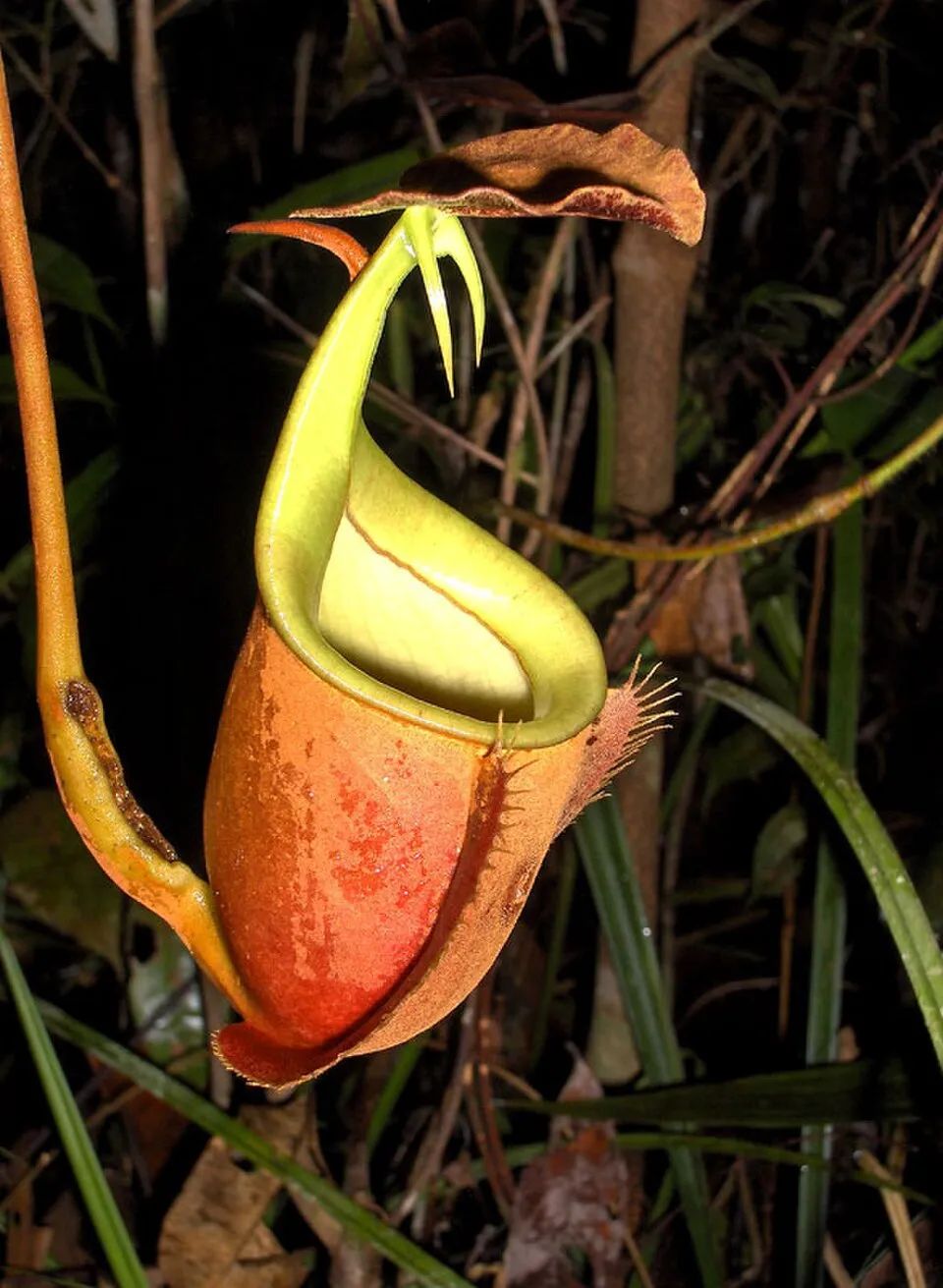
Nepenthes bicalcarata, commonly known as the two-toothed pitcher plant, is a striking carnivorous plant endemic to the peat swamp forests of Borneo and Sumatra. This impressive tropical species thrives in hot, humid lowland environments, often growing terrestrially or as an epiphyte. The plant develops into an elongated climbing vine, capable of reaching significant lengths in its natural habitat, with stems that can extend for many meters.
Its leaves are distinctively lanceolate, robust, and can grow up to 60 cm (24 inches) long, featuring a glossy dark green hue often highlighted by purple or reddish venation. What truly sets Nepenthes bicalcarata apart are its large, tubular pitchers, typically 20-25 cm (8-10 inches) in length, which are predominantly green with reddish or purple mottling. These formidable traps are uniquely adorned with two prominent, sharp 'fangs' or spurs (bicalcarate) located beneath the pitcher lid, which are believed to aid in prey capture, particularly ants.
The pitchers contain a pool of highly acidic digestive fluid, rich in enzymes, designed to break down trapped insects. Taxonomically, it belongs to the Nepenthaceae family, an ancient lineage within the order Ericales, showcasing specialized adaptations for nutrient acquisition in poor soils. Its unique morphology and ecological niche make it a highly prized species for botanical enthusiasts and a fascinating subject for scientific study, particularly regarding its carnivorous mechanisms and potential traditional uses.
Trusted Scientific References
1. Authoritative external sources for Nepenthes bicalcarata
1.1 Wikipedia — Nepenthes bicalcarata
1.2 Kew POWO (Plants of the World Online)
1.3 PubMed — peer-reviewed research
1.4 NCBI Taxonomy Browser
1.5 GBIF — Global Biodiversity
1.6Nepenthes Bicalcarata should be interpreted through verified botanical identity, practical care, and responsible safety language. This recovery note adds the missing context needed for a complete profile: match light to the plant's habit, use well-drained soil, water according to season, and avoid unsupported medicinal or edible claims. For publishing, the plant can be presented as a source-backed indoor plant with clear care guidance, common problem diagnosis, and conservative safety wording.
1.1.Nepenthes Bicalcarata — Key Features
- ✓ <strong>Distinctive Bicalcarate Teeth</strong> — Prominent, fang-like spurs beneath the pitcher lid unique to this species.
- ✓ <strong>Tropical Lowland Habitat</strong> — Native to the hot, humid peat swamp forests of Borneo and Sumatra.
- ✓ <strong>Carnivorous Adaptations</strong> — Produces large pitchers filled with acidic digestive fluid to trap and digest insects.
- ✓ <strong>Elongated Climbing Vine</strong> — Grows as a scrambling or climbing plant, reaching significant lengths in its natural environment.
- ✓ <strong>High Humidity Requirement</strong> — Demands consistently high relative humidity for optimal growth and pitcher development.
- ✓ <strong>Specialized Digestive Enzymes</strong> — Pitcher fluid contains proteases (Nepenthesin) and chitinases for efficient prey digestion.
- ✓ <strong>Traditional Medicinal Association</strong> — Historically used in folk medicine for purported diuretic and kidney-supporting properties.
- ✓ <strong>Ornamental Value</strong> — Highly sought after by collectors for its unique and striking appearance.
- ✓ <strong>Endemic Species</strong> — Naturally found only in specific regions of Borneo and Sumatra.
- ✓ <strong>Nutrient</strong> — Poor Soil Adaptation — Thrives in acidic, nutrient-deficient soils by supplementing nutrients through carnivory.
1.2.Nepenthes Bicalcarata — Quick Summary
- ✓ Nepenthes bicalcarata is a unique carnivorous pitcher plant from Borneo and Sumatra, known for its distinctive 'two-toothed' pitchers.
- ✓ It thrives in hot, humid lowland environments and grows as a climbing vine, highly prized for its ornamental value.
- ✓ Traditionally associated with diuretic properties and used for various folk remedies in Southeast Asia, particularly for fluid retention and kidney issues.
- ✓ Modern scientific research on its medicinal efficacy and human safety is very limited, and claims remain largely unverified.
- ✓ Cultivation requires specific conditions: bright, diffused light, high humidity, warm temperatures, and nutrient-poor, acidic soil.
- ✓ Caution is strongly advised for any internal medicinal use due to the lack of scientific safety data.
2.Nepenthes Bicalcarata — Scientific Identity
3.Nepenthes Bicalcarata — Quick Facts
4.Nepenthes Bicalcarata — Appearance & Identification
5.Nepenthes Bicalcarata — Native Habitat
6.Nepenthes Bicalcarata — Water Requirements
- ✓ Light — Provide very bright, diffused light; avoid harsh, direct sunlight which can scorch leaves. An east or west-facing window, or a greenhouse with 50% shade cloth, is ideal.
- ✓ Temperature — As a true lowlander, Nepenthes bicalcarata requires hot days (around 30°C / 86°F) and warm nights (around 20°C / 68°F). Cold snaps can be lethal.
- ✓ Humidity — Maintain high relative humidity, ideally above 70% during the day and even higher at night. Terrariums or frequent misting can help achieve this.
- ✓ Watering — Use distilled water, rainwater, or reverse osmosis water. Keep the growing medium consistently moist but never waterlogged. Avoid allowing the soil to dry out completely.
- ✓ Growing Medium — Use a well-draining, acidic, nutrient-poor substrate such as a mix of long-fiber sphagnum moss, perlite, orchid bark, and pumice.
- ✓ Feeding — Supplement its diet with live or dried insects (e.g., crickets, mealworms) directly into the pitchers every 2-4 weeks. Do not use conventional plant fertilizers in the soil.
- ✓ Airflow — Ensure good air circulation to prevent fungal issues, especially in high humidity environments like terrariums.
- ✓ Space — As a climbing vine, this species can grow quite large. Plan for vertical space and be prepared to prune aggressively to manage its size in cultivation.
Reviewed by the Flora Medical Global Botanical Review Panel
Multi-disciplinary editorial group · Botany · Ethnobotany · Herbal-medicine literature
Who reviewed this: This page was checked by the Flora Medical Global Botanical Review Panel — an in-house editorial group of botany graduates, ethnobotany researchers, and horticulture practitioners who collectively maintain our 7,000+ plant encyclopedia. Meet the team.
Our 4-step verification process
1. Taxonomic verification
Scientific names and synonyms cross-checked against Kew POWO, World Flora Online, and The Plant List.
2. Phytochemical & medicinal cross-reference
Active compounds, traditional uses, and reported activities are cross-referenced with PubMed, USDA Dr. Duke's database, and peer-reviewed ethnobotanical literature.
3. Conservation & distribution check
Distribution, ecology, and conservation status confirmed against GBIF occurrence records and the IUCN Red List.
4. Editorial & safety review
Every entry passes an editorial pass for clarity, originality, and safety notices (toxicity, contraindications, dosage caveats) before publication.
Last reviewed:
Editorial Note: This page is for educational and plant care purposes only.
Written by: Flora Medical Global Editorial Team
Reviewed by: Flora Medical Global Botanical Review Panel
Last Updated: June 15, 2026







Nepenthes Bicalcarata — Comments & Community Reviews
Rate this plant