
Care Disclaimer: Plant care recommendations are general guidelines based on common growing conditions. Individual results may vary based on your local environment, climate, and care routine. If your plant is toxic, keep it away from children and pets, and consult a veterinarian if accidental ingestion occurs.
1.Nepenthes Rajah — Overview
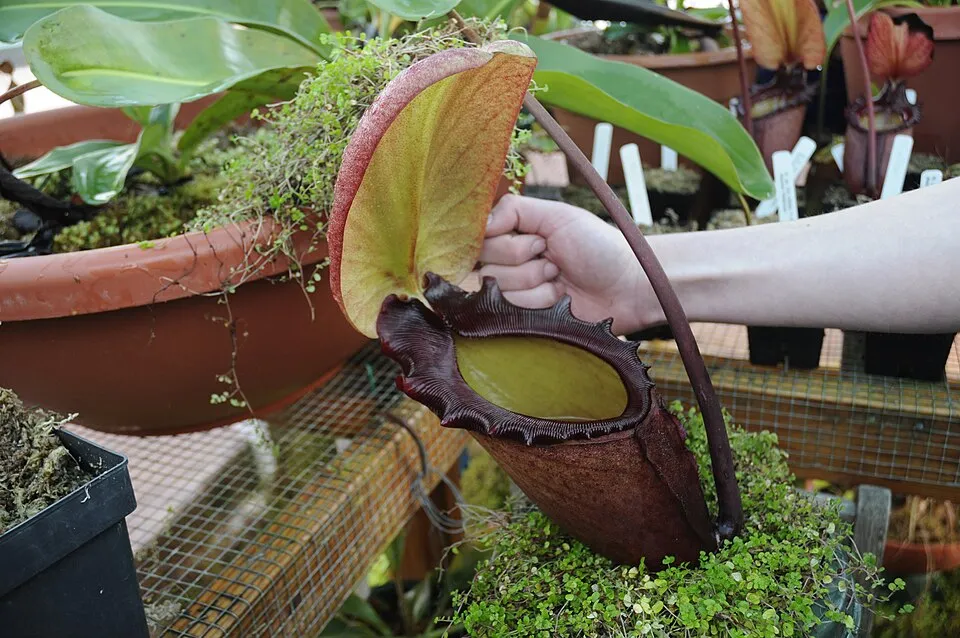
Nepenthes rajah, commonly known as the Rajah Pitcher Plant, is a truly magnificent and iconic carnivorous species endemic to the highlands of Borneo, specifically found on Mount Kinabalu and Mount Tambuyukon. This montane denizen thrives in mossy forests and open, disturbed areas at elevations ranging from 1,500 to 2,700 meters, where it experiences distinct warm days and cool nights. The plant is renowned for producing the largest pitchers within the Nepenthes genus, which can easily contain over a liter of digestive fluid. These striking pitchers, often exhibiting deep green to reddish-brown hues, can reach up to 30 cm in height and 16 cm in width, making them capable of trapping a broad spectrum of prey, including large insects and occasionally small vertebrates.
Its robust morphology includes an extensive root system, elongated and slender leaves up to 50 cm, and vines that can exceed 1.6 meters in length with a diameter of up to 1.3 meters in mature specimens. The upper parts of the leaves and pitcher peristomes often feature a waxy, slippery texture that aids in the insect-trapping mechanism. N. rajah produces small, yellowish, inconspicuous flowers arranged in a racemose inflorescence, with individual plants being either male or female (dioecious).
This species prefers well-drained, acidic soil rich in organic matter, mimicking its natural, nutrient-poor habitat. Its unique features and ecological adaptations make it a prime subject for botanical study and a highly prized, albeit challenging, specimen for dedicated horticulturists.
Trusted Scientific References
1. Authoritative external sources for Nepenthes rajah
1.1 Wikipedia — Nepenthes rajah
1.2 Kew POWO (Plants of the World Online)
1.3 PubMed — peer-reviewed research
1.4 NCBI Taxonomy Browser
1.5 GBIF — Global Biodiversity
1.6Nepenthes Rajah should be interpreted through verified botanical identity, practical care, and responsible safety language. This recovery note adds the missing context needed for a complete profile: match light to the plant's habit, use well-drained soil, water according to season, and avoid unsupported medicinal or edible claims. For publishing, the plant can be presented as a source-backed indoor plant with clear care guidance, common problem diagnosis, and conservative safety wording.
1.1.Nepenthes Rajah — Key Features
- ✓ <strong>Gigantic Pitchers</strong> — Produces the largest pitchers in the Nepenthes genus, often exceeding 30 cm and holding over a liter of fluid.
- ✓ <strong>Carnivorous Adaptation</strong> — Effectively traps and digests insects and small vertebrates using its unique pitcher structures.
- ✓ <strong>Montane Highland Habitat</strong> — Exclusively found in high-altitude mossy forests of Borneo, demanding specific temperature and humidity.
- ✓ <strong>Distinctive Morphology</strong> — Features elongated leaves, a waxy pitcher peristome, and vibrant green to reddish-brown coloration.
- ✓ <strong>Dioecious Reproduction</strong> — Individual plants are either male or female, necessitating both for true species seed production.
- ✓ <strong>Extensive Root System</strong> — Develops a broad and deep root network, requiring ample potting space for optimal growth.
- ✓ <strong>High Humidity Requirement</strong> — Depends on consistently high relative humidity (75%+) for healthy pitcher development.
- ✓ <strong>Slow Maturation Rate</strong> — Takes several years to reach appreciable size and maturity, even under ideal growing conditions.
- ✓ <strong>Ecological Keystone Species</strong> — Plays a significant role in its native ecosystem by regulating insect populations.
- ✓ <strong>Horticultural Challenge</strong> — Considered one of the most demanding Nepenthes species to cultivate, requiring expert care.
1.2.Nepenthes Rajah — Quick Summary
- ✓ King of Pitcher Plants — Renowned for its enormous, fluid-filled pitchers capable of trapping large prey.
- ✓ Endemic to Borneo — Native exclusively to the highlands of Mount Kinabalu and Mount Tambuyukon.
- ✓ Critically Endangered Status — Listed under CITES Appendix I, emphasizing its extreme conservation priority.
- ✓ Specialized Cultivation Needs — Requires precise environmental conditions including cool nights, high humidity, and specific substrates.
- ✓ Primarily Ornamental/Ecological — Valued for its unique morphology and role in its ecosystem, not a primary medicinal plant.
- ✓ Rich in Digestive Enzymes — Pitcher fluid contains potent proteolytic enzymes, a subject of scientific interest.
2.Nepenthes Rajah — Scientific Identity
3.Nepenthes Rajah — Quick Facts
4.Nepenthes Rajah — Appearance & Identification
5.Nepenthes Rajah — Native Habitat
6.Nepenthes Rajah — Water Requirements
- ✓ Temperature — Requires warm days (25-30°C) and crucially cool nights (10-15°C) to thrive, mimicking its montane habitat.
- ✓ Humidity — Maintain consistently high relative humidity, ideally above 75%, as sustained low humidity significantly hinders pitcher formation.
- ✓ Lighting — Needs very bright, diffused light for 13-14 hours daily; natural sunlight or high-efficiency LED grow lights are suitable, aiming for a bronzy leaf tint.
- ✓ Growing Medium — Use a coarse, airy, and highly absorptive substrate like pre-soaked coconut husk or a 1:1 mix of sphagnum moss and perlite.
- ✓ Potting — Requires wide, deep pots (e.g., 45 cm diameter or larger) to accommodate its extensive root system; repotting every couple of years is recommended.
- ✓ Watering — Use purified water (e.g., reverse osmosis water) and ensure excellent drainage, never allowing the plant to sit in standing water to prevent root rot.
- ✓ Feeding — Essential for robust growth; fertilize by pouring a dilute solution of MaxSea (or similar) into the pitchers (1/3 to 1/2 full) or by introducing live insects.
- ✓ Space — Mature Nepenthes rajah plants are substantial, with vines exceeding 1.6 m, making them unsuitable for small terrariums and requiring a walk-in growing chamber or greenhouse.
Reviewed by the Flora Medical Global Botanical Review Panel
Multi-disciplinary editorial group · Botany · Ethnobotany · Herbal-medicine literature
Who reviewed this: This page was checked by the Flora Medical Global Botanical Review Panel — an in-house editorial group of botany graduates, ethnobotany researchers, and horticulture practitioners who collectively maintain our 7,000+ plant encyclopedia. Meet the team.
Our 4-step verification process
1. Taxonomic verification
Scientific names and synonyms cross-checked against Kew POWO, World Flora Online, and The Plant List.
2. Phytochemical & medicinal cross-reference
Active compounds, traditional uses, and reported activities are cross-referenced with PubMed, USDA Dr. Duke's database, and peer-reviewed ethnobotanical literature.
3. Conservation & distribution check
Distribution, ecology, and conservation status confirmed against GBIF occurrence records and the IUCN Red List.
4. Editorial & safety review
Every entry passes an editorial pass for clarity, originality, and safety notices (toxicity, contraindications, dosage caveats) before publication.
Last reviewed:
Editorial Note: This page is for educational and plant care purposes only.
Written by: Flora Medical Global Editorial Team
Reviewed by: Flora Medical Global Botanical Review Panel
Last Updated: June 15, 2026







Nepenthes Rajah — Comments & Community Reviews
Rate this plant