
Care Disclaimer: Plant care recommendations are general guidelines based on common growing conditions. Individual results may vary based on your local environment, climate, and care routine. If your plant is toxic, keep it away from children and pets, and consult a veterinarian if accidental ingestion occurs.
1.Nepenthes Ventricosa — Overview
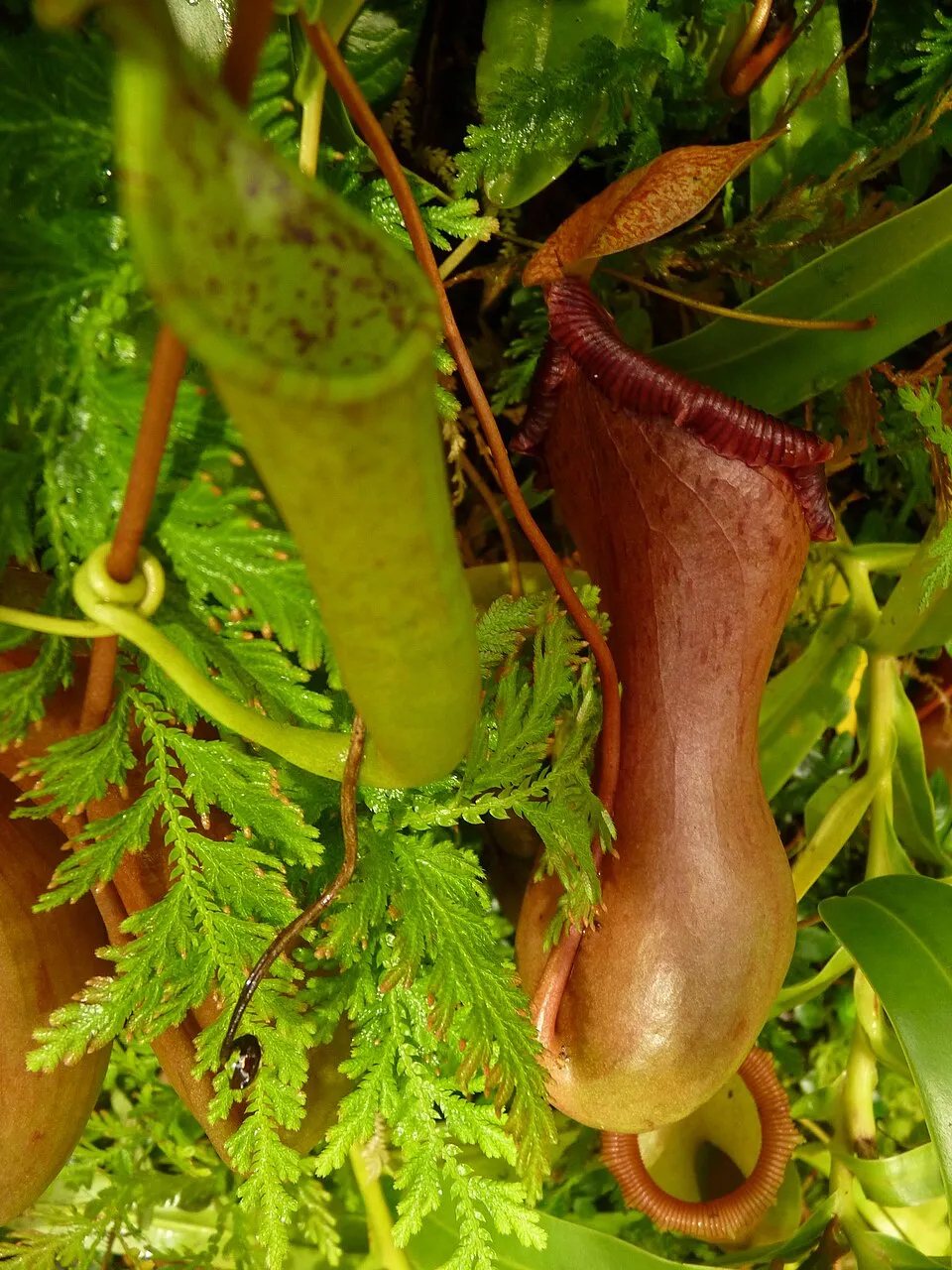
Nepenthes ventricosa, commonly known as the trumpet pitcher plant, is a remarkable and resilient species within the diverse genus Nepenthes, celebrated for its unique morphology and highly specialized carnivorous adaptations. This perennial, often epiphytic or lithophytic vine, typically exhibits a scrambling or climbing growth habit, with stems that can initially be short, but mature specimens often develop woody bases and extend significantly, reaching lengths of several meters in ideal conditions.
Its elongated, lanceolate leaves can grow up to 25 centimeters, featuring a distinct midrib that extends into a tendril. These tendrils are vital for the plant's structural support, coiling around adjacent vegetation or substrates, and critically, culminating in the formation of its iconic pitcher traps.
Each pitcher of Nepenthes ventricosa is a masterpiece of natural engineering, typically reaching up to 15 centimeters in height, though larger specimens are known. These traps display a captivating vibrant green, often beautifully mottled or streaked with shades of reddish-purple, particularly pronounced around the peristome (the ribbed rim of the pitcher mouth) and the lid. This striking coloration, alongside the secretion of sweet nectar and volatile organic compounds, acts as an irresistible lure, attracting a wide array of insect prey.
The slender stems may present a slightly pubescent texture, offering a wiry feel that aids its climbing. The root system is generally shallow and fibrous, perfectly adapted to the nutrient-poor, acidic substrates characteristic of its native highland environments. Nepenthes ventricosa is endemic to the Philippines, predominantly thriving in the cool, moist conditions of tropical mossy forests in the mountainous regions of Luzon and Mindanao.
It typically flourishes at elevations ranging from 1,000 to 2,000 meters above sea level, preferring humid environments with dappled sunlight and often growing amongst mosses and other epiphytes. Taxonomically, it belongs to the family Nepenthaceae, which is part of the order Caryophyllales, a diverse group of flowering plants known for their unique adaptations.
Trusted Scientific References
1. Authoritative external sources for Nepenthes ventricosa
1.1 Wikipedia — Nepenthes ventricosa
1.2 Kew POWO (Plants of the World Online)
1.3 PubMed — peer-reviewed research
1.4 NCBI Taxonomy Browser
1.5 GBIF — Global Biodiversity
1.1.Nepenthes Ventricosa — Key Features
- ✓ <strong>Carnivorous Pitcher Traps</strong> — Distinctive, colorful pitchers capture and digest insects.
- ✓ <strong>Endemic to the Philippines</strong> — Naturally found in specific mountainous regions.
- ✓ <strong>Highlander Species</strong> — Thrives in cool day/night temperature differentials.
- ✓ <strong>Epiphytic/Lithophytic Growth</strong> — Often grows on trees or rocks, not just in soil.
- ✓ <strong>Proteolytic Enzymes</strong> — Pitcher fluid contains enzymes for nutrient acquisition.
- ✓ <strong>Striking Aesthetics</strong> — Vibrant green and reddish-purple mottled pitchers.
- ✓ <strong>Climbing Vine Habit</strong> — Develops long stems that require support.
- ✓ <strong>Adaptable for Cultivation</strong> — Popular with carnivorous plant enthusiasts.
- ✓ <strong>Ecological Importance</strong> — Plays a role in nutrient cycling in its native habitat.
- ✓ <strong>Unique Tendril Morphology</strong> — Tendrils form into pitchers, a key adaptation.
1.2.Nepenthes Ventricosa — Quick Summary
- ✓ Nepenthes ventricosa is a striking carnivorous pitcher plant from the Philippines.
- ✓ Renowned for its unique, colorful insect-trapping pitchers.
- ✓ Primarily an ornamental species, not widely recognized for medicinal use.
- ✓ Contains proteolytic enzymes in its pitcher fluid, like nepenthesin.
- ✓ Requires specific highland conditions: bright, diffused light, cool nights, high humidity.
- ✓ Ecologically significant as an indicator species for tropical mossy forests.
2.Nepenthes Ventricosa — Scientific Identity
3.Nepenthes Ventricosa — Quick Facts
4.Nepenthes Ventricosa — Appearance & Identification
5.Nepenthes Ventricosa — Native Habitat
6.Nepenthes Ventricosa — Water Requirements
- ✓ Light — Provide very bright, diffused light; avoid harsh direct sun to prevent leaf burn. East or west-facing windows or grow lights work well.
- ✓ Temperature — As a highlander, Nepenthes ventricosa prefers warm days (20-25°C / 68-77°F) and cool nights (10-15°C / 50-59°F), requiring a distinct day-night temperature drop.
- ✓ Humidity — Maintain high relative humidity, ideally above 50% during the day and higher at night, to encourage pitcher formation. Frequent watering helps.
- ✓ Watering — Use distilled water, rainwater, or reverse osmosis water. Keep the growing medium consistently moist but not waterlogged. Avoid allowing pitchers to dry out.
- ✓ Soil — Use a well-draining, acidic, nutrient-poor substrate. Common mixes include sphagnum moss, perlite, orchid bark, and pumice.
- ✓ Feeding — While carnivorous, Nepenthes ventricosa primarily captures its own food. Supplemental feeding (e.g., a few small insects) is only needed if the plant isn't catching any prey.
- ✓ Space — Account for its climbing vine habit; mature plants can grow significantly and may require pruning or support structures like trellises.
- ✓ Airflow — Good air circulation is important to prevent fungal issues, especially in high humidity environments.
Reviewed by the Flora Medical Global Botanical Review Panel
Multi-disciplinary editorial group · Botany · Ethnobotany · Herbal-medicine literature
Who reviewed this: This page was checked by the Flora Medical Global Botanical Review Panel — an in-house editorial group of botany graduates, ethnobotany researchers, and horticulture practitioners who collectively maintain our 7,000+ plant encyclopedia. Meet the team.
Our 4-step verification process
1. Taxonomic verification
Scientific names and synonyms cross-checked against Kew POWO, World Flora Online, and The Plant List.
2. Phytochemical & medicinal cross-reference
Active compounds, traditional uses, and reported activities are cross-referenced with PubMed, USDA Dr. Duke's database, and peer-reviewed ethnobotanical literature.
3. Conservation & distribution check
Distribution, ecology, and conservation status confirmed against GBIF occurrence records and the IUCN Red List.
4. Editorial & safety review
Every entry passes an editorial pass for clarity, originality, and safety notices (toxicity, contraindications, dosage caveats) before publication.
Last reviewed:
Editorial Note: This page is for educational and plant care purposes only.
Written by: Flora Medical Global Editorial Team
Reviewed by: Flora Medical Global Botanical Review Panel
Last Updated: June 15, 2026







Nepenthes Ventricosa — Comments & Community Reviews
Rate this plant