

Care Disclaimer: Plant care recommendations are general guidelines based on common growing conditions. Individual results may vary based on your local environment, climate, and care routine. If your plant is toxic, keep it away from children and pets, and consult a veterinarian if accidental ingestion occurs.
1.Orbea — Overview
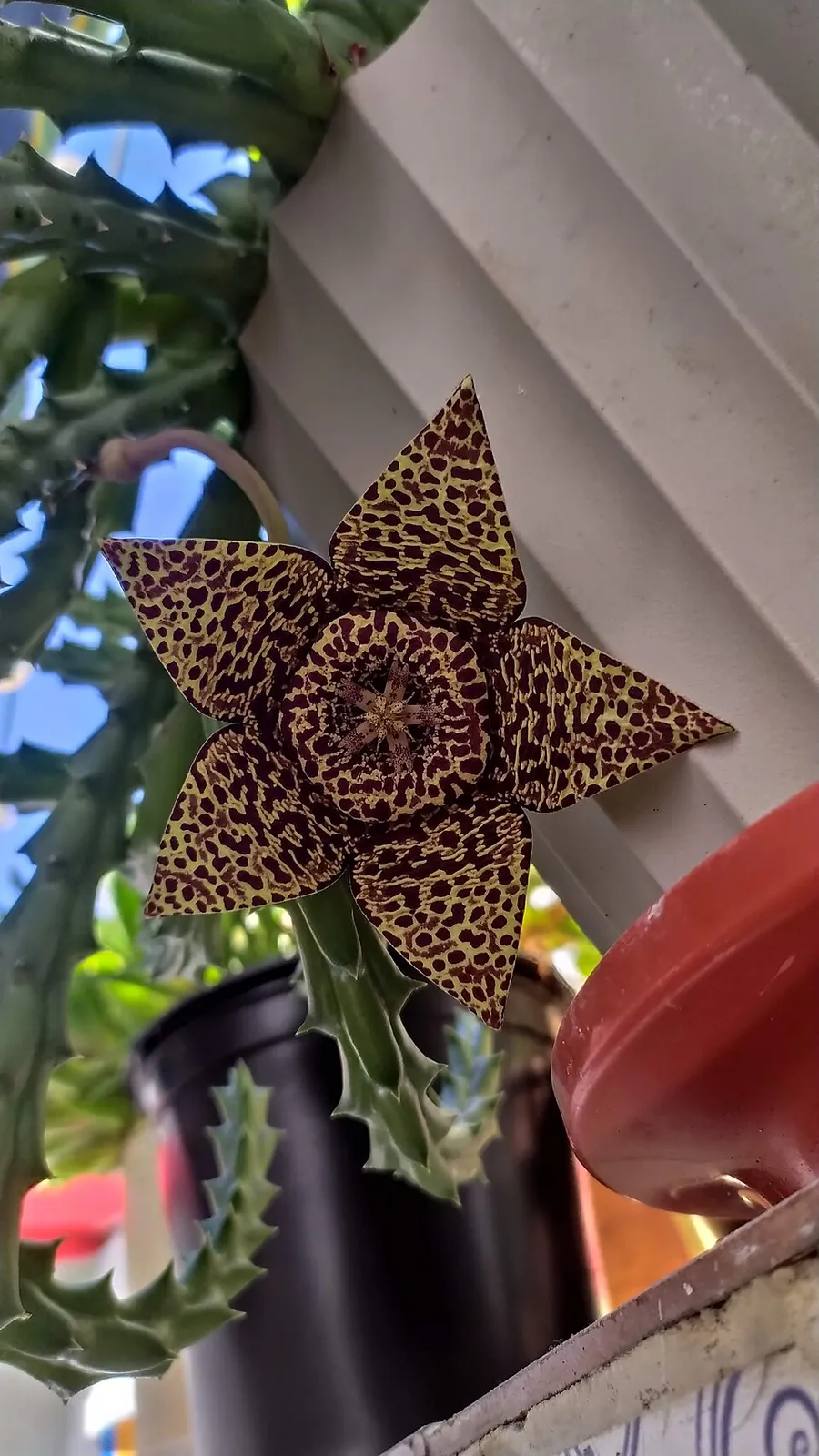
Orbea variegata, commonly known as the starfish flower or carrion flower, is a captivating succulent perennial native to the arid and semi-arid regions of South Africa. This intriguing member of the Apocynaceae family, specifically within the subfamily Asclepiadoideae and tribe Ceropegieae, showcases a remarkable morphology perfectly adapted to its dry native habitat. The plant typically forms low-growing, clumping mats, with its fleshy, four-angled stems usually reaching heights of 4 to 8 inches (10 to 20 cm) and spreading up to 20 inches (50 cm) wide.
These green to grayish-green stems are often mottled with purple or reddish hues when exposed to ample sunlight, and are adorned with soft, tooth-like protuberances along their edges, representing highly reduced, vestigial leaves. The root system is typically shallow and fibrous, optimized for efficient absorption of infrequent surface moisture.
The most striking feature of Orbea variegata is its intricate flowers, which typically emerge in late summer and autumn. These star-shaped blossoms, measuring approximately 2 to 3 inches (5 to 8 cm) in diameter, display a mesmerizing pattern of deep maroon or purple blotches and speckles on a pale yellow or creamy-white background. The flower surface often has a velvety or papillose texture, and while visually appealing, they are infamous for emitting a faint, carrion-like scent.
This unique aroma is a clever evolutionary strategy to attract flies, which serve as its primary pollinators. When successfully pollinated, the plant produces twin follicles, which are horn-like pods containing numerous seeds, each equipped with a tuft of silky hairs for efficient wind dispersal. Taxonomically, Orbea variegata is closely related to genera like Stapelia and Huernia, sharing similar growth habits and distinctive floral characteristics.
Its natural distribution spans the coastal belt of the Western Cape, Eastern Cape, and Northern Cape provinces of South Africa, where it thrives in rocky outcrops and dry grasslands.
Trusted Scientific References
1. Authoritative external sources for Orbea variegata
1.1 Wikipedia — Orbea variegata
1.2 Kew POWO (Plants of the World Online)
1.3 PubMed — peer-reviewed research
1.4 NCBI Taxonomy Browser
1.5 GBIF — Global Biodiversity
1.1.Orbea — Key Features
- ✓ <strong>Common Names</strong> — Starfish Flower, Carrion Flower, Toad Cactus, Starfish Cactus.
- ✓ <strong>Scientific Name</strong> — Orbea variegata.
- ✓ <strong>Family</strong> — Apocynaceae (Subfamily Asclepiadoideae, Tribe Ceropegieae).
- ✓ <strong>Native Region</strong> — Western Cape, Eastern Cape, and Northern Cape provinces of South Africa.
- ✓ <strong>Growth Habit</strong> — Low-growing, clumping succulent perennial with fleshy, four-angled stems.
- ✓ <strong>Flowers</strong> — Star-shaped, intricate patterns of maroon on pale yellow/white, emitting a carrion-like scent.
- ✓ <strong>Pollination</strong> — Specialized fly pollination mechanism, mimicking decaying flesh.
- ✓ <strong>Cultivation</strong> — Easy to care for, highly drought-tolerant, prefers bright, filtered sunlight.
- ✓ <strong>Ornamental Value</strong> — Highly prized in horticulture for its unique aesthetic appeal and ease of growth.
- ✓ <strong>Adaptations</strong> — Succulent stems and CAM photosynthesis for survival in arid environments.
1.2.Orbea — Quick Summary
- ✓ Striking succulent with star-shaped, carrion-scented flowers, native to South Africa.
- ✓ Primarily cultivated as an ornamental plant; no established medicinal uses or traditional applications.
- ✓ Requires well-draining soil, bright indirect light, and minimal watering, especially in winter.
- ✓ Known for its exceptional drought tolerance and unique fly-pollination strategy.
- ✓ Keep away from children and pets; ingestion is not recommended due to unknown toxicity.
2.Orbea — Scientific Identity
3.Orbea — Quick Facts
4.Orbea — Appearance & Identification
5.Orbea — Native Habitat
6.Orbea — Water Requirements
- ✓ Sunlight — Provide bright, indirect sunlight; while it tolerates some direct morning sun, protect Orbea variegata from intense afternoon sun to prevent scorching.
- ✓ Watering — Water sparingly, allowing the soil to dry out completely between waterings; reduce watering significantly during winter dormancy to prevent root rot.
- ✓ Soil — Use a well-draining cactus or succulent potting mix; avoid heavy, compacted soils that retain too much moisture, as this can lead to fungal issues.
- ✓ Temperature — Thrives in temperatures between 20°C and 35°C (68°F-95°F); it can tolerate minimum winter temperatures around -6.7°C (20°F) in well-drained conditions.
- ✓ Humidity — Prefers dry atmospheric conditions, typical of its native arid habitat; high humidity can encourage fungal diseases, especially if air circulation is poor.
- ✓ Fertilizer — Fertilize sparingly with a balanced, diluted succulent fertilizer once or twice during the active growing season (spring to early autumn).
- ✓ Pruning — Prune only to remove old, shriveled, or errant stems to maintain an attractive shape and encourage bushier growth, using clean, sharp shears.
- ✓ Container — Choose a pot with excellent drainage, preferably ceramic or terracotta, that is 1 to 2 inches (2.5-5 cm) larger than the plant's current root ball.
Reviewed by the Flora Medical Global Botanical Review Panel
Multi-disciplinary editorial group · Botany · Ethnobotany · Herbal-medicine literature
Who reviewed this: This page was checked by the Flora Medical Global Botanical Review Panel — an in-house editorial group of botany graduates, ethnobotany researchers, and horticulture practitioners who collectively maintain our 7,000+ plant encyclopedia. Meet the team.
Our 4-step verification process
1. Taxonomic verification
Scientific names and synonyms cross-checked against Kew POWO, World Flora Online, and The Plant List.
2. Phytochemical & medicinal cross-reference
Active compounds, traditional uses, and reported activities are cross-referenced with PubMed, USDA Dr. Duke's database, and peer-reviewed ethnobotanical literature.
3. Conservation & distribution check
Distribution, ecology, and conservation status confirmed against GBIF occurrence records and the IUCN Red List.
4. Editorial & safety review
Every entry passes an editorial pass for clarity, originality, and safety notices (toxicity, contraindications, dosage caveats) before publication.
Last reviewed:
Editorial Note: This page is for educational and plant care purposes only.
Written by: Flora Medical Global Editorial Team
Reviewed by: Flora Medical Global Botanical Review Panel
Last Updated: June 15, 2026







Orbea — Comments & Community Reviews
Rate this plant