
Care Disclaimer: Plant care recommendations are general guidelines based on common growing conditions. Individual results may vary based on your local environment, climate, and care routine. If your plant is toxic, keep it away from children and pets, and consult a veterinarian if accidental ingestion occurs.
1.Orchid Brassia — Overview
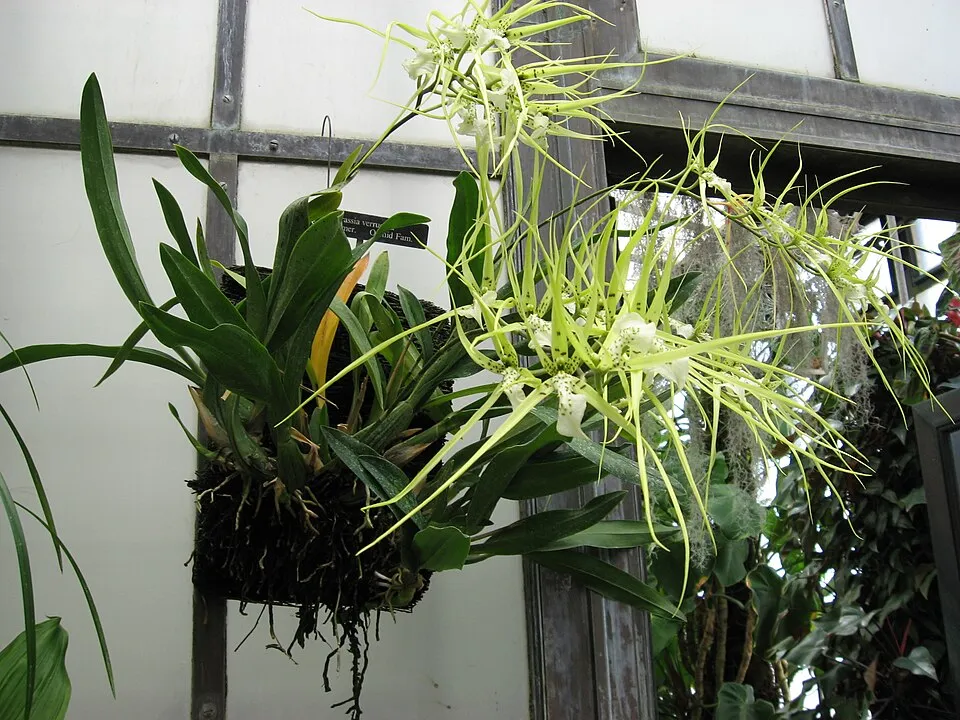
Orchid Brassia, scientifically designated as Brassia verrucosa and commonly known as the spider orchid due to its strikingly unique floral morphology, is a captivating epiphytic species within the expansive Orchidaceae family. This elegant plant typically achieves a mature height of approximately 60 to 75 centimeters, presenting an upright, graceful growth habit. Its foliage consists of elongated, arching leaves that can extend up to 30 centimeters in length, displaying a lustrous, vibrant green hue that enhances any botanical collection. The most distinctive feature of Brassia verrucosa is its intricate, star-shaped flowers, which typically range in color from a soft yellow to a greenish-yellow.
These remarkable blooms measure between 5 to 10 centimeters across and are characterized by their exceptionally long, slender, spidery lateral sepals, which can reach an impressive length of up to 12 centimeters, creating a mesmerizing visual spectacle reminiscent of a spider. The plant's pseudobulbs, essential for storing moisture and vital nutrients, are smooth-textured, offering a tactile contrast to the finely ribbed margins of its leaves. These pseudobulbs develop sequentially along a creeping rhizome, forming a robust and stable base for the plant's sustained growth. The root system, characteristic of epiphytic orchids, is composed of thick, aerial roots covered in a spongy layer of velamen, which efficiently absorbs atmospheric moisture and dissolved nutrients.
Taxonomically, Brassia verrucosa is classified under the subfamily Epidendroideae and the tribe Oncidiinae, reflecting its close evolutionary kinship with other popular genera such as Oncidium and Odontoglossum. Native to the humid, tropical forests spanning Central and South America, its natural distribution ranges from Honduras southwards to Ecuador. In these native habitats, it thrives as an epiphyte, anchoring itself securely to tree branches, benefiting from dappled sunlight and consistent atmospheric moisture. Its adaptability and unique beauty have made it a favored species for indoor cultivation, where it flourishes in well-drained, aerated media.
Trusted Scientific References
1. Authoritative external sources for Brassia verrucosa
1.1 Wikipedia — Brassia verrucosa
1.2 Kew POWO (Plants of the World Online)
1.3 PubMed — peer-reviewed research
1.4 NCBI Taxonomy Browser
1.5 GBIF — Global Biodiversity
1.1.Orchid Brassia — Key Features
- ✓ <strong>Distinctive Spider</strong> — like Flowers — Characterized by exceptionally long, slender lateral sepals that resemble spider legs.
- ✓ <strong>Epiphytic Growth Habit</strong> — Naturally grows on tree branches, absorbing moisture and nutrients from the air and rain.
- ✓ <strong>Pseudobulb Storage</strong> — Features smooth pseudobulbs that store water and nutrients, crucial for survival during dry periods.
- ✓ <strong>Velamen Roots</strong> — Possesses thick, aerial roots covered in a spongy velamen layer for efficient moisture absorption.
- ✓ <strong>Vibrant Green Foliage</strong> — Displays elongated, arching leaves with a lustrous, vibrant green hue.
- ✓ <strong>Tropical Forest Native</strong> — Indigenous to the humid, tropical regions of Central and South America.
- ✓ <strong>Moderate Size</strong> — Reaches a mature height of 60-75 cm, making it suitable for indoor cultivation.
- ✓ <strong>Yellow to Greenish</strong> — Yellow Blooms — Flowers typically range in color from soft yellow to greenish-yellow, often with spotting.
- ✓ <strong>Oncidiinae Tribe Member</strong> — Closely related to Oncidium and Odontoglossum orchids, sharing some taxonomic characteristics.
- ✓ <strong>Adaptable for Cultivation</strong> — Popular among orchid enthusiasts for its relatively straightforward care requirements when conditions are met.
1.2.Orchid Brassia — Quick Summary
- ✓ Brassia verrucosa is an exquisite epiphytic orchid, known as the spider orchid for its unique, elongated floral sepals.
- ✓ Native to Central and South American tropical forests, it thrives in humid, dappled light conditions.
- ✓ Primarily an ornamental plant, it offers significant aesthetic and well-being benefits.
- ✓ Requires specific care regarding temperature, light, humidity, and watering for optimal growth.
- ✓ While not traditionally used medicinally, the Orchidaceae family contains diverse phytochemicals.
- ✓ General safety precautions apply, including avoiding ingestion and mindful handling for sensitive individuals.
2.Orchid Brassia — Scientific Identity
3.Orchid Brassia — Quick Facts
4.Orchid Brassia — Appearance & Identification
5.Orchid Brassia — Native Habitat
6.Orchid Brassia — Water Requirements
- ✓ Temperature Management — Maintain night temperatures around 13°C minimum and daytime temperatures between 18°C and 29°C for optimal growth.
- ✓ Light Requirements — Provide bright, indirect sunlight; an east or west-facing window is ideal, or a shaded south-facing window. Avoid direct, harsh sun.
- ✓ Watering Protocol — Use rainwater and water frequently during warm periods (every 3-4 days), ensuring the plant never completely dries out. Reduce watering significantly in cooler, lower-light conditions (fortnightly or every three weeks).
- ✓ Feeding Schedule — Apply a specialized orchid fertilizer in three out of four waterings, following product instructions for dilution.
- ✓ Humidity Control — High humidity is crucial. Mist lightly in the mornings during summer and consider placing the pot on a moist gravel tray to create a beneficial microclimate.
- ✓ Potting Medium — Use a well-aerated, free-draining epiphytic orchid compost, typically bark-based or a mixture including coconut shell, ensuring excellent drainage.
- ✓ Repotting Timing — Repot every two to three years in the spring when new growth emerges, preferably before new shoots fully develop, using damp, pre-soaked compost.
Reviewed by the Flora Medical Global Botanical Review Panel
Multi-disciplinary editorial group · Botany · Ethnobotany · Herbal-medicine literature
Who reviewed this: This page was checked by the Flora Medical Global Botanical Review Panel — an in-house editorial group of botany graduates, ethnobotany researchers, and horticulture practitioners who collectively maintain our 7,000+ plant encyclopedia. Meet the team.
Our 4-step verification process
1. Taxonomic verification
Scientific names and synonyms cross-checked against Kew POWO, World Flora Online, and The Plant List.
2. Phytochemical & medicinal cross-reference
Active compounds, traditional uses, and reported activities are cross-referenced with PubMed, USDA Dr. Duke's database, and peer-reviewed ethnobotanical literature.
3. Conservation & distribution check
Distribution, ecology, and conservation status confirmed against GBIF occurrence records and the IUCN Red List.
4. Editorial & safety review
Every entry passes an editorial pass for clarity, originality, and safety notices (toxicity, contraindications, dosage caveats) before publication.
Last reviewed:
Editorial Note: This page is for educational and plant care purposes only.
Written by: Flora Medical Global Editorial Team
Reviewed by: Flora Medical Global Botanical Review Panel
Last Updated: June 15, 2026







Orchid Brassia — Comments & Community Reviews
Rate this plant